The AM Industry Is Growing. Arno Held Thinks It Still Needs to Get Smaller


Additive manufacturing is now a $24.2 billion industry, but Arno Held believes too many companies still compete for market share. That was one of the more pointed arguments during an opening-day panel at Formnext 2026, where industry leaders discussed the growing gap between Europe, China, and the United States and why industrial adoption still lags behind the technology’s potential.
Moderated by Sven Krause, the panel brought together Held, Mahdi Jamshid, Markus Heering, Rainer Lotz, and Ross Trepleton. I’ve known Krause and Held for many years, and both have a talent for cutting through complicated issues. This discussion was no exception.
What stood out was the contrast between Jamshid’s market data and Held’s concerns about the industry’s financial health.
A $24.2 Billion Industry Growing at Different Speeds
Jamshid, Director of Market Intelligence at Wohlers Associates, opened with the numbers.
According to Wohlers Report 2026, global additive manufacturing industry revenue reached $24.2 billion in 2025, up 10.9% from the previous year. But growth looks very different by region.
Asia-Pacific, driven primarily by China, showed the strongest growth, at approximately 20%. North America followed at around 12%, while Europe grew by about 6%, according to the regional figures he cited during the discussion.
In the United States, defence is a major driver, particularly for metal AM. In China, domestic industrial demand for metal AM and a rapidly expanding polymer AM industry, including equipment exports, support growth.
Jamshid suggested that AM is also helping China strengthen its position as a global manufacturing centre. Jamshid also pointed to a change in the applications driving the market. Earlier generations of AM technology frequently began with a technical capability in search of a problem. Today, more opportunities begin with a real manufacturing need that AM can address. He identified applications associated with cooling, artificial intelligence infrastructure and data centres among the areas attracting particular interest.
Arno Held: An Industry Still Recovering From the Hype
Held, now operating through Held Holding after many years as Managing Partner at AM Ventures, offered a less comfortable assessment.
His enthusiasm for the technology remains intact. His view of the industry’s business structure has become more critical. Held described the period of heavy investment and inflated expectations that brought substantial capital into AM, creating businesses that were not necessarily financially sustainable.
The industry is still dealing with the consequences. In his assessment, AM remains exceptionally fragmented relative to its size. Too many companies compete in a market that, compared with global manufacturing, is still very small. Held argued that consolidation is necessary, but the companies normally expected to lead it are themselves financially constrained.
In a more mature industry, a small number of profitable market leaders would acquire weaker competitors, integrate businesses and establish a more stable structure. Held sees few companies in AM currently capable of performing that role.
The financial markets reflect the problem. He referred to publicly traded AM companies whose stock market valuations have fallen below the cash on their balance sheets, presenting this as evidence of weak investor confidence. Restoring that confidence requires profitable businesses, access to capital, and eventually acquisitions that reduce fragmentation.
Lotz of Renishaw challenged the argument that consolidation should be the primary objective. Lotz agreed that the industry had spent years experimenting with technologies and applications, often without sustainable returns. However, he argued that AM has now reached a level of technical maturity where productive businesses are emerging around clearly defined applications.
He warned against excessive consolidation, arguing that the industry’s diversity of companies and technical approaches also contributes to innovation.
Held remained unconvinced. He pointed to the many variations built around a relatively small set of fundamental AM technologies, questioning whether the industry’s current size could support such fragmentation.
It was one of the session’s more substantial disagreements: whether AM needs fewer, stronger suppliers or whether its diversity remains an important industrial advantage.
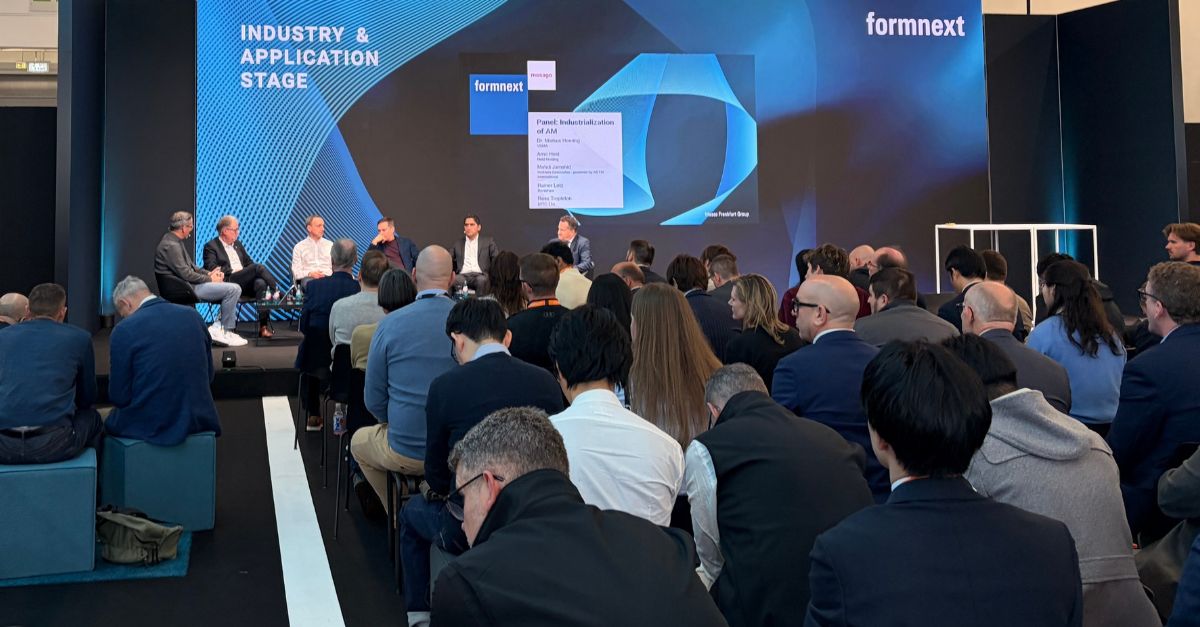
Arno Held, Mahdi Jamshid, Markus Heering, Rainer Lotz, Ross Trepleton and Sven Krause discuss the state of AM during an opening-day panel at Formnext 2026 in Frankfurt, Germany. Photo by Ulf Lindhe.
Industrial Demand and the Supply Chain Problem
Trepleton, Director of Component Manufacturing at the UK’s Manufacturing Technology Centre (MTC), described a different obstacle.
Fifteen years ago, much of his work concerned technical problems: process repeatability, robustness, part design and post-processing. Those issues have not disappeared, but the conversations have increasingly shifted toward commercial questions.
Suppliers are reluctant to invest in AM capacity without firm customer orders. But industrial customers want to see qualified suppliers with enough capacity before committing to production. It’s a problem that leaves both sides waiting for the other to move first.
Trepleton described work in the UK to combine anonymous demand forecasts from major industrial customers, giving suppliers a clearer picture of future opportunities without requiring customers to commit too early. He also contrasted European supply-chain development with the much larger AM production facilities being established in Asia, where investments can involve hundreds of machines rather than small installations.
Trepleton argued that industrial AM knowledge must move beyond specialist engineering teams and become part of procurement, legal and supply-chain functions.
In his view, Europe still lacks sufficient end-to-end manufacturing capability like that offered by more vertically integrated businesses elsewhere.
Europe Has Experience. The US Has Speed. China Has Strategy.
Held argued that Europe retains an important competitive advantage: decades of industrial engineering experience and extensive work on qualifying AM applications for production. But that experience has not translated into the same growth pace seen in the United States and China.
Jamshid explained some of the policy differences behind these developments. He described US defence procurement restrictions on certain foreign AM equipment, alongside initiatives to simplify qualification and improve data sharing across defence organisations. He also said further restrictions are being discussed for the US fiscal year 2027 defence legislation, but these proposals have not yet become law.
China’s industrial policy works differently. Jamshid described the country’s emphasis on technological self-reliance and the role of national planning in directing industrial investment and capacity expansion.
Held contrasted these developments with Europe’s more fragmented approach. He praised the speed with which American businesses adopt innovation and the strategic direction behind China’s industrial development. Europe, in his view, needs more of both.
Heering of VDMA agreed that the European industrial base remains strong but emphasised the difficulty of coordinating investment, industrial policy and technological development across national boundaries. He described the transition toward local-for-local manufacturing, driven by changing trade policies, tariffs and industrial requirements, as a broader challenge for European machinery builders.
Heering argued that even large manufacturers cannot tackle every technological challenge alone, making cooperation across companies and borders increasingly important.
Defence: An Accelerator With a Risk Attached
Defence featured prominently throughout the conversation, particularly in relation to North American demand.
Held offered one of his strongest warnings on the subject. He described defence spending as both a blessing and a curse for AM. Current military expenditure supports industrial activity and creates significant opportunities, but defence budgets are political decisions rather than permanent market conditions.
Held went so far as to call defence spending the industry’s “heroin”, warning that companies could become too dependent on government money. He argued that AM needs more commercial applications outside defence, including in industries with tighter margins.
Lotz disagreed. Renishaw sees strong interest in consumer electronics, energy, data centres and medical applications alongside defence. He described defence as a welcome accelerator rather than the foundation of the entire AM business.
Lotz also distinguished between established defence manufacturers and a newer generation of defence technology companies. The latter, including companies developing drones and associated systems, often integrate AM and software into their products and development processes from the outset.
Traditional defence organisations, by contrast, often operate within established procurement processes, qualification requirements, and production methods that can make adopting new manufacturing technologies considerably slower.
Trepleton added that defence demand should be consolidated with opportunities from other industries to support a more resilient supply chain, rather than encouraging dependence on a single sector.
AI and the Factory
The panel also considered how AI and automation could change manufacturing. Lotz rejected the idea that these technologies necessarily compete. Modern AM systems generate extensive process data, which AI could help analyse to improve production.
For Lotz, the more important opportunity is integrating AM into the wider factory. He referred to Siemens’ work on industrial software and automation as an example of the direction needed: connecting design, manufacturing operations and the finished product rather than treating AM as a separate production environment. Reducing the time and cost lost between individual process steps is central to improving AM productivity.
Heering agreed on the importance of integration but noted that many AM companies are relatively small, with limited resources to develop complete manufacturing systems themselves. He argued for greater cooperation and common approaches, especially as conventional manufacturing moves toward increasingly automated and autonomous production.
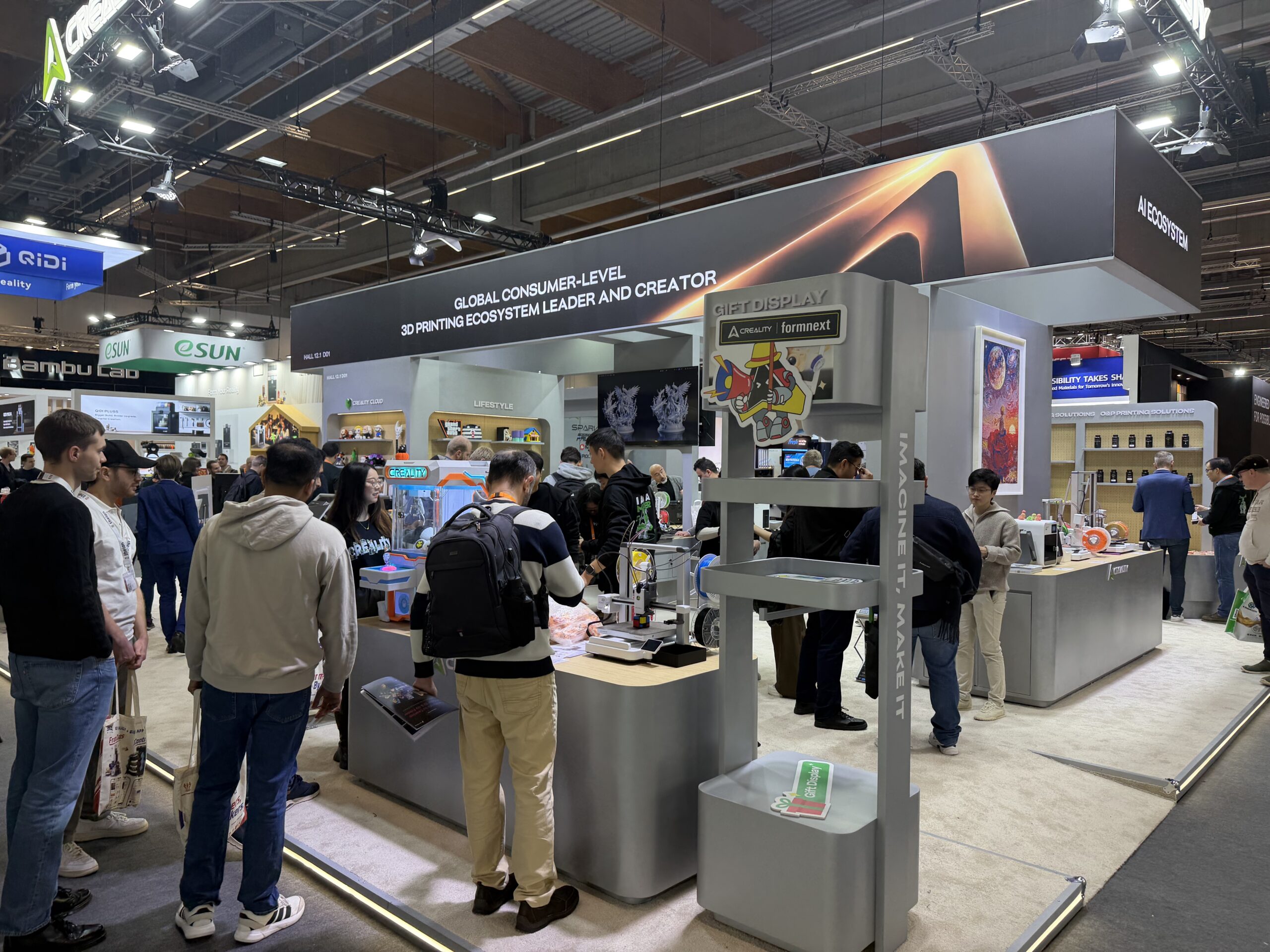
Formnext 2026. Image courtesy of 3DPrint.com.
A Personal Note: Growth Is Not the Same as a Healthy Industry
What made this panel interesting was the gap between the industry’s growth and its financial health. Jamshid’s figures show a growing market, while Held’s comments remind us that many of the companies operating in it are still struggling.
I also think Held’s distinction between the technology’s potential and the industry’s condition matters. Too often, criticism of AM companies is interpreted as criticism of AM itself. They are two very different things.
I am not entirely convinced by Held’s argument for consolidation. Lotz has a point about diversity and competition, and I have some personal experience of what small companies can achieve when they challenge established players. Some of the industry’s most important developments have come from precisely those companies, and losing that capacity for innovation would come at a cost.
Ross’s supply-chain observations also show how difficult the next stage of AM’s growth could be. The technology is ready for more industrial applications, but suppliers still need committed customers, and investors still need businesses that can make money.
After more than two decades in this industry, I find it encouraging that discussions like this have moved so far beyond whether additive manufacturing works.
We know the technology works. The bigger challenge now is building an industry that works just as well commercially.
Subscribe to Our Email Newsletter
Stay up-to-date on all the latest news from the 3D printing industry and receive information and offers from third party vendors.
Print Services
Upload your 3D Models and get them printed quickly and efficiently.












You May Also Like
3DPOD 322: Neil Hopkinson on Stratasys’ New H550 SAF 3D Printer
Coming to you from Formnext 2026, Joris Peels and Maxwell Bogue welcome Neil Hopkinson, Vice President of SAF Technology at Stratasys, for a conversation about what’s next in industrial 3D...
Formnext 2026: Large-Format 3D Printing Gets Bigger, Smarter, and More Production-Ready
The race to build bigger 3D printers is picking up speed at Formnext 2026, as manufacturers turn their attention to industrial-scale production. At the trade show in Frankfurt, Germany, companies...
Continuum Powders Releases the Argos Atomizer for Industrial Settings
Continuum Powders is releasing the new Argos Melt-to-Powder (M2P) atomizer. This takes the firm’s offering to a more industrial large-scale setting. The system is a hybrid plasma torch melting and...
AMPulse Asia: The Race to Build Bigger
New investments, larger 3D printers, and expanding production capabilities lead this edition of AMPulse Asia. From Raise3D’s latest funding round and a major metal powder project in China to new...