ExOne Bets on Smaller Foundries with the S-Print Pro

ExOne has released the S-Print Pro, a more affordable-than-usual compact system for foundries. The company hopes that this will make its system more accessible to new customers and to customers such as print services and pattern job shops. Compact, of course, in the context of this being an industrial binder jet solution. Installation space is still 12 m², and it’s built on the S-Max system.
Build volume is 1,200 × 750 × 500 mm, layer thickness is 0.10–1.00 mm, and the printer can print one build per shift (approximately 8 hours). The machine has a furan binder with silica sand, CeraBeads, or silicon carbide; it has a 400 dpi resolution and weighs 4,000 kg while measuring 5,250 × 2,255 × 3,100 mm. So compact is relative to the usual behemoths in this class of system. CeraBeads are spherical beads made out of an aluminum silicate called Mullite. Back in 2020, ExOne announced that it would optimize its systems to work with these beads, made by Itochu. Cerabeads are said to reduce, in some cases, damage to sand casts during transport and storage while improving the surface roughness and overall smoothness of the final parts.
Eric Bader, the CEO of ExOne Global Holdings, said,
“The S-Print Pro is the product foundries have been asking us for: quality industrial sand printing in a system that’s affordable to acquire, install, and run. Since the ExOne and voxeljet merger, our teams have been focused on combining the best engineering, application knowledge, and customer insight to solve this real production challenge. This launch reflects that work — and our commitment to making industrial binder jetting more accessible to foundries worldwide.”
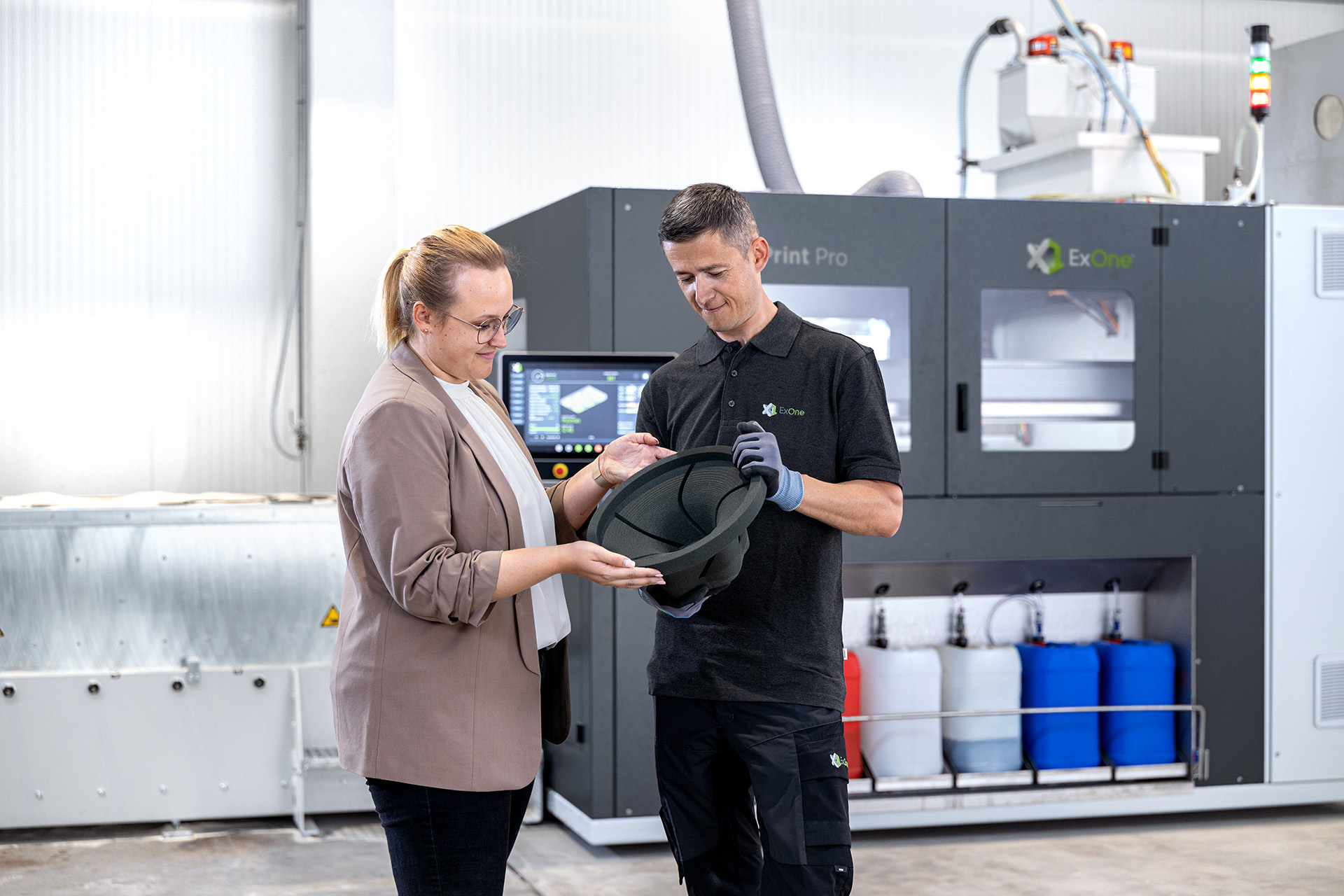
The S-Print Pro. Image courtesy of ExOne.
And Aldo Randazzo, Director of Application Management at ExOne, stated,
“Most of the world’s foundries are small operations, many with fewer than 100 employees. They are the backbone of the manufacturing industry, yet industrial binder jetting has rarely been built for their scale or budget. We aim to close that gap with the new S-Print Pro.”
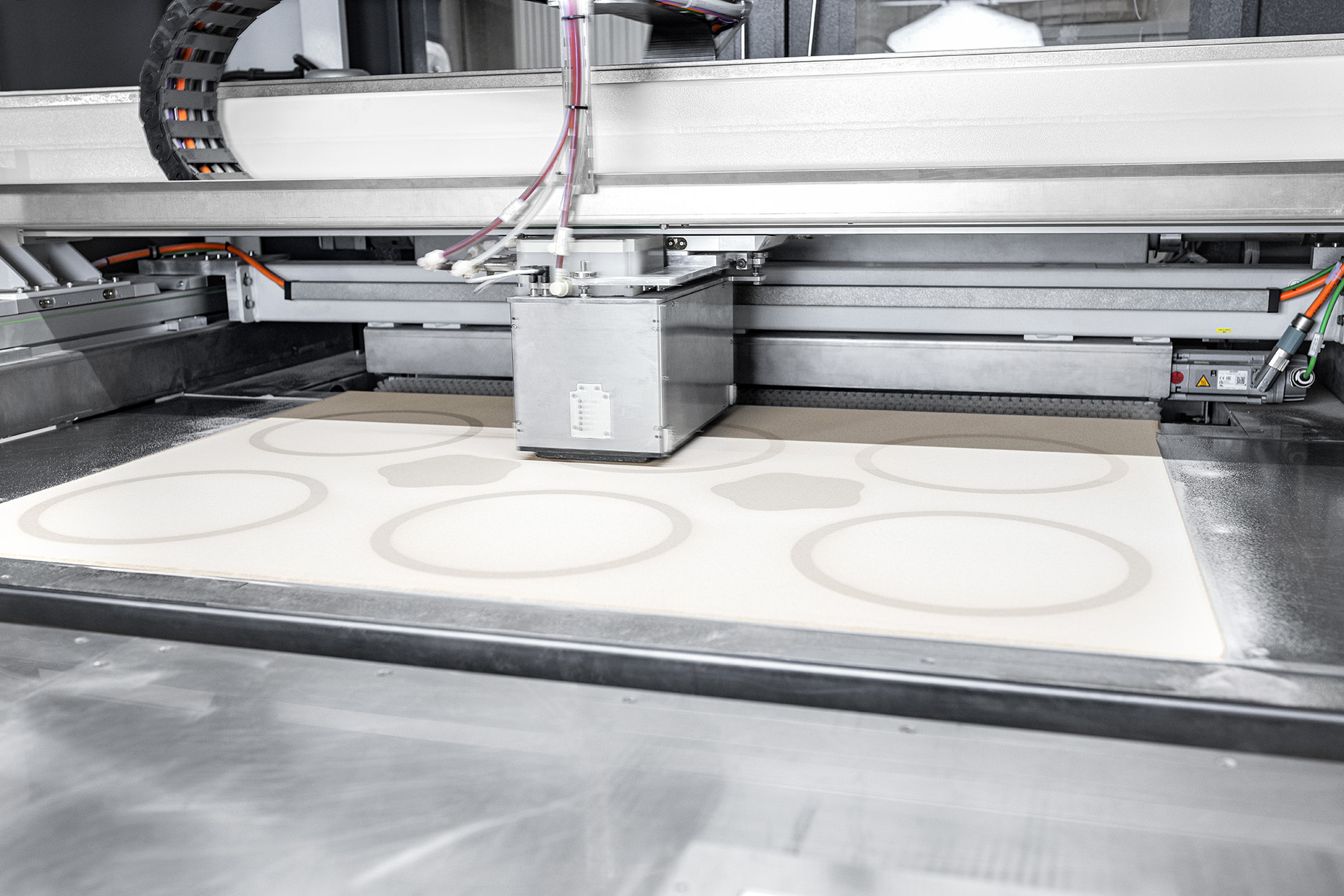
The S-Print Pro buildplate and printhead. Image courtesy of ExOne.
The printer uses the user-replaceable CoreBoost printhead and StepX surface smoothing, which should reduce stair-stepping and enable printing of more geometries. The company says that maintenance overall has been optimized to be simple and easy.
This seems like a sensible move by ExOne; the company has to show stability, progress, and a focus on the long term. A lot of foundry operators are conservative and traditional, working with thousand-year-old processes. They’re unlikely to be swayed by gadgets and fly-by-night things. Showing a focus on the long term is important to them. A lot of the stuff they have usually lasts a long time. These players have traditionally been difficult to sway with 3D printing. So a more entry-level production machine lowers their risk and may shorten sales cycles while making them more likely to adopt the technology. True lab machines don’t really get used a lot in foundries since their parts are often bigger than the build volume. They also often lack productivity features, so they can’t really give them a true idea of what the technology can do. By having a reasonably easy-to-operate and implement machine, ExOne can give these firms a chance to try something out in actual production.
This may let them build trust and also show that you’re thinking about the long term. So, generally, this is a good move toward building the firm’s future and the future of their relationship with foundries. Across the US, interest is growing in retooling, investing in, and expanding foundries. There are real opportunities in defense and beyond to tap into long lead times for parts. People have yet to collectively figure out how best to benefit from this backlog, but the money is now circulating among the opportunities. This system could be an excellent way for ExOne to benefit from this development.
Subscribe to Our Email Newsletter
Stay up-to-date on all the latest news from the 3D printing industry and receive information and offers from third party vendors.
Print Services
Upload your 3D Models and get them printed quickly and efficiently.













You May Also Like
The Manufacturing Race Behind the Drone Revolution
We are in the middle of a major manufacturing shift focused on the production speed and payload capacity of uncrewed aerial systems (UAS), or drones. A recent Manufacturing Dive article...
ADDMAN to Buy Up to $10.8M in Nickel 718 Powder from 6K Additive Over 30 Months
After years of buildup, we’re finally starting to see what the US metal additive manufacturing (AM) market could look like at scale. To be sure, it’s still not quite there,...
Metal AM in a Multipolar World, Part 2: How PBF and DED Could Change by 2035
The first decades of PBF development were heavily shaped by machine capability: more power, more lasers, larger build volumes, better recoating, and improved process monitoring. These developments will continue, but...
Advanced Manufacturing at IMTS 2026: 3D Printing and AI and Drones, Oh My!
Last week’s International Manufacturing Technology Snow (IMTS) in Chicago welcomed over 90,000 attendees to the jungle that is McCormick Place. With over 1.17 million square feet of exhibit space, and...