DEVCOM Armaments Center Demonstrates Remote 3D Printing of Electronics at Valiant Shield 2026


The US Army’s DEVCOM Armaments Center, headquartered at Picatinny Arsenal in New Jersey, has become one of the US military’s most important hubs for drone R&D. At the recent Valiant Shield exercise in the Indo-Pacific, a team from the Armaments Center showed off how forward-thinking it is in its drone manufacturing approach by incorporating electronics 3D printing into remote drone repair operations.
At Valiant Shield (June 21-July 2), one member from the Armaments Center worked with participants at Schofield Barracks in Oahu, while another three from Picatinny were at Camp Kinser, the Marine base in Okinawa. Meanwhile, another engineer stayed back at headquarters in New Jersey to provide support from a distance. Additionally, the Armaments Center representatives collaborated on the 3D printed electronics drone repair with Marines from the 3rd Maintenance Battalion, as well as Sciperio, the R&D-focused sister company of electronics 3D printing innovator nScrypt.
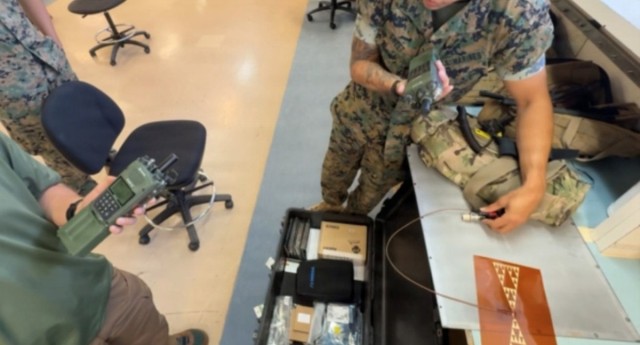
Along with the remote location, environmental factors in Hawaii including both the tropical climate and the salt air constituted big challenges for the servicemembers working with the silver inks used in the repair process. Aside from that, multiple printers were damaged en route to the exercise, which meant that personnel on the ground had to do some minor repairs before work could start in earnest.
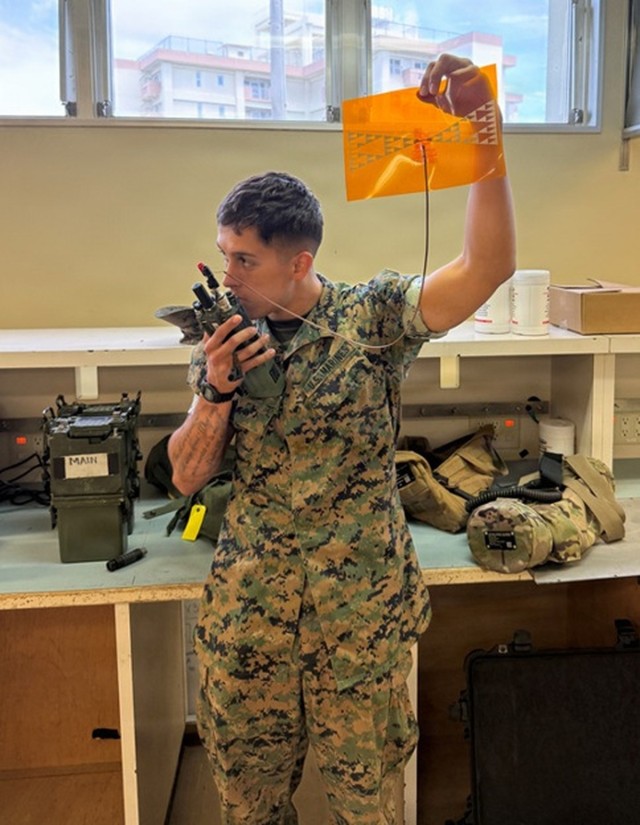
And finally, of course, the Marines that the Armaments Center team worked with had to get up-to-speed on the printing process itself. Soon enough, they were able to execute some test runs of custom flexible antennas, which brought everyone’s innovative sides to the fore: the war-gamers started imagining how they eventually might be able to replace existing antennas with lighter, more cost-effective alternatives.
It’s also noteworthy that the exercise involved using 3D scanners to reverse-engineer broken parts, enabling them to print the replacements. Going forward, the Marines made a request that the Armaments Center look into developing an automated solution for diagnosis and printing of broken electronics components, incorporating user feedback into the development process. The Armaments Center representatives plan to work with Manufacturing USA institute NextFlex, dedicated to hybrid electronics manufacturing, to get the ball rolling. Relevantly, nScrypt is a longtime NextFlex member.
According to a recent report from AM Research, the 3D printing market for drones could reach nearly a billion dollars by 2034, an estimate which, if anything, seems conservative. Obviously, much depends not only on the rate of military adoption of AM for drones between now and then, but also the extent to which drone manufacturers diversify into the commercial market.
With that in mind, increasing opportunity to integrate 3D printed electronics into both military and commercial drones is something of a hidden variable that could end up raising the market’s growth potential over the next decade. Here, it’s perhaps worth pointing out that the Alabama-based company Performance Drone Works (PDW) just got a conditional loan from DoD’s Office of Strategic Capital (OSC) for $820 million.
While there’s little information on how much AM is involved in PDW’s workflow, we do know that the company is collaborating with Florida startup Material Hybrid Manufacturing to test 3D printed conformal batteries for military drones. Also, the Army works extensively with PDW’s C100 system, and the Army’s work in that context includes testing out 3D printed supplemental components, as well as repair parts. PDW’s business strategy already includes public safety and infrastructure monitoring as nonmilitary elements, providing an example of how 3D printed electronics and other repair parts for the commercial market could ultimately benefit from preceding military adoption.
Finally, it’s impressive simply to step back and observe the sheer number of different objectives that the military is able to work towards in a two-week exercise. In addition to training in both process and product development, there’s training going on in repairing the printers themselves. This isn’t something I see highlighted very often, but it’s just as vital. I’ve stressed this countless times over the years, but the private sector should be taking notes on military workforce development capabilities.
Images courtesy of DEVCOM Armaments Center
Subscribe to Our Email Newsletter
Stay up-to-date on all the latest news from the 3D printing industry and receive information and offers from third party vendors.
Print Services
Upload your 3D Models and get them printed quickly and efficiently.













You May Also Like
Metal 3D Printers for the Desktop Are Finally Starting to Feel Like Desktop Products
FDM 3D printing is becoming increasingly accessible, yet metal 3D printers designed for everyday desktop use remain rare on an ordinary workbench. The real challenge is not making a metal...
What 3D2GO Says About 3D Printing’s Growth in Southeast Asia
The Philippines offers an interesting case study in how 3D printing can develop in Southeast Asia, and Manila-based 3D2GO helps illustrate it. 3D printing in Southeast Asia doesn’t have to...
The Frankenservice Part 2: Have Your Cake and Eat it Too
This series of articles delves into a thought experiment. What if we let go of using a few machines very optimally, but instead use lots of different machines to meet...
Silencer Market Set to Test Metal Additive’s Readiness for Production Prime Time With Enormous Market Expansion
Throughout the history of additive manufacturing (AM) technologies, there are only a couple of really interesting case studies in which we see a market significantly disrupted and revolutionized by AM....