Walter Reed Gets Premarket Clearance to Make 3D Printed Point-of-Care Medical Devices


The Walter Reed National Military Medical Center’s 3-D Medical Application Center (3-D MAC) has received premarket clearance to make 3D printed medical devices. This is the first time that a point-of-care institution has gotten clearance to make patient-specific devices in-house. The FDA will now let the 3-D MAC make its Titanium Cranial Plate (TCP) System in-house. 3D Systems helped the VA get to this point, assisting with the regulatory process, process control, and design optimization, and helping them set up a quality management system (QMS). The VA also got support from Defense Health Agency’s (DHA) Office of Regulated Activities (ORA).
3D Systems CEO Jeff Graves said,
“We believe point-of-care manufacturing is transforming the future of healthcare by bringing personalized medical devices closer to the patient. Our unique collaborations with the U.S. Defense Health Agency and the Department of Veterans Affairs underscore our leadership in this space and reinforce our commitment to expanding this business as a long-term growth driver for 3D Systems.”
With this premarket notification, K253116, an important step is being taken towards more prevalent in-hospital implants. The Hospital for Special Surgery (HSS) is already doing this with LimaCorporate, the Mayo Clinic is working on it, and the VA under Beth Ripley, and many others, have been working on this for many years. So far, you have to have a lot of volume in procedures, and a lot of money, to do this. It’s difficult to see this becoming commonplace real soon. But, it will spread to the largest, most cutting-edge and best hospitals worldwide. Making exigent medical devices, custom devices for very special situations, and series of devices in-house all let a hospital succeed where others can not. Additive is a way to differentiate yourself, or indeed in this case, to save a boatload of money. The VA knows that it will have a considerable number of these procedures, so for them it’s ultimately a cost calculation and a savings.
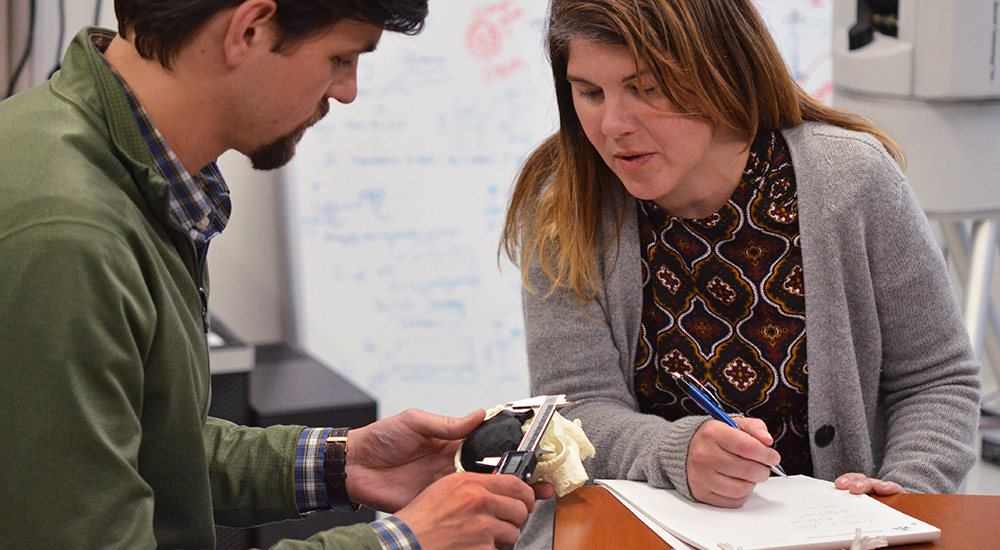
In the photo above, Dr. Beth Ripley and Brian Strzelecki perform a quality check on a model of a kidney with a cancerous tumor to ensure the 3D printed model accurately represents the patient’s anatomy. (Photo by Chris Pacheco)
The TCP implant itself was designed by the 3-D MAC’s Dr. Peter Liacouras. It’s a reconstructive plate system that can be used for traumatic head injuries, or diseases like cancer.
Dr. Liacouras said,
“The former National Naval Medical Center (NNMC) began using medical 3D printing in the late 1990s, and the former Walter Reed Army Medical Center (WRAMC) created the 3D MAC in the early 2000s. When I came on board in 2006, I helped to streamline a lot of the methods used to create the models, devices, and implants.”
In 2011, the NNMC and WRAMC integrated to form the WRNMMC.
“One feature of the TCP is that the fixation bars are already incorporated into the design, so you can simply place it and screw it down. You can also plan the fixation locations using the CT scans and the 3D reconstructions,” Dr. Liacouras explained. “We can get these out quite quickly because we receive the CT scans and do all the design and manufacturing in-house.”
He continues, saying that,
“While point-of-care 3D printing has been around for quite a while, there have been no clear regulations around it. When the FDA began talking about applying more regulations a few years ago, Dr. Ripley and I decided to get ahead of the situation. We applied for a joint incentive fund (JIF), which helped us each implement a quality management system, which you need to comply with FDA regulations.”
The 3-D MAC will not stop here though, and is also working on PEEK, as well as a custom titanium ridge augmentation matrix (CTRAM) for locally supporting bone growth. It also hopes to become a manufacturing center for other VA facilities. This could lead to many more devices being made in the future. The VA itself is an immense institution, with 339,000 staff, a budget of $445 billion, and serving a large population of 9 million. Point-of-care medical devices are becoming more accessible now, but it’s still something that’s beyond most hospitals.
Lt. Col. Andrea Mountney, deputy director for the ORA, stated,
“Additive manufacturing is changing how we deliver patient care and puts a critical capability directly into the hands of our military providers. By securing 510(k) clearance for the 3D MAC Titanium Cranial Plate System, we are delivering personalized patient-unique implants at the point-of-care – accelerating casualty treatment, sharpening surgical outcomes and speeding the recovery of our wounded service members. The Defense Health Agency Research and Development’s ORA is proud to have partnered with Walter Reed to provide the regulatory support that has transformed battlefield-driven innovation into an FDA-cleared standard of care for those who serve.”
For bracing, CMF, and trauma cases, making devices onsite is very desirable. If we look beyond this to implants, then it would really depend on what kind, at what volume, and what outcome. And way beyond that, to bioprinted tissue, we can see definite advantages to making structures close to patients. Along with 3D printing individualized medicines and nutrition, we can see a lot emerging in the point-of-care 3D printing space right now, and will expect more going forward.
Subscribe to Our Email Newsletter
Stay up-to-date on all the latest news from the 3D printing industry and receive information and offers from third party vendors.
Print Services
Upload your 3D Models and get them printed quickly and efficiently.













You May Also Like
Binder Jetting’s Next Test: High-Temperature Superalloys, with AmPd Labs and Continuum
Can binder jetting deliver the performance of investment casting while reducing cost, lead times, and manufacturing complexity? That’s the focus of The Future of High-Temperature Superalloys, an upcoming webinar presented...
Lyten’s Graphene Filaments Power Modovolo’s US-Made 3D Printing Platform
Drone manufacturer Modovolo has selected Lyten as the primary filament supplier for its industrial 3D printing platform, a move the companies say will strengthen U.S.-based manufacturing for aerospace, defense, and...
AMPulse Asia: India’s Orbital Launch Headlines a Busy Second Half of July
The second half of July brought major developments across Asia’s additive manufacturing sector. Highlights included India’s first private orbital launch powered by 3D printed engines, a billion-yuan ownership change at...
Australian OEM AML3D Closes Record Year, Eyes $54M Global Sales Pipeline
The US Department of Defense (DoD) finally seems to be implementing a strategy it has spent years refining, centered on bringing its international allies and partners more into the fold...