Application Focus Promises Success but Demands Risk


This is Part II of a five-part series by AMPOWER, Gold Sponsor of Additive Manufacturing Strategies (AMS) 2027.
For most of this industry’s history, the commercial task was to sell a 3D printer. The customer’s application was the customer’s problem. Any geometry could in principle be produced, so any inquiry was a legitimate inquiry, and growth came from widening the funnel. That model worked for as long as the technology itself was the reason to buy.
It no longer is. Part I of this series described what changed. The price position has been taken, and taken structurally, by Chinese equipment suppliers. Product Leadership remains open, but the window is narrowing as the technology matures and investors grow more cautious. What is left for Western suppliers is the position the Value Disciplines Model calls Customer Intimacy, and what it means in practice is application focus: committing the majority of engineering, application, and commercial capacity to one narrowly defined user group, and accepting that inquiries from outside that group will go unanswered.
That commitment is a genuine entrepreneurial risk, and it is a different kind of risk than this industry is used to carrying. Selling a machine was a transaction. Choosing a user group is a bet on somebody else’s industry, on their investment cycle and on their willingness to industrialize a new process. The upside is a position that competitors cannot quickly copy. The downside is real, and it arrives first, because the revenue given up is felt this quarter while the return on focus appears years later.
Strategy, in other words, shows up as a list of things a company has decided not to do. If that list does not exist, there is no strategy, only an intention.
The industry inherited its lack of focus
Additive Manufacturing did not become unfocused by accident, and the fragmentation is not a failure of management discipline. It is the direct consequence of the argument that built the industry.
AM was sold on the promise of geometric freedom. The machine could produce any shape, without tooling, without minimum quantities. The promise was arbitrariness itself, and it was genuinely new. But a supplier whose core argument is anything cannot logically prefer one user group over another. Arbitrariness was the product feature, and it quietly became the go-to-market model. Sales followed wherever the promise landed, which was everywhere and nowhere in particular.
The result is visible in how the industry’s revenue is distributed today. Figure 1 shows global revenue for metal and polymer AM equipment in 2025, split by user industry. The largest single group, defense and space, accounts for 19 percent. Everything behind it sits between 4 and 10 percent: dental, industrial, medical and part manufacturing suppliers at around 10 percent each, consumer goods at 9, civil aviation at 8, automotive at 6, energy and tooling at 4. There is no center of gravity in this picture.
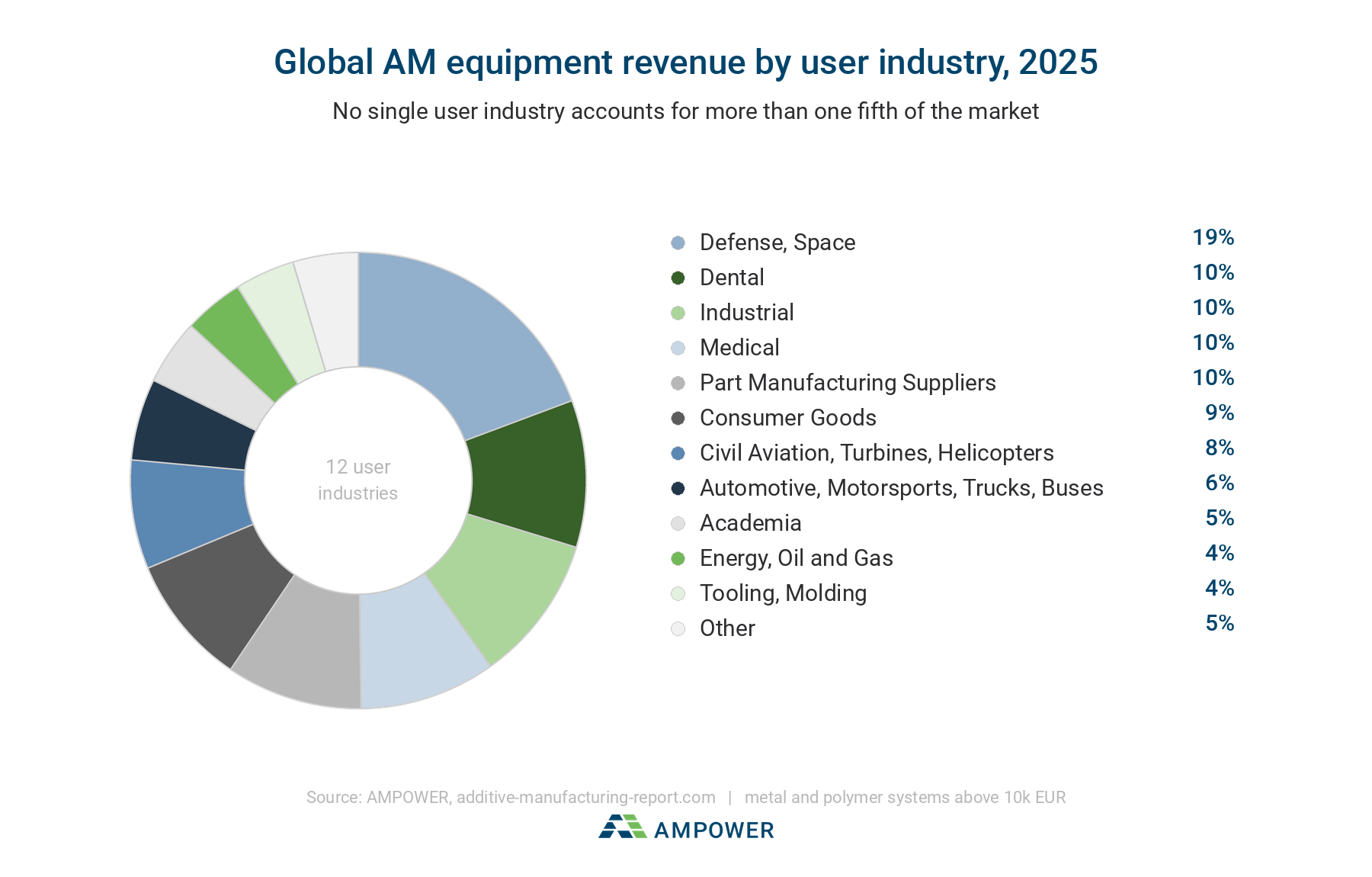
Figure 1: equipment revenue by industry. Image courtesy of AMPOWER.
The composition of the largest slice deserves a second look. Defense and space lead the field, but, as Part I argued, a significant share of that demand rests on capability-development funding that is front-loaded by design. The biggest segment in the industry is therefore also the one whose durability is least certain. Following the largest number is not an application focus.
For an individual supplier, the chart usually repeats itself in miniature: an installed base spread across six or eight sectors, none of them deep. That spread carries a cost which rarely appears in a management report. Application knowledge stays shallow because it is rebuilt from scratch in each new sector. Reference cases do not compound, because a qualified bracket in aerospace convinces nobody in orthopedics. Service economics stay poor because field teams travel across unrelated process windows. And the user, facing several suppliers who all present broad capability and no specific depth, compares what remains comparable. That is price. The competitive pressure described in Part I is therefore not purely external. Part of it is self-inflicted, and its origin is the very promise that made the industry attractive in the first place.
Undoing that inheritance is the strategic task of the next five years.
Depth first, then breadth
The mechanics of focus are frequently understood backward. Companies treat market leadership as the reward for successful expansion. In practice, it is the precondition for it.
A supplier who genuinely dominates one user group has accumulated things that cannot be bought quickly: process parameters proven across dozens of production programs, qualification experience with that industry’s regulators, cost models the customer recognizes as realistic, and a reference list where every name means something to the next buyer. That is where the promised success comes from. At that point the supplier is no longer selling a machine that others also sell. It is selling a shorter path to a qualified part, and that is a conversation about value rather than about price per laser.
Only from such a position does expansion work. Adjacent segments are then entered with proven capability instead of a presentation. The alternative route, visible presence in five industries at once, produces the opposite: everywhere a challenger, nowhere the obvious choice, and a discussion that returns to price in the second meeting.
The uncomfortable implication is that the definition has to be narrow enough to feel uncomfortable. “Medical” is not a focus. It is a trade fair category. A focus is specific enough that the supplier can name the twenty companies that matter, the applications they are trying to industrialize, and the reason those applications currently fail to scale.
The daily adversary is not the competitor
Focus is rarely abandoned in a strategy meeting. It erodes in the weekly sales call.
An inquiry arrives from a sector outside the defined focus. The customer is credible, the name is good, the volume is real, and the technical requirement is only slightly different from what the company already does. Declining feels irrational, particularly in a quarter where the pipeline is thin. So the application team takes it; a special configuration is developed; the machine is delivered; and support obligations follow for the next seven years.
Each of these decisions is defensible on its own. Together they consume exactly the capacity the focus strategy depends on. The resource that focus protects is not revenue. It is engineering and application attention that is finite and cannot be bought back later.
The practical countermeasure is a small number of explicit questions that every inquiry from outside the focus must pass before it consumes development capacity. Figure 2 outlines such a filter. Is that segment potentially scaling, or a niche within the niche? Does the application share a process window with the focus segment? Will the know-how gained transfer back into it? Can it be served from the existing portfolio without any special development? Is the customer willing to fund the deviation? The point of writing the filter down is not bureaucratic. A documented “no” is defensible before a supervisory board, while an undocumented one looks like a missed opportunity. At the same time, documenting the details of each decision will lead to improved judgment in the future and the identification of trends that may influence future strategy reviews.
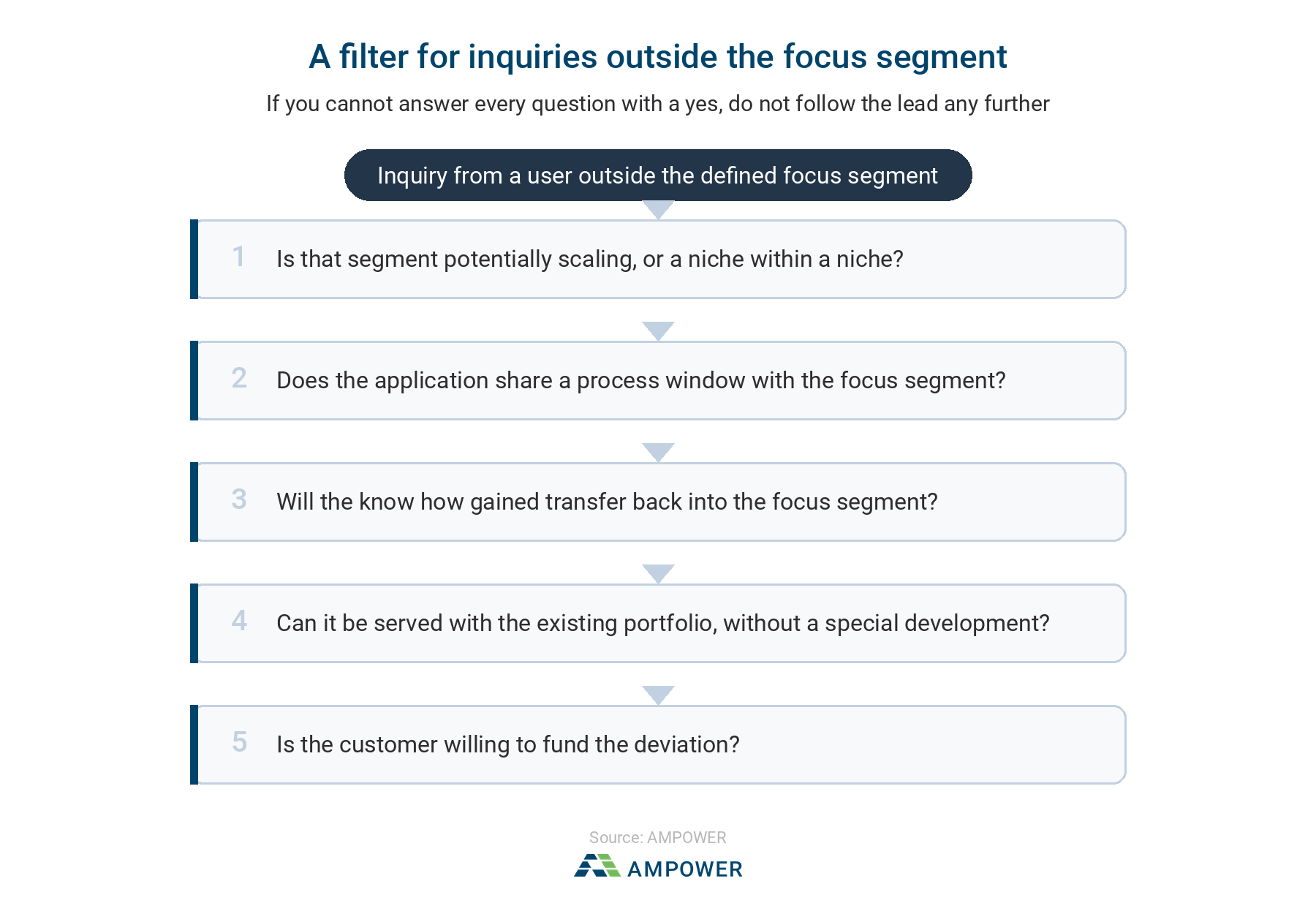
Figure 2: Decision filter for evaluating opportunities outside the strategic focus. Image courtesy of AMPOWER.
A bigger bet deserves better evidence
None of this removes the risk. It concentrates it, and that is the whole point of the strategy. The correct response to a concentrated risk is not to hedge, because hedging reproduces the fragmentation that created the problem in the first place. The correct response is to make the decision on better evidence than the industry has been used to.
This is where the analogy to selling a printer finally breaks down. A machine sale could be judged on a quotation and a build job. A focus decision has to be judged on how an entire user group behaves over the next five years: which applications are moving from pilot to series, at what production volumes, against which conventional process, and with which supplier already positioned. That information exists, but very little of it exists inside the supplier.
The evidence a supplier holds in-house is systematically biased for structural reasons. Users tell their suppliers what maintains the relationship. They report satisfaction with the equipment running at 40% utilization. They describe pilot programs in language that sounds like production. They rarely explain why a competitor was preferred, and almost never explain the internal business case that quietly stalled.
The same users speak very differently to a neutral third party. In AMPOWER’s interviews with users across industries and regions, they openly describe which applications actually run in series and which have been parked, what utilization they achieve, which suppliers they prefer and why, and what would need to change for a business case to close. Combined with market and technology data across processes and regions, this produces what a focus decision actually requires: which user groups are genuinely scaling, where the incumbent position is weak enough to be taken, what those users need from a product and a service model, and what they are willing to pay for it. The same evidence base then feeds directly into portfolio and product definition, because a focus decision that is not translated into the roadmap changes nothing.
Risk-taking and diligence are not opposites here. The bet gets larger, so the analysis behind it has to get better.
Focus without blindness
A focused strategy that is never questioned becomes the next inheritance to undo. Two mechanisms prevent that.
The first is a fixed review rhythm. The chosen position is re-examined at defined intervals against evidence, not against the last three customer conversations. Segments mature, applications shift, and a definition that was correct three years ago is usually too broad or too narrow today.
The second is a deliberate scouting mandate outside the focus. A small part of the organization should be tasked with users whose applications are marginal today but could scale within a few years and extend the business model. This work has to be structurally separated from the sales pipeline, with its own budget and its own targets. Where scouting is left to the sales organization, every unwanted inquiry is reclassified as scouting, and the focus dissolves through the very mechanism meant to protect it.
Focus and exploration are not in conflict. They are in different budgets.
Part III of this series moves one level deeper, into the application layer. A focus decision is only as good as the understanding of the applications it rests on, and that understanding is where Western suppliers still hold an advantage worth defending.
About the author
Matthias Schmidt-Lehr is Managing Partner at AMPOWER, a Hamburg-based strategy advisory dedicated to additive manufacturing. AMPOWER advises equipment and materials suppliers, contract manufacturers, industrial users and investors on market strategy, portfolio positioning, due diligence and customer excellence, and publishes the annual AMPOWER Report on the global additive manufacturing market. AMPOWER is a Gold Sponsor of Additive Manufacturing Strategies (AMS) 2027.
Subscribe to Our Email Newsletter
Stay up-to-date on all the latest news from the 3D printing industry and receive information and offers from third party vendors.
Print Services
Upload your 3D Models and get them printed quickly and efficiently.













You May Also Like
AM Investment Strategies 2026 Sets the Stage for AMS 2027
AM Investment Strategies 2026 Nov. 5 · 12 p.m. ET · Free online event RESERVE YOUR SPOT ↗ A one-hour online discussion featuring some of the biggest names in 3D...
With Its Latest $200M Round, ICON May Be Running Away With the 3D Printed Construction Market
I used to view ICON, the Austin-based additive construction (AC) firm, as one of a handful of companies that could realistically consider itself the leader of the 3D printed construction...
How Should Businesses Build New Business? Dirk Simon Weighs In — Part 1
Dirk Simon had deep experience in materials and chemistry before joining the 3D printing industry. Instrumental in BASF and Farsoon’s market introduction, Dirk has spent a lot of time thinking...
3D Printing Services Near $2.5B as AM Market Shifts Beyond Hardware
The additive manufacturing market may be growing again, but one of the more interesting numbers behind that recovery has little to do with selling 3D printers. AM services generated nearly...