Achieving Customer Excellence in AM, Part I: Why AM Strategies Have to Change

Additive manufacturing suppliers have competed on technology for most of the past two decades. Laser count, build volume, build rate, and process monitoring defined the pitch, and for a long time these were a reasonable proxy for customer value. Between 2020 and 2025, the ground under that logic shifted. This article examines what the equipment revenue numbers reveal about the industry’s competitive structure and why they raise a strategic question that most Western suppliers have yet to answer.
Five years of equipment revenue
Global revenue from metal and polymer AM equipment grew by 41 percent between 2020 and 2025. The distribution of that growth is the actual story. Chinese suppliers moved from roughly 10 percent of global equipment revenue to 26 percent. US-based suppliers went the other way, from 51 to 34 percent, losing revenue in absolute terms in a growing market. German suppliers grew absolutely, but lost share as well.
About two-thirds of all equipment revenue growth in this period was captured by Chinese suppliers. Companies such as Bright Laser Technologies, Farsoon, Eplus3D and HBD did not win that share with a superior feature set. They won it with a cost base and an iteration speed that Western system suppliers have not matched, supported by a home market large enough to fund both.
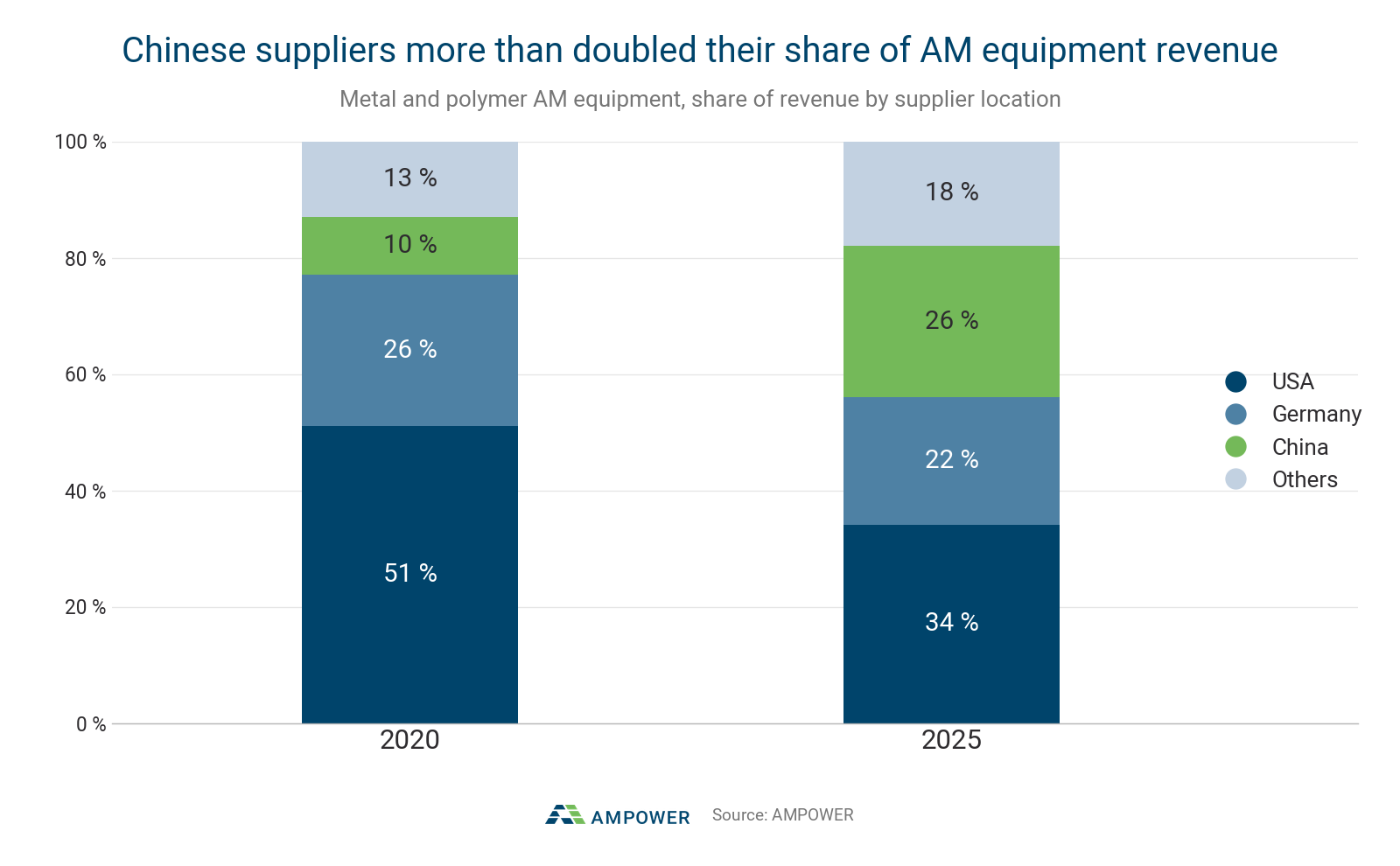
Figure 1: Share of metal and polymer equipment revenue by supplier location, 2020 vs 2025. Image courtesy of AMPOWER.
Defence is carrying the Western position
Defence is currently the load-bearing pillar for almost every Western AM supplier. Two forces drive it: the substantial funds the US Department of War is channeling into additive manufacturing, and the rapid build-out of drone production. Without that momentum, the Western share of 2025 equipment revenue would look considerably weaker.
That makes the durability of the spending a fair question, and the two sources differ on it. Drone programmes are tied to production volume and to a demand picture that shows little sign of easing. A large share of Department of War funding, by contrast, goes into capability development: qualifying processes, building initial capacity, proving out supply chains. Spending of that kind is front-loaded by design. It generates equipment revenue now without guaranteeing a recurring stream later.
Cheap machines expand the market
For users, the shift in supply is closer to an opportunity than a threat. The barrier to AM adoption has never been what the technology can do. It has been cost per part, and machine depreciation is a large share of that. A system priced at a fraction of an equivalent Western machine changes which business cases close: series parts at industrial margins, tooling, consumer goods, spare parts at commodity price points. That is good news for adoption. It is not good news for suppliers whose strategy still assumes that selling machines at Western price points is a viable core business.
One strategic position has closed
Michael Treacy and Fred Wiersema described three value disciplines a company can lead in: operational excellence, product leadership and customer intimacy. A company must lead in one and stay competitive in the others. Applied to AM today, the choice has narrowed.
Operational excellence, meaning standardised products, low variants and the lowest total cost, is no longer an open position for most Western suppliers. It is structurally occupied. It survives where markets are shielded, above all in defence, and where export control or certification requirements limit who is allowed to sell. As the numbers above suggest, that shelter partly rests on budgets that are front-loaded by design.
Product leadership remains viable, and remains expensive. The problem is duration: the window between a genuine technical lead and its replication has shortened to a few years. Several of the AM startups now in difficulty were built on a thesis that assumed a longer window. For investors reviewing such portfolios, that assumption is the first thing worth testing.
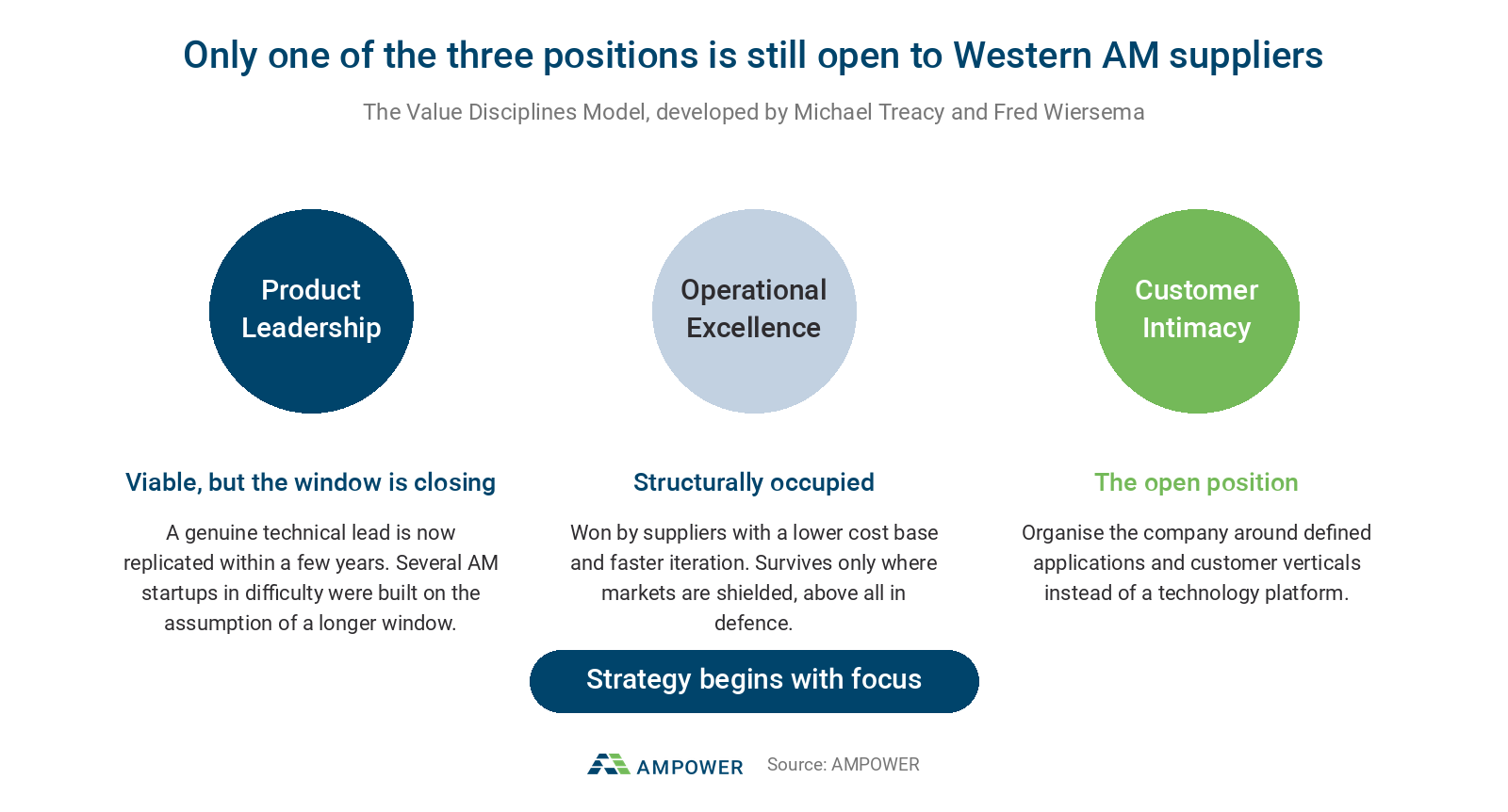
Figure 2: The Value Disciplines Model, and which position is still available to Western AM suppliers. Image courtesy of AMPOWER.
Customer and applications are now the focus
That leaves customer intimacy, which in AM means considerably more than good service. It means organising the company around a defined set of applications and customer verticals rather than around a technology platform: understanding the part, its qualification path, its cost model and its regulatory environment better than the customer does, and selling a qualified route to a production part rather than a machine with a parameter set.
This is demanding. It requires giving up market breadth and rebuilding sales and product management around applications instead of specifications. Most Western AM suppliers describe themselves as customer-centric. Far fewer can name the ten applications that will carry their revenue three years from now.
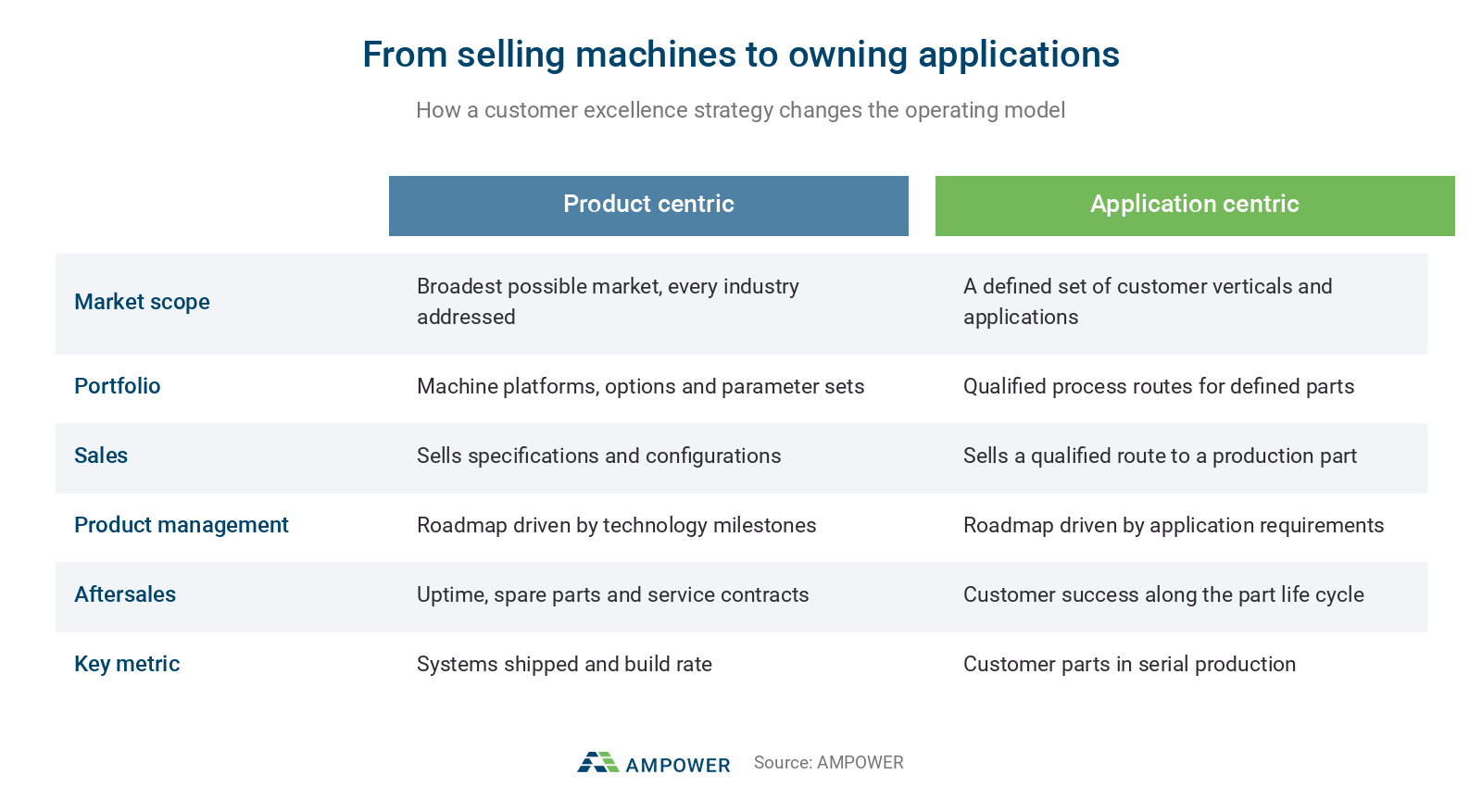
Figure 3: Product-centric versus application-centric operating model. Image courtesy of AMPOWER.
Part II examines how a supplier can test that honestly.
About the author
Matthias Schmidt-Lehr is Managing Partner at AMPOWER, a Hamburg-based strategy advisory dedicated to additive manufacturing. AMPOWER advises equipment and materials suppliers, contract manufacturers, industrial users and investors on market strategy, portfolio positioning, due diligence and customer excellence, and publishes the annual AMPOWER Report on the global additive manufacturing market. AMPOWER is a Gold Sponsor of Additive Manufacturing Strategies (AMS) 2027.
Subscribe to Our Email Newsletter
Stay up-to-date on all the latest news from the 3D printing industry and receive information and offers from third party vendors.
Print Services
Upload your 3D Models and get them printed quickly and efficiently.













You May Also Like
AM Investment Strategies 2026 Sets the Stage for AMS 2027
AM Investment Strategies 2026 Nov. 5 · 12 p.m. ET · Free online event RESERVE YOUR SPOT ↗ A one-hour online discussion featuring some of the biggest names in 3D...
With Its Latest $200M Round, ICON May Be Running Away With the 3D Printed Construction Market
I used to view ICON, the Austin-based additive construction (AC) firm, as one of a handful of companies that could realistically consider itself the leader of the 3D printed construction...
Deals, Dollars and 3D Printing: What’s Moving in AM
There’s been plenty of business activity in additive manufacturing (AM) lately, with new deals, partnerships and investments in production. One of the bigger moves comes from Sweden, where investment firm...
Oerlikon Adds ATLIX’s xBUILD 5000, Plans More for 2027
Oerlikon has installed a new ATLIX xBUILD 5000 metal 3D printer at its facility in Huntersville, North Carolina, marking the first production deployment of the system worldwide. The machine will...