3D Printing News Briefs, October 1, 2026: Defense, Enclosures, & More


In today’s 3D Printing News Briefs, we’re starting with defense news, first from Massivit and then from AML3D. Then we’ll move on to U.S. manufacturing of a new large-format LPBF system by Fives AddUp, and end with an AI platform for design custom 3D printable PCB enclosures.
Massivit Announces Expansion of RapidWings Platform in North America
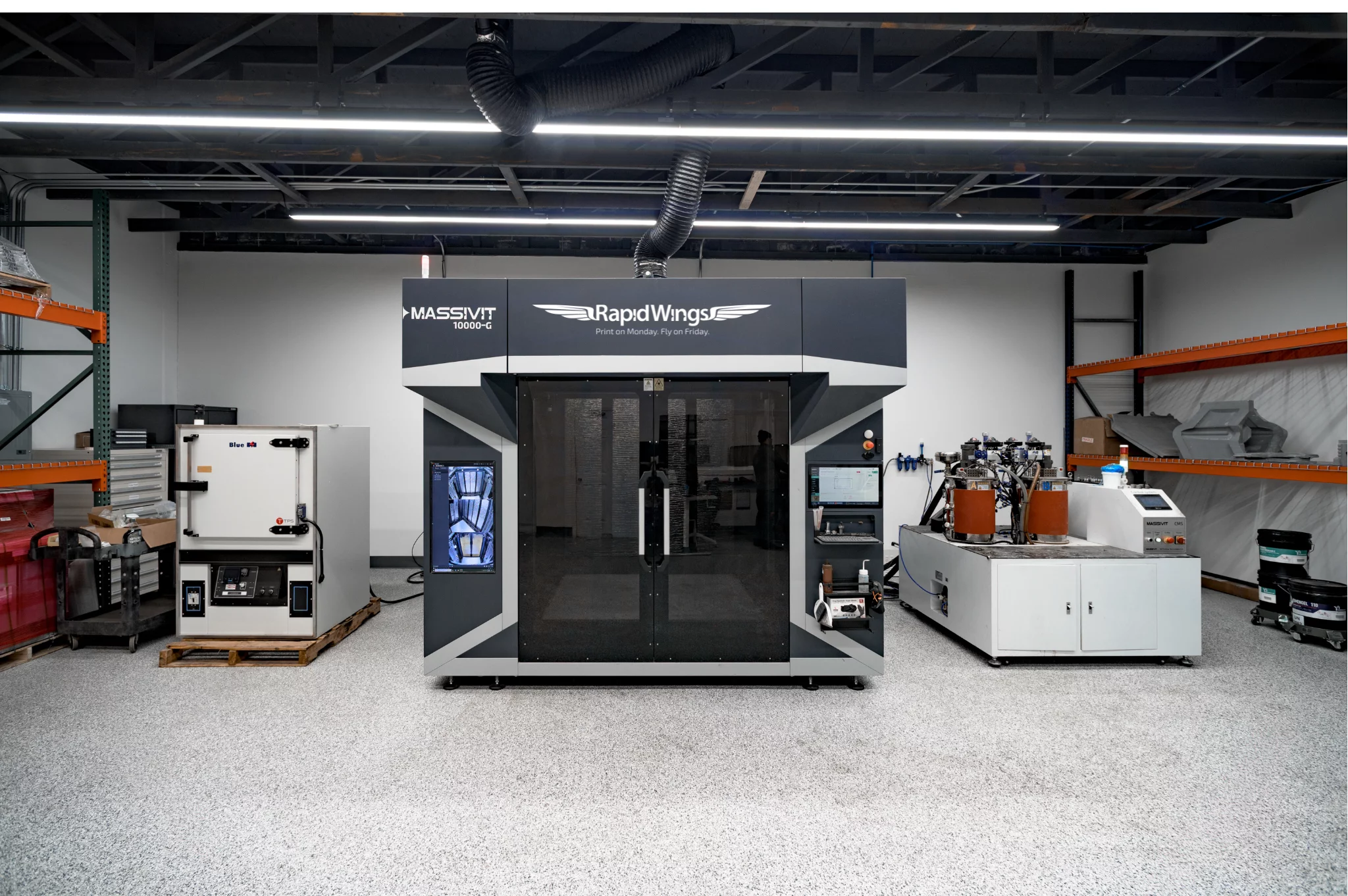
This summer, Massivit launched RapidWings, its turnkey composite manufacturing platform for aerospace and defense manufacturers, and then opened its first Europe-based Service Center to support RapidWings. Now, the company announced an expansion of the RapidWings platform by delivering composite tooling services in North America. Through Massivit’s collaboration with Oregon-based design and manufacturing firm Artek, RapidWings will offer on-demand large-format tooling services, demonstrations, and prototyping at Artek’s Portland facility. This will not only speed up composite manufacturing in North America, but it will also expand the platform’s services for customers on the continent. RapidWings services include design, digital tooling, full-scale prototypes, tool finishing, and demonstrations. Massivit’s Cast-In-Motion (CIM) tooling technology is at the core of the company’s RapidWings operation in North America. CIM delivers large isotropic molds, jigs and fixtures, and masters by pairing advanced AM with dual-component materials, which helps reduce tooling time by 90%.
“Our collaboration with ARTEK expands the availability of RapidWings tooling services in North America and complements the broader growth strategy of the RapidWings platform, including initiatives previously launched in Europe,” said Yossi Azarzar, CEO of Massivit.
“U.S. military branches, OEMs and defense contractors are striving to clear production backlogs caused by surging demand that outpaces legacy manufacturing capabilities. RapidWings is transforming Aerospace and Defense infrastructure across multiple regions, allowing both governments and industry to accomplish sovereign, autonomous production at the point of need.”
AML3D Signs Initial AU$0.5 Million Production Parts Order for US Navy Submarines
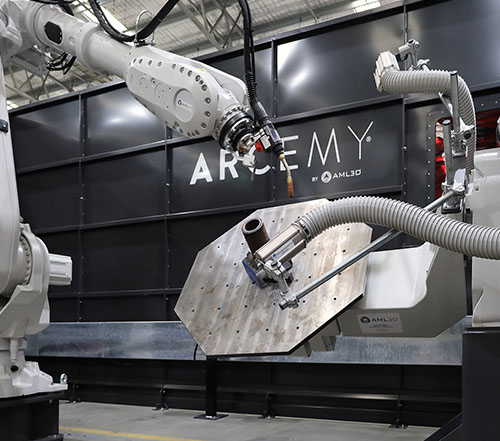
Large-scale ARCEMY metal 3D printer. Image courtesy of AML3D.
The first drivers of AML3D‘s ongoing U.S. scale-up strategy are component manufacturing and system sales in support of the US Navy’s Submarine Industrial Base (SIB). The company recently announced an initial order from Austal USA Advanced Technologies to make 3D printed production parts for Navy submarines. The order, valued at approximately AU$0.5 million, is for three large, high-pressure fluid control components. This will shift production of the Copper-Nickel (CuNi) parts from traditional manufacturing to AML3D’s advanced ARCEMY system, driven by wire-arc additive manufacturing (WAM) technology. The parts will be printed to Navy specifications at the company’s US headquarters and technology center at Stow, Ohio, and the order itself demonstrates that AML3D is able to successfully convert a CuNi qualification program to support the US Navy SIB. Delivery, testing, and commissioning of the printed production parts is expected to be complete by the end of Q3 FY27.
“It is exciting to deliver parts that directly support the US Navy nuclear submarine programs. AML3D has been diligently delivering component and materials qualification and test programs for the US Navy over several years. We have always known that our WAM® technology produced parts that match and regularly exceed traditional manufacturing. We view this order for production parts from Austal USA as a strong endorsement of our WAM® technology,” said AML3D CEO Sean Ebert.
“It is also pleasing to have another growth driver within our successful US Scale-up strategy firing up. We have already deployed 17 ARCEMY® systems to meet US demand to date, with 16 of those in support of the US Navy SIB. Demand for ARCEMY® in the US is continuing to grow and now, of equal importance, demand for component manufacturing is also growing. The US Navy has said they expect 1,600 different components will be additively manufactured by 2030. Our growth story is just beginning.”
Fives AddUp Expands U.S. Manufacturing Capabilities for FormUp 750
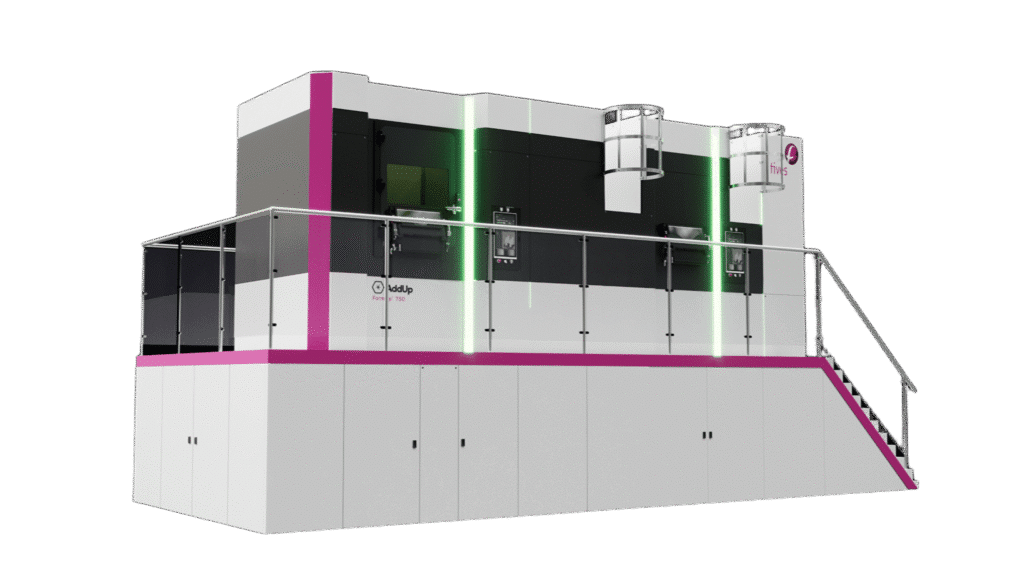
The AM subsidiary of the French industrial engineering Fives Group, Fives AddUp, is planning to set up U.S. manufacturing capabilities for its next-gen, large-format FormUp 750 LPBF printer. The company’s engineering teams in France are currently designing and developing the FormUp 750, and machines purchased for the European market will be made and assembled in France. But, starting in 2027, initial U.S. industrialization activities will begin for the FormUp 750 at the Fives Machining Systems Inc. (FMSI) Hebron, Ohio facility; this planned U.S. manufacturing will ultimately serve the North American market. FMSI’s U.S. manufacturing capability will be complementary to Fives AddUp’s current North American presence, and by adopting a regional approach, the company can bring support and production much closer to its U.S. customers. The new FormUp 750 will extend the original FormUp 350 platform to a 750 x 750 x 1000 mm build volume, and can deploy up to 12 lasers. It’s meant for industrial production of large, high-value, complex parts in advanced industries like energy, aerospace and defense, maritime, and space.
“For aerospace, defense, and other advanced industrial customers, additive manufacturing is becoming a strategic production capability. Fives AddUp’s FormUp 750 is bringing next-generation metal additive manufacturing technology closer to the North American market, supported by the responsiveness, expertise, and industrial strength of the Fives Group network. Our goal is to help customers scale production, advance qualification programs, and access the local support they need to move additive manufacturing into critical applications,” said Nick Estock, North America CEO, Fives AddUp.
Flux Introduces New AI Capabilities for 3D Printing Custom PCB Enclosures
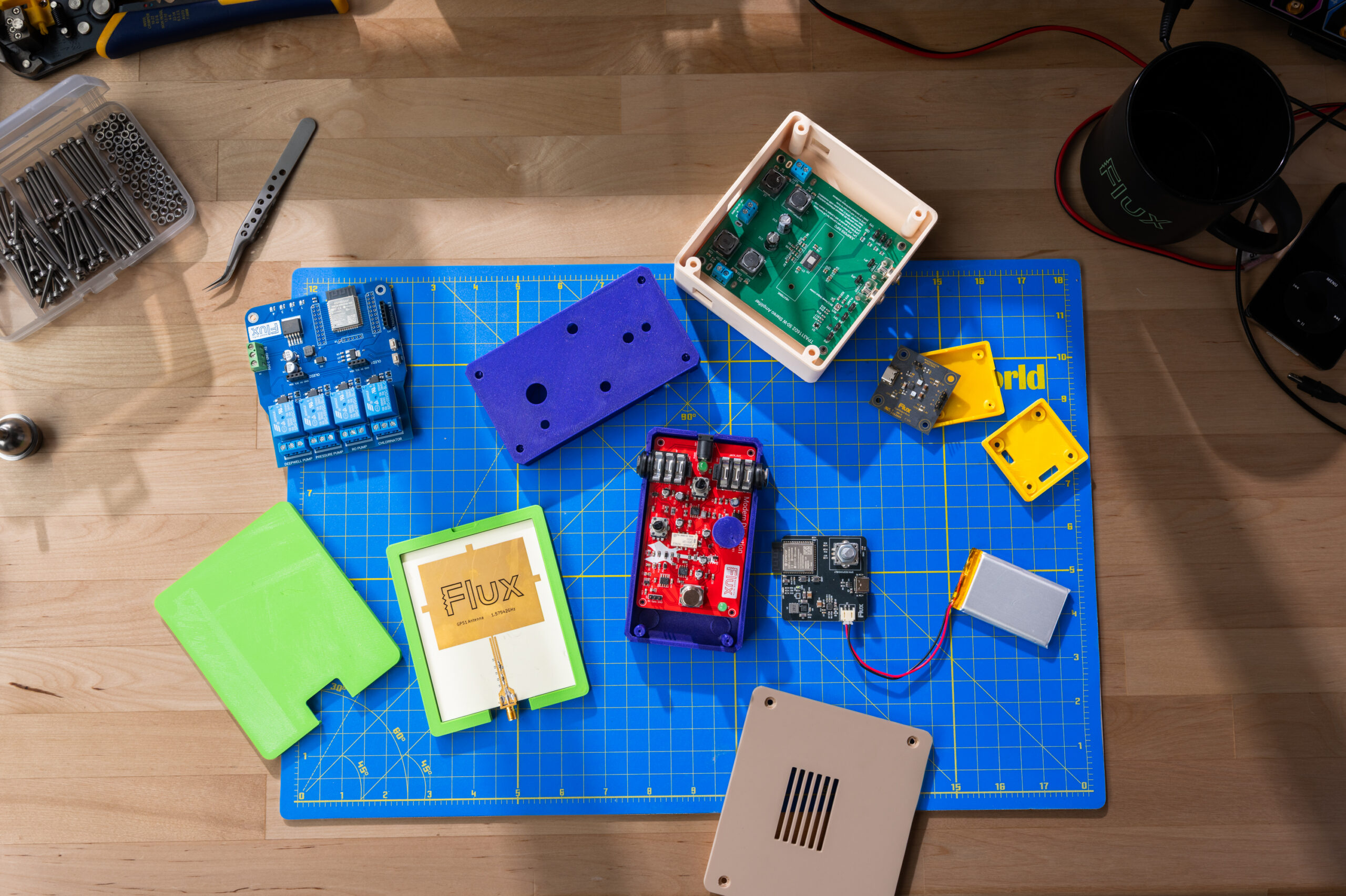
AI-powered hardware design platform Flux, based in San Francisco, recently launched new capabilities for turning printed circuit board (PCB) designs into custom 3D printed enclosures. Typically, when hardware companies need to design a PCB enclosure, they had to either hire a mechanical engineer or try to figure it out with an mCAD program. If it wasn’t right the first time, the mechanical design had to be redone, which cost both time and money. With Flux, companies should be able to design custom-fit 3D printable PCB enclosures much more easily—just type what you need into the Flux chat window. Flux does all the mechanical engineering, creating enclosures that match your PCB’s real geometry. Users can preview their build, and enclosures appear as realistic 3D assets with features like mounts, screw holes, curved edges, and latches. You can request changes to the enclosure’s feel, look, and functionality, and once it’s exactly what you want, the design is exported in standard 3D printing file formats. The 3D printable enclosures that Flux makes are great for testing, and the capability is now available with all Flux plans. There’s even a free two-week trial if you want to test the platform out first.
“Software developers take for granted that they can come up with an idea, build a prototype, and quickly iterate on it. Hardware developers haven’t had that luxury until now. With Flux, they can skip the time and expense of first-round manufacturing and iterate on 3D-printed prototypes even before they’ve tested the board. It’s a huge accelerator for product development, and a powerful tool for communicating your vision. Instead of trying to get your idea across with a slide deck, you can actually hand what you’re building to a partner, an investor, or a potential cofounder,” said Matthias Wagner, Co-Founder and CEO of Flux.
“Testing is a real dilemma for small hardware companies. The time and cost involved in creating a testable prototype are really high. But if you don’t test, you often wind up regretting it. Flux is the first practical solution that allows builders to skip the mCAD stage entirely and go from board design to an enclosed, 3D-printable prototype in one workflow.”
Subscribe to Our Email Newsletter
Stay up-to-date on all the latest news from the 3D printing industry and receive information and offers from third party vendors.
Print Services
Upload your 3D Models and get them printed quickly and efficiently.













You May Also Like
3D Printing News Briefs, October 10, 2026: Drones, WAAM, Ceramics, & More
We have a packed 3D Printing News Briefs for you this weekend! First, America Makes celebrated the recent National Manufacturing Day with 3D printed drones, and then it’s on to...
3D Printing News Briefs, October 3, 2026: Hypersonics, Hotends, & More
We’re starting off with defense in this weekend’s 3D Printing News Briefs, as Titomic was awarded a $5 million U.S. defense contract, and VulcanForms announced a partnership with Specter Aerospace...
The Part Is Only Half the Story: Why 3D Printing Needs a Digital Thread
A 3D printed part can generate a lot of information. The challenge is keeping track of it. Manufacturers need to know which design was used, what material went into the...
Advanced Manufacturing at IMTS 2026: 3D Printing and AI and Drones, Oh My!
Last week’s International Manufacturing Technology Snow (IMTS) in Chicago welcomed over 90,000 attendees to the jungle that is McCormick Place. With over 1.17 million square feet of exhibit space, and...