AMCOM Wants More Expeditionary 3D Printers for US Army Aviation Systems

Disrupt yourself or someone else will do it for you: this is the lesson that the US military has been conveying to its suppliers all year. The advanced manufacturing demonstrations that spanned much of the summer have broadcast this message at maximum volume. Expeditionary additive manufacturing (AM) capacity is the objective around which all the others are being organized.
While the present post won’t reach you in time for you to act on the information, the US Army wants three more expeditionary AM systems, all for various polymer materials; proposals were due yesterday, August 31. Anyhow, the call for submissions was only issued on August 24, so the Army presumably had the intended recipients in mind prior to the call’s issuance. In that vein, the notice points out that Geofabrica, based in Michigan, is an incumbent with experience relevant to the project, so that might be who gets the contract.
Moreover, I think there are takeaways far more interesting than a potentially missed opportunity for a single contract. Above all, no matter how many expeditionary AM systems the US military acquires, from no matter how many vendors, the Pentagon seems to always want more. One reason for this, of course, is that there are as many different possibilities for expeditionary AM systems as there are AM processes that can be containerized or otherwise deployed in rugged environments.
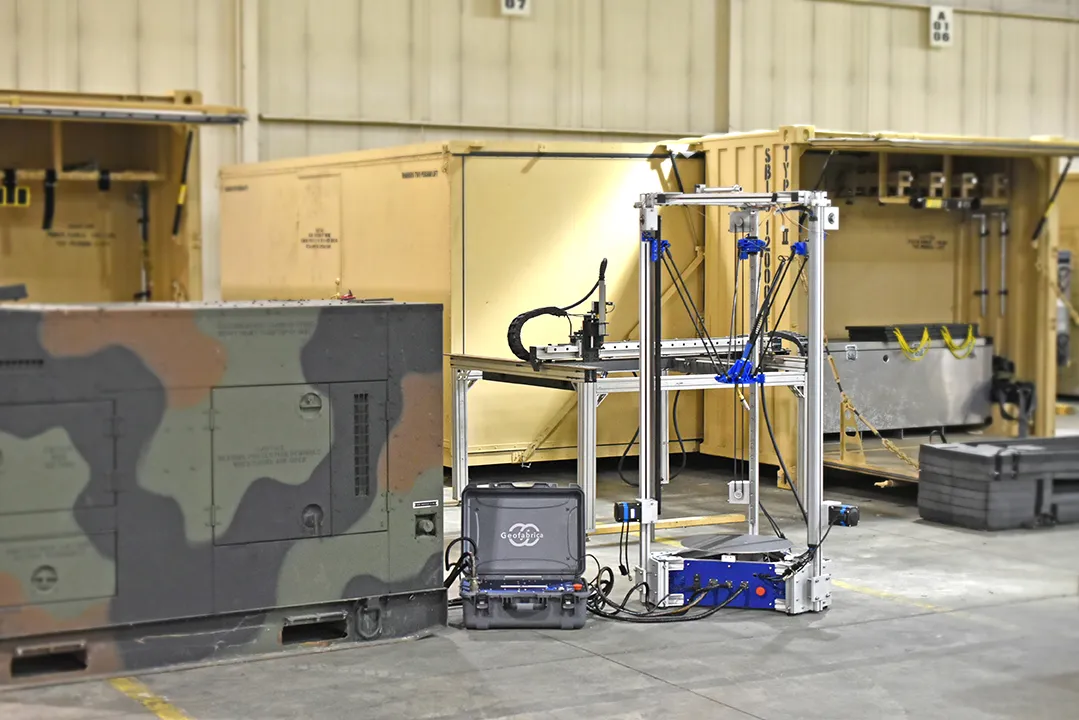
Image courtesy of Geofabrica
However, this doesn’t mean that every individual need that the US military has for an expeditionary AM capability is already being fulfilled by a single incumbent that is too entrenched to be challenged by a competitor. That is, for any given process, there are multiple vendors working to address the Pentagon’s needs. This is the most interesting angle: there seems to be some level of genuine competition going on in US military procurement. When is the last time when that happened for a sustained period of time?
The specific agency that called for proposals, by the way, is the US Army Aviation and Missile Command (AMCOM), which plans to deploy a system at each of three locations: Fort Campbell in Kentucky, Fort Bragg in North Carolina, and Fort Hood in Texas. The notice says the machines will be used for “low-demand, non-flight safety essential” parts whose lack of availability can nonetheless still lead to aircraft-on-ground (AOG) status. Drones are among the systems in AMCOM’s portfolio of responsibilities, and in this context, it’s relevant that Ft. Campbell, Ft. Bragg, and Ft. Hood are all critical to the US Army’s drone capabilities.
As I’ve frequently noted, it’s important to view what the military is attempting to do with expeditionary AM holistically, not just in terms of the goal of being able to produce a specific kind of part at the point-of-need. Thus, for instance, expeditionary AM systems are as significant in terms of their implications for training military personnel how to use 3D printers and other advanced manufacturing equipment, as they are in terms of enabling technologies for on-demand, localized parts production.
With that in mind, assuming as I am that the US military still hasn’t settled on a preferred expeditionary system for every process, ease-of-adoption will likely be among the most important considerations in determining who wins the race to deliver expeditionary 3D printing to Pentagon customers. And that’s indeed just one example of a variable, other than part quality and cost, that will factor into the decision-making process.
So the “strategic” demand signal is clear: make your AM process expeditionary-friendly. But the “tactical” demand signals, i.e. the demand signals expressing what each branch wants in an expeditionary 3D printer, are apparently still unsettled and should remain so for some time. In other words, if you didn’t get in on this specific call for submissions, there will almost certainly be plenty additional opportunities.
Featured image courtesy of US Army
Subscribe to Our Email Newsletter
Stay up-to-date on all the latest news from the 3D printing industry and receive information and offers from third party vendors.
Print Services
Upload your 3D Models and get them printed quickly and efficiently.













You May Also Like
Creality K3 Opens for Pre-Order at $849, Advancing Multi-Color 3D Printing
Creality has officially opened pre-orders for the Creality K3, its latest flagship K Series 3D printer, starting at $849 in the United States. Recognized as an IFA Innovation Awards 2026...
Beyond the Printer: HP and DyeMansion Tackle the Future of Prosthetics
Making a custom orthotic or prosthetic device involves much more than producing the final part. Patients need to be measured, devices must be designed to fit their bodies, and finished...
3D Printing News Briefs, October 14, 2026: Bolus, Aerospace Tooling, Water Filter, & More
In today’s 3D Printing News Briefs, we’re starting with medical news, as Myrava has received FDA 510(k) clearance for its 3D printed bolus. Moving on to aerospace and metals, AML3D...
Can India’s AM Push Help Make it a Viable Supplement to China?
Diversifying manufacturing supply chains to locales outside of China has nothing to do with actually cultivating “substitutes” to the Chinese economy. The real stakes are these: China is an irreplaceable...