The U.S. Army Has Zeroed in on 3D Printing’s Drone Ecosystem Role

In a speech he gave at the U.S. Army’s Global Force Symposium back in March, General James Rainey, the head of U.S. Army Futures Command, said the branch was in the process of assessing how additive manufacturing (AM) could enable a rapid scale-up of autonomous drone production capabilities. The point, General Rainey said, was to bolster domestic training exercises related to unmanned aircraft systems (UAS): “What we need right now is the ability to replicate the UAS threat during training at home station. …And we need to do it at a price point that is ridiculously low: We don’t need the Gucci cameras and everything else.”
Earlier in that same month, it was reported that Fort Campbell’s 101st Airborne Division, led by Maj. Gen. Brett Sylvia had started 3D printing its own drones for training exercises, as part of a new Army effort, “transforming-in-contact“, involving “…identifying specific units to experiment with near-term networked communications systems designed to counter the threats leaders see evolving on the battlefield”:
Notably, Defense Scoop reported that Sylvia told them that, “…the transforming-in-contact effort is the most significant modernization process he’s seen in his 30-year career. That’s partly because it is user driven and not lab driven.“
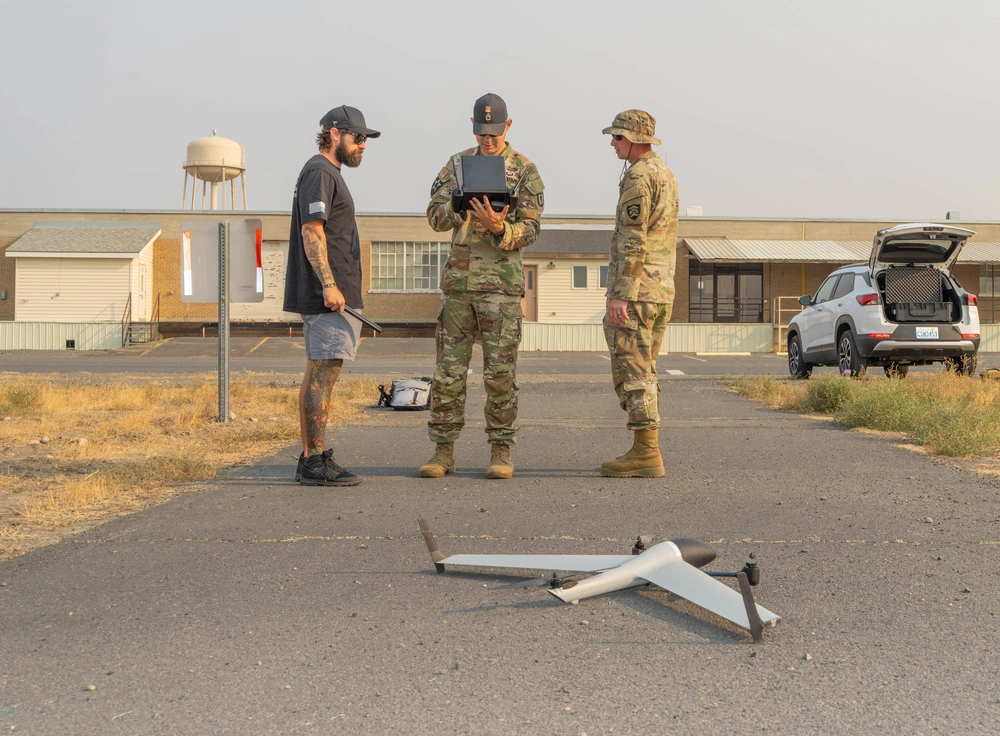
Oregon Army National Guard soldiers train with the Flightwave Edge 130 unmanned aircraft system at the Rees Training Center.
The transforming-in-contact approach to 3D printing drones appears to be spreading: the Oregon Army National Guard has incorporated AM into the center of its new drone training program, “draw[ing] inspiration from” the 101st Airborne and Hawaii’s 25th Infantry Division. Earlier this month, at Oregon’s Rees Training Center (RTC), the Regional Training Institute (RTI) held two different training courses in UAS piloting, one from September 3-5, the other from September 3-12.
The longer course, which focused on a variety of small UAS, included drones featuring 3D printed parts made by EchoMAV, a Texas-based company that produces finished drones as well as modular drone kits, with all parts NDAA-compliant. As with the 101st Airborne, the main point of incorporating cheaper systems — including the 3D printed drones — into the Oregon Army National Guard course is to enable more comprehensive training by “supplement[ing] expensive commercial systems”:
RTI commander Lt. Col Mark Timmons told DVIDS, “These systems cost $45,000 apiece, so…where do we go once we get them here and we want to loan these out to various UAS operators? Well, what’s going to happen? We know what’s going to happen. They’re going to crash.
“The opportunity for us to be able to essentially design and build by 3D printing our own aircraft, partnering with a company who are experts in the technology piece of it and the compliance piece of it, putting those two efforts together gives us an Oregon-made, essentially US-made system.”

Oregon Guard advances drone capabilities with new training systems.
According to DVIDS, prices for the custom prototypes that the Oregon Army National Guard developed with EchoMAV run from $2,000 to $5,000, which includes the ground control stations. That price difference between the custom-built drones and the commercial systems tracks with what a U.S. Army battalion based in Germany reported earlier this year, in a story about 3D printing surveillance drones for a training exercise in Poland.
Of course, the U.S. military and its suppliers are doing many things with AM right now. But the reason why small drones, specifically, matter so much is precisely of this training course strategy: it addresses an urgent need in a way that can be scaled quickly, solving many different challenges simultaneously.

Staff Sgt. First Class Gregory Mannen operates an RQ-28A Sky Ranger drone during training at Rees Training Center, Oregon.
In addition to lowering costs and enhancing training methods, the strategy also helps the military move away from reliance on competitors’ supply chains. On a longer timeline, that latter objective will become even more attainable by combining drone kits with 3D printed components with conventionally manufactured, domestically-produced parts, including motors, from companies like Unusual Machines, a business model that the company’s CEO discussed with me in a recent interview.
At this point, the reason why the U.S. military needs this sort of broad-sweeping success story with AM goes far beyond the symbolism of moral victories that were more relevant at earlier phases in the Department of Defense’s (DoD) AM buildup. That symbolism still matters, but to truly accelerate DoD’s AM adoption for the long haul, the DoD needs to be able to draw data from a systematically implemented change management program. That’s the only way the department will be able to gauge what works to the point where it can proceed with applying AM systematically for every application that has shown promise thus far.
Images courtesy of Major Wayne Clyne, Oregon National Guard Public Affairs Office
Subscribe to Our Email Newsletter
Stay up-to-date on all the latest news from the 3D printing industry and receive information and offers from third party vendors.
Print Services
Upload your 3D Models and get them printed quickly and efficiently.











You May Also Like
ARC & ORNL Form Partnership to Accelerate AI-Enabled Manufacturing for Defense
Last year, Autonomous Resource Corporation (ARC) became the surprising owner of Desktop Metal’s (DM’s) assets following the bankruptcy of the one-time additive manufacturing (AM) unicorn, an acquisition that cost ARC...
RAPID 2026 in Pictures: The Coolest & Craziest Things on the Show Floor
Last week, North America’s premier 3D printing trade show, RAPID+TCT 2026, came to Boston. I spent two days trekking the show floor, trying to see as much as I could,...
Euler Viewer for Metal LPBF 3D Printing Released
Icelandic software startup Euler has released Euler Viewer, a real time build viewer for metal LPBF. The product does not need to be installed, and doesn’t require hardware to be...
3D Printing News Briefs, April 8, 2026: LiDAR Scanning, Vapor Smoothing, FDM Optimization, & More
We’ll kick off today’s 3D Printing News Briefs with some 3D scanning news from Artec 3D, and then move on to new America Makes Project Calls. Then, Raise3D and AMT...