AM & the Military’s Self-Infliction of Rapid Change

I’ve noted before that the additive manufacturing (AM) market for defense has started to evolve so quickly that it’s impossible to even keep track of all the updates in real time. That was at least two wars ago; how much truer that observation is today, with the Iran War remaining wholly unfinished despite all the attempts of the US administration to pretend it’s no longer taking place.
As irresponsible as that attitude is, it’s certainly understandable: the natural impulse when faced with things that are both this unpleasant to think about and this much of a challenge to get a handle on is to simply ignore those things and move on to more enjoyable matters. On the other hand, the defense market is too integral to the fate of too much — including the fate of the AM industry — for one to be able to afford to lose the thread of current events for very long.
With that in mind, now may be a good time to step back and consider if there is a general picture emerging from all the seemingly disparate elements contained in months’ worth of daily news, press releases, and government funding announcements. Perhaps if we can identify some of the broadest themes, the constant onslaught of new information will become less overwhelming.
Containerization is Real
Containerized AM platforms are becoming a real thing, or they’re trying to, at least. The San Diego startup Firestorm Labs is solid evidence of this, as the company just closed an $82 million Series B round, and, just as importantly, the company got $30 million from the Pentagon, as part of something called the Accelerate the Procurement and Fielding of Innovation Technologies (APFIT) program. The contract could end up being worth as much as $50 million, and, among other things, involves the delivery of five of the company’s xCell manufacturing units to “an undisclosed customer in the Indo-Pacific region.”
Is that customer one of the US bases in the Indo-Pacific Command (INDOPACOM)? Could it even be one of the US military’s allies in the region, like the Philippines military? The latter just tested manufacturing at the edge in joint exercises with Western armed forces, and the results suggest significant potential to both save money and speed up deliveries.
Speaking of manufacturing at the edge, that’s one of the main topics of a webinar on drones, “UAS Additive Strategies”, that 3DPrint.com and AM Research are presenting on June 30, between 11:00 AM and 2:30 PM Eastern. Cheaper drones are probably the primary factor behind the increasing interest in making containerized factories a dependable reality — that’s what Firestorm Labs, for instance, is largely focused on — but they’re not the only factor.
Both low-cost drones and containerized systems, in fact, are symptoms of the same overarching theme, which is adaptability. Recognition that the US military desperately needs greater adaptability is the principal catalyst for all the other changes involved in the overlap between AM and the defense sector.
If you can obtain a “good enough” weapons system at a fraction of the cost of some idealized “perfect” weapons system, you can reduce the likelihood that you’ll hamstring your ability to respond to some future blindspot by overcommitting to what’s currently on the market: that’s the lesson the US military’s enemies are teaching it, presently. And one solution that could ultimately provide the ability to respond to as many different unforeseen threats as possible, down the road, is distributed manufacturing: that’s the lesson Pentagon planners are learning, which is pushing them in the direction of containerized factories that support expeditionary production capabilities.
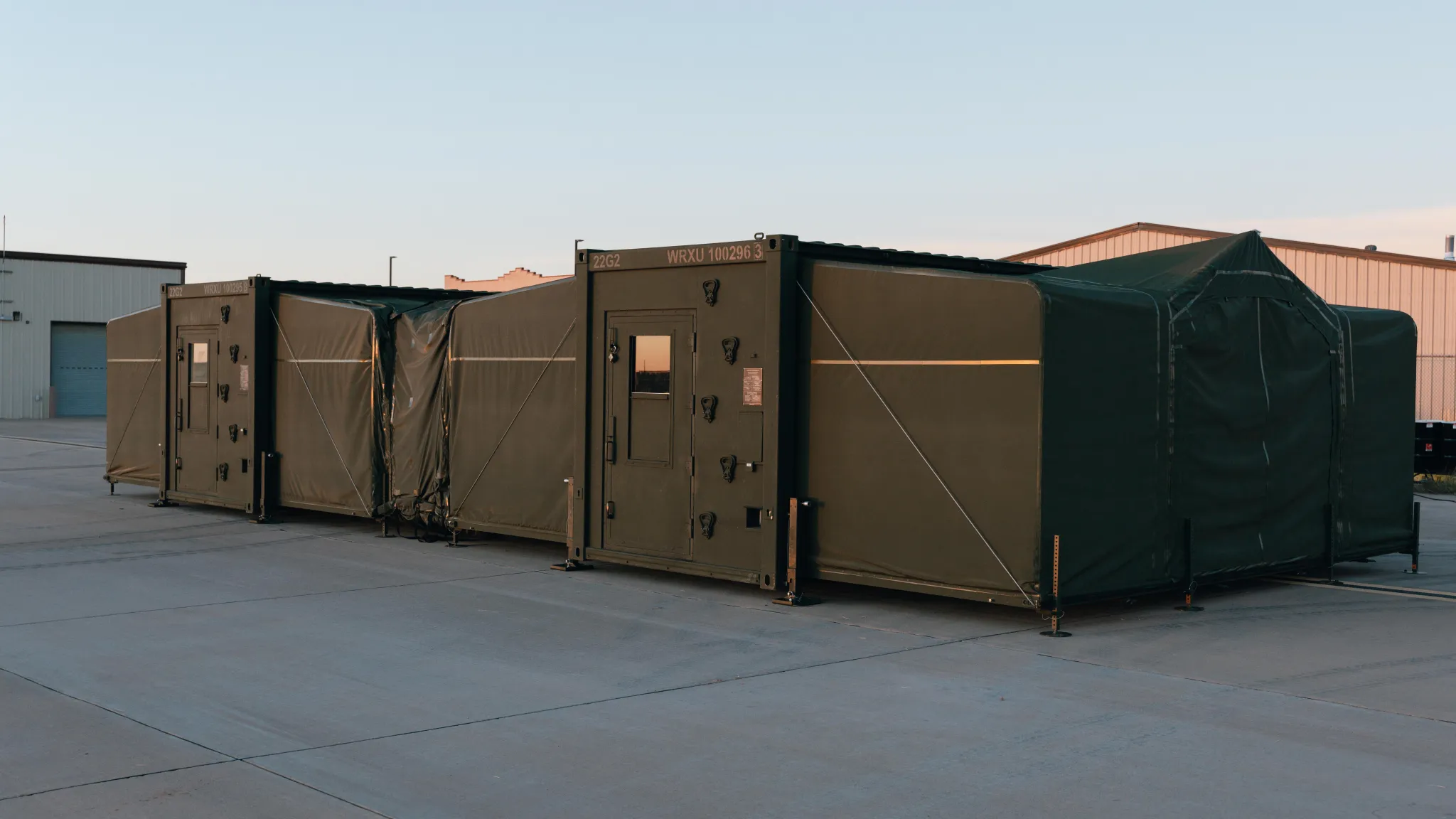
Image courtesy of Firestorm Labs
Tension Persists Between the US Government and the Defense Giants
That issue of adaptability extends beyond adopting new manufacturing processes. It also involves a shifting dynamic between the suppliers that traditionally comprise the US defense sector, and the DoD, which butters those suppliers’ bread.
Last year, the US Army Secretary, Dan Driscoll, along with multiple other DoD officials, started intensifying the rhetoric surrounding plans to let the US military supply its own replacement parts with 3D printing. In September 2025, Driscoll reportedly told “a media roundtable“,
“[We’re] empowering our generals to take on that risk where we have the right to repair so that they can make these very small parts to get things back on and get them back into the hands of our soldiers. I think you’re going to think that these are kind of one-off instances. I don’t know the exact number, but my commitment to you is, or my best guess is, that this is a meaningful step forward.”
A couple of months later, Driscoll would go so far as to say that, ““The defense industrial base broadly, and the primes in particular, conned the American people and the Pentagon and the Army into thinking that it needed military specific solutions, when in reality, a lot of these commercial solutions are equal to or better, and we’ve actually harmed ourselves with that mentality.”
Driscoll framed the objective that he’s trying to work towards like this:
“It used to be 90 percent of things we bought were purpose-built for the military or the Army, and 10 percent were off the shelf. ..what we are trying to do is flip it to 90 percent being commercially available and 10 percent being specific in the worst of cases, because when you actually start to think about what large-scale conflict looks like, you cannot scale one-off solutions as quickly and easily as you can scale commercially available things” (Emphasis added.)
It can’t be stressed highly enough that the Pentagon is framing all of these issues in terms of what the US military will require in a large-scale conflict. What’s happening in Iran may qualify as the sort of scenario the Pentagon was thinking of. But you should also consider the subtext that the entire global elite surely has in mind, which the foreign minister of Singapore, for one, voiced when he said in late April that the Strait of Hormuz conflict is merely “a dry run” for war between the US and China.
That is precisely how seriously Pentagon decision-makers are treating the need to accelerate the US military’s AM adoption, as illustrated by Driscoll’s recent remarks that he plans to partner “with nontraditional entities like academia” to develop the IP for replacement parts from scratch, which can then be leased or purchased by the Army. This sort of solution would address exactly the problem Driscoll has been criticizing re: the US military’s inability to repair its own parts, cheaply, in live combat conditions.
Most pressingly, Driscoll wants to produce interceptors because that’s the challenge that Iran has brought to the surface most acutely. But obviously, once the precedent is set, the dynamic could apply to just about anything that the US military can figure out how to print. The handful of largest primes can only view this as a threat.
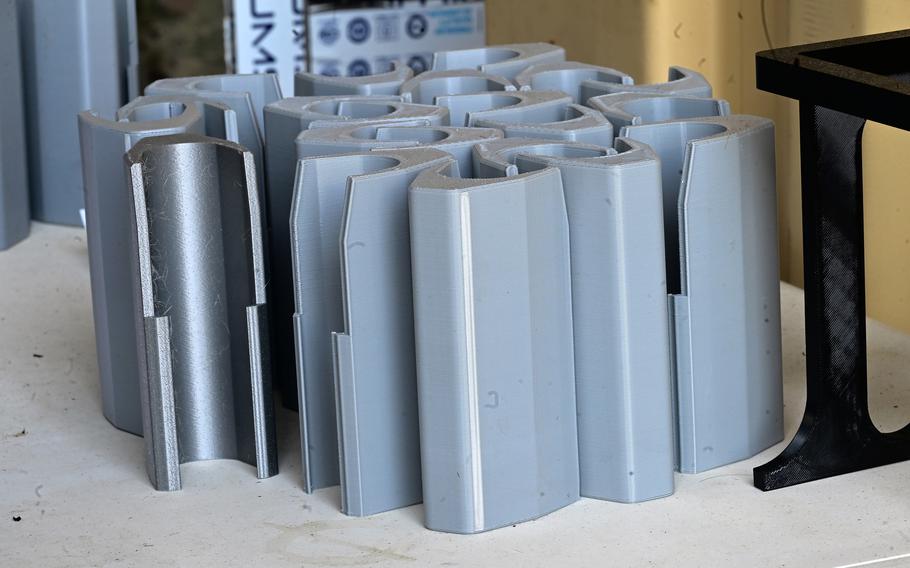
Bipod adapters printed by the US and the Philippines militaries during recent joint exercises. Image courtesy of Stars and Stripes
Adapting the Unadaptable
It may indeed only be a threat meant to light a fire under the proverbial seats of the likes of Boeing, RTX, etc. Driscoll has said that the Army will provide more details on the plan “in the next four to six weeks”. In this context, one shouldn’t lose sight of just how much of the AM industry’s progress, historically, the primes have been responsible for. They may need to disrupt themselves in order to meet the challenge of the moment, but there’s no question that they have the technological capability to do so, if they can figure out some deal with the Pentagon to lease their IP in exchange for royalties on the parts produced.
As Driscoll was issuing his latest broadsides on the defense sector, Lockheed Martin was issuing a peculiar message of its own, a press release from late April that didn’t really announce anything new, but simply drew the reader’s attention to how familiar Lockheed Martin is with metal PBF. Perhaps the most genuinely new announcement in that release was Lockheed Martin’s confirmation that the company’s Precision Strike Missiles (PrSM) heavily incorporate AM in the manufacturing process, although I already knew this because I looked it up when it was reported that some of the worst damage inflicted on Iranian civilian targets by US strikes fit the profile of what PrSMs are known to be capable of.
So, that’s not exactly a badge of pride for the AM industry, but it does show that the defense sector status quo understands the message being conveyed to it by the Pentagon, and is attempting a response. The primes are trying to change, if not for the better, then at least for the cheaper. The takeaway from all of these developments is that two leviathans — one public (the Pentagon), the other private (the defense contracting establishment) — know that they have to do things differently, and are trying to accomplish that before the world forces the issue on them against their will.
That is the web that the AM industry now finds itself entangled in. It would be nice if one could avoid it by choosing not to work directly with the defense sector, but the value of the AM industry is so disproportionately tied to this market segment that it’s going to impact you no matter what. If the idea of defense work turns your stomach too much, my recommendation would be to hitch your wagon to one of the other strategically critical sectors that Vanesa Listek has done a remarkable job of laying out for everyone in this 3DPrint PRO piece. They, too, are all in the process of trying to figure out how to disrupt their own status quo.
Featured image, from Schofield Barracks in Hawaii, courtesy of Defense One/Jennifer Hlad
Subscribe to Our Email Newsletter
Stay up-to-date on all the latest news from the 3D printing industry and receive information and offers from third party vendors.
Print Services
Upload your 3D Models and get them printed quickly and efficiently.













You May Also Like
How Should Businesses Build New Business? Dirk Simon Weighs In — Part 1
Dirk Simon had deep experience in materials and chemistry before joining the 3D printing industry. Instrumental in BASF and Farsoon’s market introduction, Dirk has spent a lot of time thinking...
The Frankenservice Part 2: Have Your Cake and Eat it Too
This series of articles delves into a thought experiment. What if we let go of using a few machines very optimally, but instead use lots of different machines to meet...
The Additive Chicken Coop, Part IV: Lemmings
If we look at our past, we can see how making custom machines, incessantly watching ourselves, and our inability to rescope shaped our industry. We have also looked at the...
The Additive Chicken Coop, Part III: Bananas
A friend of mine, Ed Davis, once pointed out the level of strategic replication in additive. I wasn’t aware of it before and haven’t been able to unsee it since....