Phase3D Gets Air Force Contract for Real-Time CMC Inspection


Inspection software and tooling firm Phase3D has been given a Department of the Air Force contract. Its Fringe Inspection platform will be used in ceramic matrix composites (CMCs). CMCs are an evolving class of materials used for applications such as turbine blades, thermal protection for hypersonic vehicles, and gas turbines. These materials have been engineered for super-high-temperature performance. Just one possible application, TPS, the thermal protection tiles on the skin of rockets, missiles, spacecraft, and the like, is incredibly significant. Blankets, tiles, and complex composite structures are often difficult to make and are a bottleneck for the New Space economy and the Air Force.
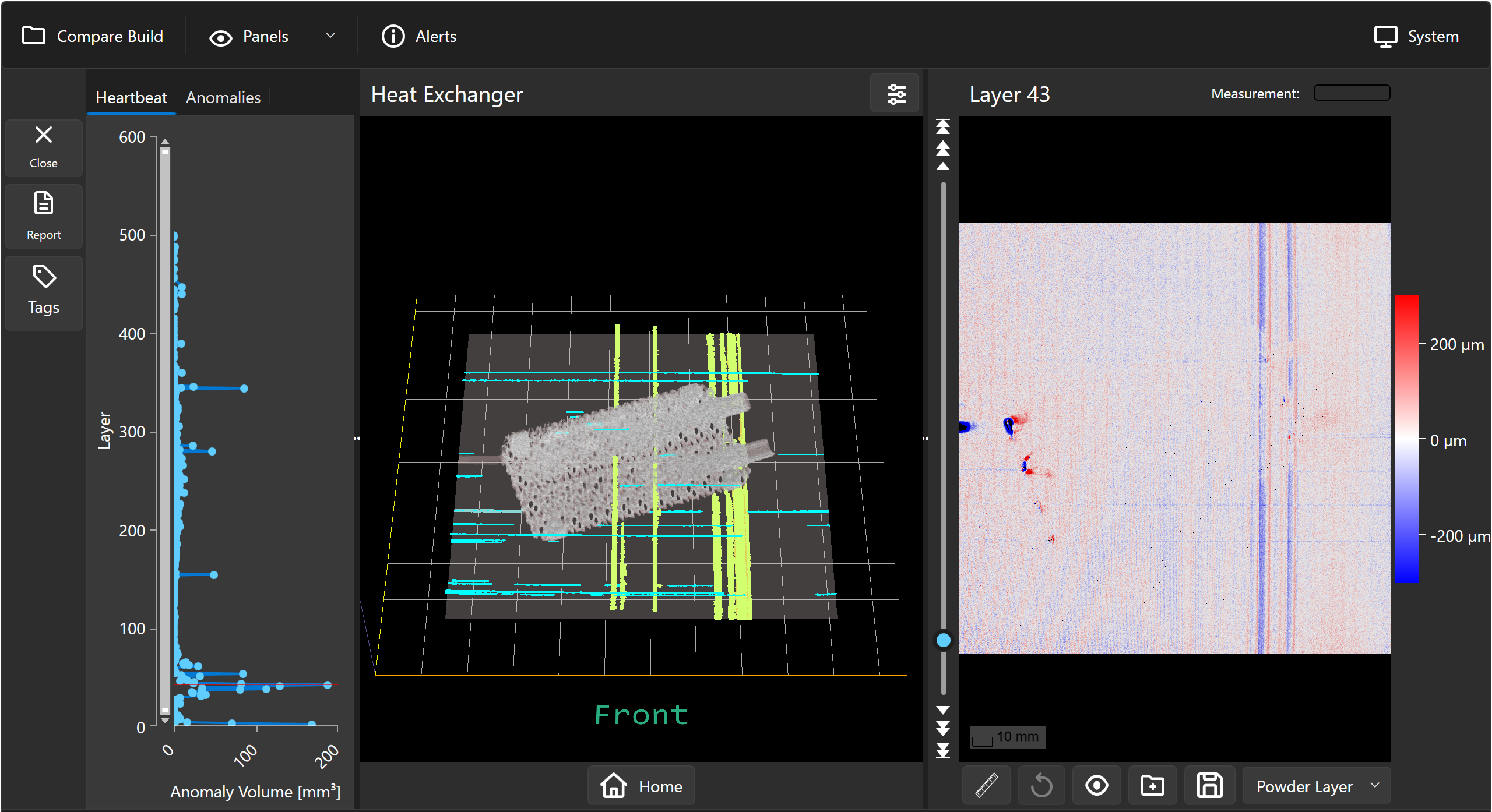
Figure 2 – Fringe Operator is a visualization and analysis tool that helps customers identify anomalies causing build failures in real time. Image courtesy of Phase3D.
Just making TPS well at sale will be enough to warrant stratospheric investment by the US Government. But CMCs like Carbon Silicon Carbide, where carbon fiber is embedded in a silicon carbide matrix, give a high-strength, ultra-high-temperature-resistant material that can work for hypersonics body structures as well and turbo machinery up to temperatures of 1500C. Another class of these materials, UHTCMCs, are ultra-high-temperature ceramic matrix composites; they are rather aptly named, as they can operate under load up to 2000 °C. That’s incredible performance and unlocks things like use in rocket nozzles and scramjet components. They could also be used in tokamaks and other reactors. One of these combinations, Carbon Fiber Hafnium Carbide–Tantalum Carbide, can even operate up to 3500 °C. It’s much less dense than Tungsten, maintains properties for longer during heating than Tungsten, and doesn’t shatter abruptly like ceramic alternatives. Diet Tungsten is therefore a very special material indeed.
If you’d like to make things that go very fast, this class of materials will come up often as a possible solution to many of your needs. And with less thermal expansion than a lot of alternatives, as well as high fracture toughness, it’s an ideal candidate for a lot of very important building blocks of space and aerial dominance. A lot of these materials are also difficult to machine, next to impossible to machine. In CNC, the material is effectively sheared by a tool that is significantly harder than the workpiece, and here we hit the problem that there isn’t much out there harder than this. Whereas the UHTCMCs are not yet commercially available, possibly taking up rather a lot of headspace for some ladies and gentlemen at ORNL, probably, more quotidian CMCs such as the Carbon Silicon Carbide are entering limited production through 3D printing. Parts can be made through LPBF, binder jet, Direct Ink Write, and continuous fiber processes generally combined with a pyrolysis step. Now a lot of this is, of course, non-standard, and fiber plus LPBF is never going to be wonderful, so Phase3D is being positioned here as a window into a future where this stuff can be made much more easily.
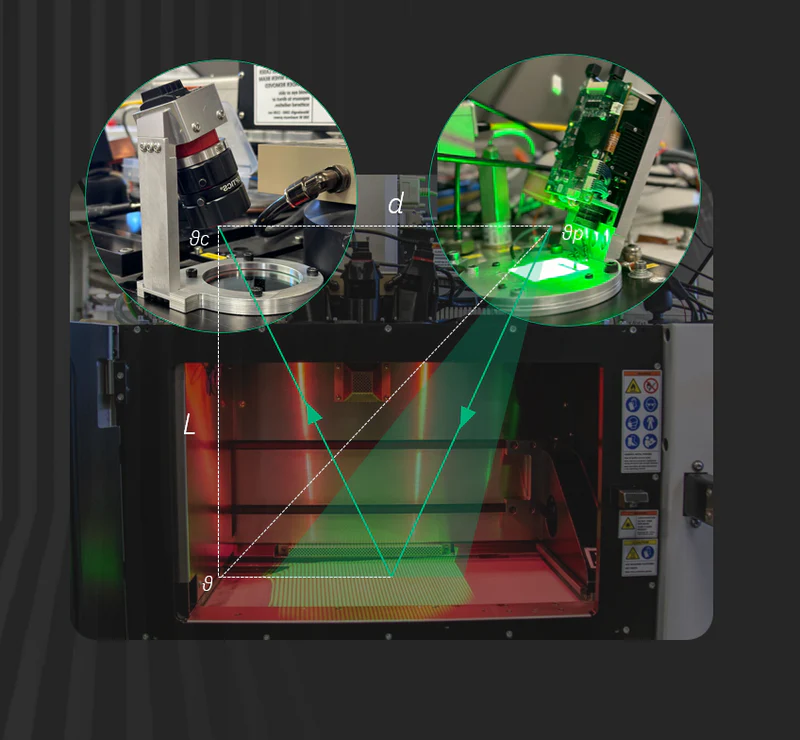
Phase3D’s Fringe Inspection system projects structured light onto a build surface to measure geometry and detect deviations during printing. Image courtesy of Phase3D.
A specific problem that Phase3D will help solve is that CMCs are not more widely used because “Air Force sustainment and production environments because conventional non-destructive evaluation (NDE) methods, developed largely for metals and polymer composites, cannot reliably detect the matrix cracking, fiber pull-out, porosity, and delamination that can occur throughout CMC fabrication.”
Matrix cracking occurs when different rates of thermal expansion between the materials used cause the matrix to deform and crack as it cools. Porosity is an issue, especially during the pyrolysis step, when air voids in the part can cause it to fail unpredictably. Fiber pull-out is important because it prevents emerging cracks from propagating, deflecting energy into the surrounding area or along the fibers so that the entire part doesn’t fail catastrophically. When printing, you can cut these fibers or damage their coating; your fibers may not be positioned well or be too short to achieve the desired effect. This pull-out mechanism is one of the main advantages of continuous carbon fiber 3D printing over other processes that may damage fibers or only work with short carbon fibers. Curious about why Continuous Composites keeps suing everyone? This is why.
Beyond this, getting this right is kind of a Goldilocks problem, in that it would require a lot of testing to validate and determine the ultimate length and placement of the fiber for each geometry and use case. Fiber pull-out is the same effect that makes Kevlar vests work. There, the bullet impacts the composite, pulling the Kevlar fibers from the resin itself. That spreads the force of this very localized high-speed impact across the vest, saving the wearer. Bamboo is another example, it is in effect a composite of cellulose fibers in lignin.
Meanwhile, delamination can occur as gases escape during pyrolysis, as parts cool, or during post-processing. This is a later-stage failure, so it is expensive and needs to be caught, and the part needs to be completely remade. If Phase3D could be used to ameliorate these defects or speed up the process overall, it would be very useful indeed. Phase says that during CMC production, defects can be introduced at nearly every stage, from tape fabrication and ply stacking through autoclave consolidation, pyrolysis, melt infiltration, and final machining. And this will be key to saving a lot of time in experiments and production.
Phase3D will be deployed by the Air Force Life Cycle Management Center’s Propulsion Directorate (AFLCMC/ROD) and Rapid Sustainment Office (AFLCMC/RSO) as well as the Air Force Research Laboratory‘s Materials and Manufacturing Directorate (AFRL/RX). The company will “develop material-specific calibration routines, anomaly-classification models, and validation protocols that allow Fringe Inspection to identify surface deformation and defect signatures as CMC parts are built, rather than waiting for post-process CT scanning or destructive sectioning.” Reducing CT time and finding out when and where problems occur will also be huge time-savers for the folks experimenting with making these materials. Especially with different fibers, coatings, fiber lengths, and placements, there could be significant effects on performance and failure modes.
Phase3D CEO Niall O’Dowd said,
“Fringe Inspection was built to answer one question in real time: is the part you are building the part you designed? We’ve spent years proving that out on metal parts for NASA, the Air Force, and leading aerospace primes. This program lets us ask the same question of a completely different material system, one the Air Force is counting on for the next generation of propulsion and thermal protection, and where the cost of finding a defect after the part is finished is even higher than it is in metal.”
For now, in Phase I, the team will look at using CMC in production and how it could be deployed, working with partners such as the Oklahoma City Air Logistics Complex (OC-ALC) and Ellsworth Air Force Base.
Applications Engineering Manager, Andrew Holiday said,
“Ceramic matrix composites are notoriously hard to qualify because so much can go wrong across so many stages, from tape fabrication all the way through infiltration and final machining. The industry has been trying to solve that with post-process CT scans and destructive testing, the same approach that used to hold back metal additive manufacturing. Real-time, layer-by-layer visibility is exactly what this material needs, and it is exactly what Fringe Inspection already does.”
This is a great move for Phase3D and positions them at the forefront of the development and industrialization of a key material family. CMCs could solve many problems at scale for the Air Force, and if Phase3D helps them accelerate their research, the company will be well positioned for growth and staying power in this segment.
Subscribe to Our Email Newsletter
Stay up-to-date on all the latest news from the 3D printing industry and receive information and offers from third party vendors.
Print Services
Upload your 3D Models and get them printed quickly and efficiently.













You May Also Like
AM Investment Strategies 2026 Sets the Stage for AMS 2027
AM Investment Strategies 2026 Nov. 5 · 12 p.m. ET · Free online event RESERVE YOUR SPOT ↗ A one-hour online discussion featuring some of the biggest names in 3D...
With Its Latest $200M Round, ICON May Be Running Away With the 3D Printed Construction Market
I used to view ICON, the Austin-based additive construction (AC) firm, as one of a handful of companies that could realistically consider itself the leader of the 3D printed construction...
How Should Businesses Build New Business? Dirk Simon Weighs In — Part 1
Dirk Simon had deep experience in materials and chemistry before joining the 3D printing industry. Instrumental in BASF and Farsoon’s market introduction, Dirk has spent a lot of time thinking...
3D Printing Services Near $2.5B as AM Market Shifts Beyond Hardware
The additive manufacturing market may be growing again, but one of the more interesting numbers behind that recovery has little to do with selling 3D printers. AM services generated nearly...