Continuous Composites Receives $17M for Carbon Fiber 3D Printing


Shortly on the heels of launching a lawsuit against competitor Markforged, Continuous Composites has closed a $17 million Series A financing round. Led by B. Riley Financial subsidiary B. Riley Venture Capital (BRVC), this is the Idaho startup’s fifth funding round, bringing it to a total of $20.7 million in financing. Previous capital has been received by materials developer Arkema and centuries-old construction materials giant Saint-Gobain.
Continuous Composites says that the funding will aid in bringing its proprietary Continuous Fiber 3D Printing (CF3D) technology to market while “advancing and protecting its patent portfolio”. In other words, it sounds as though some of these funds will be used in its lawsuit against Markforged, the first to commercialize the 3D printing of continuous reinforcement fibers, but perhaps not the first to patent it?
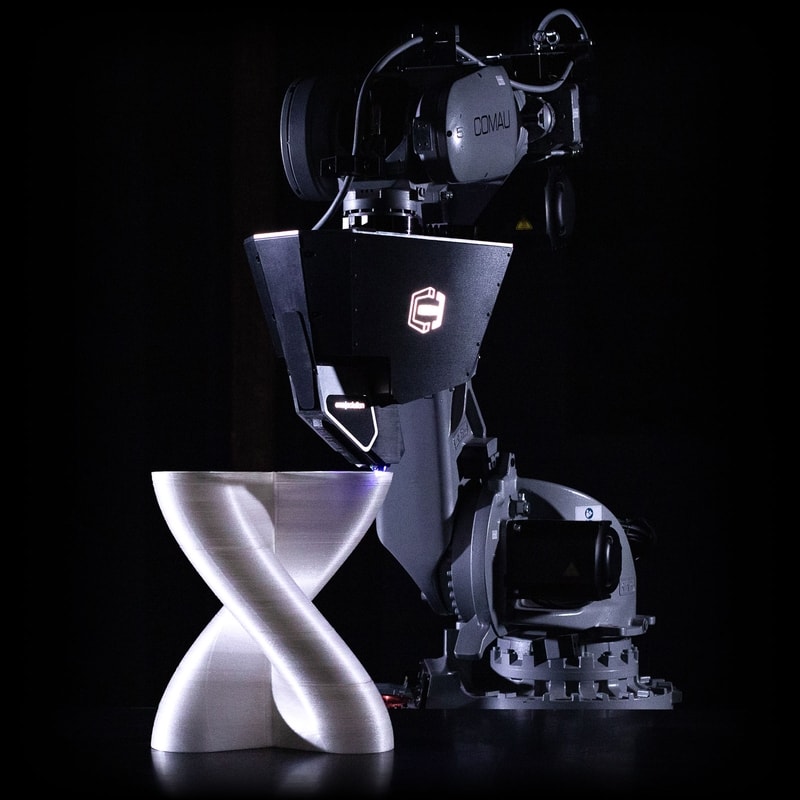
Continuous Composites’ continuous reinforcement fiber 3D printing process. Image courtesy of Continuous Composites.
CF3D is a unique technology that feeds continuous reinforcement fibers into a 3D printing head, where it is saturated with a photopolymer matrix material. As it exits the printhead, it is cured in place. The technology has been shown mounted to industrial robotic arms capable of 3D printing materials in mid-air. In addition to 3D printing with a variety of materials, the company is able to embed electronics and other functional items into the prints as they are built. This has fueled Continuous Composites’ work with the U.S. Air Force.
Todd Sims, BRVC President, will be joining the board of the startup. About the company, Sims said, “We are thrilled to partner with Tyler and the entire Continuous Composites team as they bring their disruptive technology to the market. We were drawn to Tyler’s vision and leadership, the attractive revenue and margin profile of the business, and their blue-chip customers, both industrial and governmental, which we see as clear validation of the CF3D technology.”

Image courtesy of Continuous Composites.
It will be exciting to see how the startup’s technology is used by customers when it finally makes it market officially. It will have a growing number of savvy competitors to fight against, in addition to Markforged, including Arevo, Impossible Objects, CEAD, Fortify, Anisoprint, and 9T Labs. Given that it may have the earliest patent on continuous carbon fiber reinforcement for 3D printing, does that mean that some of these businesses will have to look over their shoulders? If it targets Markforged on the desktop, will it also target Arevo for large-format continuous carbon fiber 3D printing?
Subscribe to Our Email Newsletter
Stay up-to-date on all the latest news from the 3D printing industry and receive information and offers from third party vendors.
Print Services
Upload your 3D Models and get them printed quickly and efficiently.













You May Also Like
Creality K3 Opens for Pre-Order at $849, Advancing Multi-Color 3D Printing
Creality has officially opened pre-orders for the Creality K3, its latest flagship K Series 3D printer, starting at $849 in the United States. Recognized as an IFA Innovation Awards 2026...
Prusa Core One L+: A Worthy Upgrade?
Disclosure: The Core One L+ was provided to me by Prusa3d free of charge for the purpose of this review. I have not received any other compensation. All opinions expressed...
Prusa Upgrades Its Lineup with CORE One+ (Gen 2), CORE One L+, and XL+
Prusa Research has updated its high-end desktop 3D printer lineup. The company is offering new and improved versions of the machines it targets at industrial and power users, with the...
Zaha Hadid Architects Print 6M Model with WASP’s Robotic Arm Solutions
Zaha Hadid Architects (ZHA) have successfully used WASP 3D printers to make a 6-meter-tall model of an aircraft control tower. Zaha Hadid Architects’ Tech Lab made the tower in-house for the ZHAviation...