Can Metal Recycling Help Scale Additive Manufacturing? Continuum and AM Research White Paper Takes a Look


Metal additive manufacturing (AM) is growing, but making more parts also means using more metal powder. That raises a simple question: where will all that material come from?
A new white paper from Continuum Powders and Additive Manufacturing Research (AM Research) argues that recycling will have to become a much bigger part of the answer.
Titled Metal AM at Scale: The Closed-Loop Materials Era, the free white paper looks at how metal AM can grow while manufacturers face pressure to lower costs, secure critical materials, and reduce their dependence on fragile global supply chains.
The numbers help explain why this matters. According to the white paper, the value of metal 3D printed parts grew from just under $3 billion in 2016 to more than $8 billion in 2025. As that market grows, demand for the metals used in those parts increases with it. At the same time, many of the industries adopting metal AM the fastest, including aerospace, defense, and energy, rely on high-value materials that can be expensive and difficult to source.
So instead of treating metal scrap as waste, manufacturers can recycle it and turn it back into powder for AM. Continuum has built its business around this approach. The Houston-based company uses its Greyhound Melt-to-Powder (M2P) technology to turn metal feedstock, including recycled material, into spherical powder for advanced manufacturing.
For metal AM, recycling can also help with costs and material supply. Recycling metal locally can also help manufacturers secure the materials they need, especially as the U.S. looks to bring more manufacturing back home and rely less on foreign sources of critical metals.
The white paper looks at this connection between metal AM, recycling, and supply chains. Among the topics covered are cost efficiency, supply autonomy, high-value materials for strategic industries, defense manufacturing, and the move toward closed-loop production.
The numbers also start to look different as AM moves into higher-volume production. When companies are making fewer parts, recycling powder may not have a big impact on costs. But as production grows, the amount of material being used grows too, making material costs much more important.
Companies like Siemens Energy are already working this way. Continuum has worked with Siemens Energy to turn high-value metal scrap back into powder for AM. Instead of throwing that metal away and buying new material, it can go back into the manufacturing process.
From Metal Scrap to High-Temperature Parts
A companion webinar takes a closer look at one area where these materials could be used. Held on August 6, The Future of High-Temperature Superalloys was presented by Continuum in partnership with 3DPrint.com and featured experts from AmPd Labs and Continuum. While the live event has ended, the full webinar is now available to watch on demand.
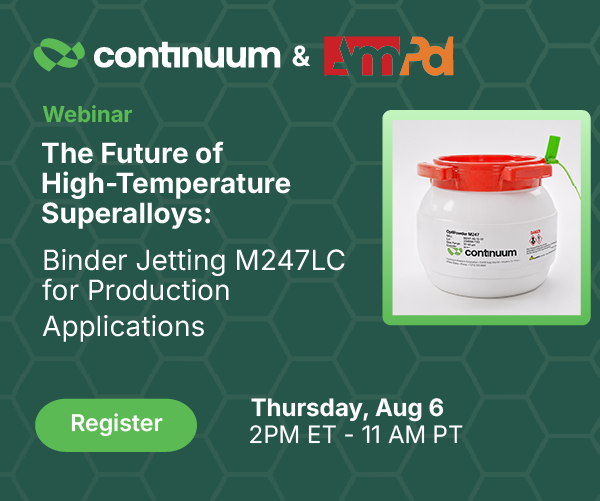
Continuum Webinar. Image courtesy of 3DPrint.com
Much of the discussion focused on MAR-M 247LC, a nickel-based superalloy used in demanding applications such as aerospace propulsion and energy systems. Traditionally, parts made from materials like MAR-M 247LC have mostly been made using investment casting. That process can involve tooling and long lead times. AmPd Labs and Continuum are instead looking at whether binder jetting can provide another way to manufacture these parts.
During the webinar, Tim Neal, CEO of AmPd Labs; Sean Harkins, Co-Founder and Chief Operating Officer of AmPd Labs; and Dr. Sunil Badwe, Vice President of Research and Development at Continuum, discussed recent work with binder-jetted MAR-M 247LC.
That includes mechanical testing comparing binder-jetted material with conventionally cast material, as well as the material science behind processing the alloy and the work still needed to qualify it for production.
The potential is important because high-temperature superalloys are exactly the type of high-value materials where reducing waste and creating more secure sources of feedstock could make a difference.
If binder jetting can produce these materials at the required performance levels, manufacturers could have another option for making critical components while reducing some of the tooling, lead times, and supply chain constraints associated with traditional manufacturing.
This ties back to the main point of the Continuum and AM Research white paper. Scaling metal AM is not just about adding more printers. Manufacturers also need a reliable and affordable supply of materials. Recycling valuable metals and putting them back into production could help make metal AM work on a much larger scale.
The free white paper, “Metal AM at Scale: The Closed-Loop Materials Era,” can be downloaded from AM Research.
The companion webinar, The Future of High-Temperature Superalloys, is also available to watch on demand.
Subscribe to Our Email Newsletter
Stay up-to-date on all the latest news from the 3D printing industry and receive information and offers from third party vendors.
Print Services
Upload your 3D Models and get them printed quickly and efficiently.













You May Also Like
50,000 Orders and Counting: EPlus3D & Chinese AM Services Provider Are Scaling Liquid Cooling Solutions for AI Servers
An under-appreciated story driving the additive manufacturing (AM) industry this year has been the divergence between what’s driving the market in China and what’s driving it everywhere else. Let’s start...
Additive Manufacturing Has a Major Growth Opportunity; Trust Will Decide Who Captures It
After years of overpromising, the next phase of AM growth will be won by companies that consistently deliver what they say. When I entered additive manufacturing in 2014, after 15...
Seven Trends Reveal What’s Next for 3D Printing at TCT Shenzhen 2026
TCT Shenzhen 2026 opened on October 14 in Hall 15 of the Shenzhen World Exhibition & Convention Center in Bao’an, and ran through October 16. The event brought together equipment...
AM Investment Strategies 2026 Sets the Stage for AMS 2027
AM Investment Strategies 2026 Nov. 5 · 12 p.m. ET · Free online event RESERVE YOUR SPOT ↗ A one-hour online discussion featuring some of the biggest names in 3D...