50,000 Orders and Counting: EPlus3D & Chinese AM Services Provider Are Scaling Liquid Cooling Solutions for AI Servers

An under-appreciated story driving the additive manufacturing (AM) industry this year has been the divergence between what’s driving the market in China and what’s driving it everywhere else. Let’s start with everywhere else, where we know the big driver has, yet again, been defense. That story is more than familiar enough.
Chinese AM companies, on the other hand, can’t stop boasting about what they’re doing for AI hardware and consumer electronics, with the latter category dominated by applications for smartphones. This may just be good marketing, but it’s effective. Moreover, the way that the Chinese government acts as a kind of board of directors for the collective Chinese economy means that companies in China have a knack for organizing around a specific goal and then scaling it into existence. So, if manufacturers in China are talking about something, it’s often only a matter of time before they achieve it.
EPlus3D, for instance, says it has 50,000 orders for liquid cooling components for AI servers. (If you don’t know why the AI buildout is catalyzing demand for liquid cooling solutions, you should purchase this report. In fact, even if you do know why, you should purchase it.) I recently wrote about why the AM industry should care about the Schneider Electric acquisition of PTC, and what EPlus3D is doing is a perfect example of why the AM industry should care: AI liquid cooling has very quickly gone from being a realistic forward-looking opportunity to being a source of revenue derived from actively fulfilling B2B orders.
Indeed, EPlus3D said it delivered its first components in August, that its partner, Toptra Laser Technology in Hangzhou, has three dedicated production lines for the components comprised of 15 machines, and that this allows it to produce 1,000 components a month. Toptra Laser Technology has ordered five additional machines to keep up with demand.
I don’t know if EPlus3D has other manufacturers making the components as well, or if it’s also making them itself. This is an important question because even with the additional machines, Toptra would presumably only reach a production capacity of around 1,300 units per month, unless there’s a plan to scale up production further on the existing machines. (I also don’t know if the orders are going through EPlus3D or through Toptra, but that’s less relevant here.)
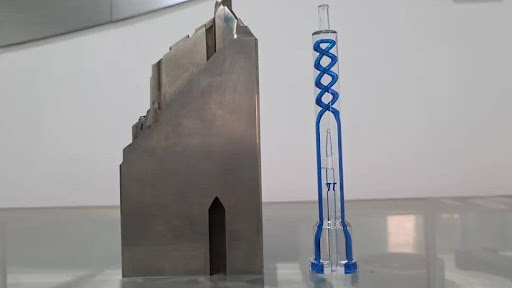
Complex liquid cooling components produced by Metal PBF.
The point is that if EPlus3D is an indicator of the broader market, and if I’m interpreting the production-capacity angle correctly, it seems there are already significant backlogs for these components. This would accord with what’s being reported about the broader market landscape in AI power and thermal solutions, and would also accord with what we wrote in the AM Research data centers report: that by 2033 the needs of the AI cooling market could require as many PBF machines just for that purpose as are already installed globally for all purposes.
Additionally, that reinforces what I wrote in my post about how China should focus on directing the capabilities of its overall industrial base towards domestic consumption rather than toward exports. While AI cooling hardware is in the B2B category, AI usage as a form of retail consumption is a major component within China’s plans to increase domestic consumer spending through 2030. That’s both in direct spend on AI subscriptions and in the demand it stimulates for Chinese smartphones.
On top of that, there are similar skill sets and production infrastructure involved in producing thermal solutions for the AI market that overlap with those used to produce consumer electronics. This is perhaps the most important aspect to keep in mind, and is also the one people seem to lose sight of the most, especially people who are prioritizing defense manufacturing at the expense of everything else.
We’re already seeing the AM industry in the West trend towards creating dedicated production hardware and infrastructure ecosystems to service the defense market, which would simply repeat the same pattern that, starting in the 1980s, led US industry to lose its lead in machine tool manufacturing to Japan and Germany, a position that it has never recovered from. A big selling point for AM was supposed to be the versatility of production capacity, represented by machines that could be used for many different purposes.
While it’s unrealistic to think that, in practice, a manufacturer could use one of its machines for any conceivable purpose on any given day, certain markets still share more similarities than others, like AI and consumer electronics. The defense sector’s needs also call for machines that are relevant to other markets, especially energy. The idea of a machine that can make anything at any moment may be impractical; however, a machine that can produce for more than one industry but is limited to just one suggests a lack of imagination. The AM industry would do well to find a sweet spot somewhere in the middle.
Images courtesy of EPlus3D
Subscribe to Our Email Newsletter
Stay up-to-date on all the latest news from the 3D printing industry and receive information and offers from third party vendors.
Print Services
Upload your 3D Models and get them printed quickly and efficiently.












You May Also Like
Seven Trends Reveal What’s Next for 3D Printing at TCT Shenzhen 2026
TCT Shenzhen 2026 opened on October 14 in Hall 15 of the Shenzhen World Exhibition & Convention Center in Bao’an, and ran through October 16. The event brought together equipment...
Beyond the Printer: HP and DyeMansion Tackle the Future of Prosthetics
Making a custom orthotic or prosthetic device involves much more than producing the final part. Patients need to be measured, devices must be designed to fit their bodies, and finished...
Oerlikon Adds ATLIX’s xBUILD 5000, Plans More for 2027
Oerlikon has installed a new ATLIX xBUILD 5000 metal 3D printer at its facility in Huntersville, North Carolina, marking the first production deployment of the system worldwide. The machine will...
10 Years of Multi Jet Fusion: Onsite at HP’s Vancouver, Washington Facility
At this year’s RAPID event in Boston, HP Additive Manufacturing Solutions celebrated ten years in the additive manufacturing (AM) market. The company ushered in the milestone with several innovations, including...