The Two Paths to AM Print Services Market Growth


New market research: AM Research is building its new Additive Manufacturing Services Market 2.0 model.
Things continue to heat up in the world of additive manufacturing (AM), and many of the “roads” to growth lead to the print services market. As we’ve covered in two recent articles, this is a segment of the market we are dedicating a lot of our research to in the fourth quarter of the year, and we expect it to drive the market in a big way over the next two years (or more).
Within the AM print services sector, it’s easy to lose track of everything happening and all the competitive ins-and-outs, niche regional market players, and what developments are actually moving the industry forward. The way we see it at AM Research, there are two paths to market growth in the services sector—and both are happening simultaneously. This tandem development is one of the main reasons we are projecting the services market to grow by more than three times its current size (estimated around $10 billion worldwide) over the next decade.
Growth Through Expansion in New AM Users
Manufacturers and other entities that need parts made often turn to service bureaus to get their AM plans off the ground, rather than figuring out the pitfalls of in-house AM production. Making prototypes in-house with 3D printing is easier and more cost-effective than ever, but the “rapid prototyping” business model has existed for decades in the printing segment as a streamlined way to meet these needs.
Many service bureaus have reported lower prototyping activity in certain industry segments over the last couple of years due to macroeconomic challenges impacting the pace at which new products are being designed and introduced. Still, really, much of this phenomenon can be explained by simply easier and more cost-effective access to 3D printing for prototyping by manufacturers themselves, thanks to the rise of the “cheap and good” polymer material extrusion printer.
So if manufacturers relatively new to AM aren’t as likely or as incentivized to use a service bureau to make prototypes today, how could the AM services market grow through an expansion in the number of new AM users?
One explanation we can credit is that the underlying technical ecosystem of AM is maturing. It is now allowing print services companies to better target new customers not with just “parts” used for basic early-stage prototypes, which can now easily and cheaply be done in-house, but more readily and smoothly onboard these same customers with bridge and even longer-term production of truly finished, production-grade parts. Even if a part’s design or requirements change slightly as projects mature, service bureaus are better equipped than ever to meet the needs of manufacturers moving into AM for more serious production. And more importantly, service providers can do this for different customer types, not just one industry.
This is happening as gaps in the AM production ecosystem continue to be filled. Better post-processing and finishing technologies, greater automation for AM printers, and software that can orchestrate and connect more parts of the necessary processes to deliver a final part. We recently wrote an article about how Oerlikon is expanding its production capacity with a new ATLIX metal powder bed machine, and how the diversity of systems in its metal services operations allows them to serve more customer types.
In the railway and robotics industries, this is pretty obviously playing out right in front of us. These two aren’t exactly the leaders in additive manufacturing historically, but now, as the underlying structure of additive has matured both technologically and in stability, service partners look like an attractive option for companies that need real parts, in varying capacities, with both speed and flexibility. In robotics, Protolabs is capitalizing on changing industry dynamics incentivizing domestic production. In railway, Stratasys Direct Manufacturing is leveraging new options for qualified materials for train transportation integrators to keep trains in service more cost-effectively.
Print services marketplaces like Xometry, Craftcloud, and Hubs have all seen strong growth over the last year. In an interview with Craftcloud, its ownership suggested that its success has largely come from interest from those getting into additive manufacturing for the first time, but not necessarily for prototyping. This stands to reason, because marketplaces that don’t own the means of production and instead connect AM producers to customers who need parts are less likely to see large production-scale projects flow through a marketplace, which brings us to the other path to growth in the AM services market.

SmarTech Analysis Executive Vice President of Research Scott Dunham.
Scaling Production with Established Users
There’s also a major movement afoot in the additive market for scaled production of parts in increasingly large volumes. There’s all kinds of activity in this area today, from consumer electronics parts to defense contracts for submarine parts, suppressors, drones, and much more. This path to growing the print services market leverages the increasing capabilities of businesses acting as ‘additive contract manufacturers’ to provide access to stable, quality production services using AM technologies in a big enough way to support big-time manufacturing. It’s one thing to make small runs of parts and one-offs used in a production sense as a “real” part, but another to provide these final parts in large numbers to support big contracts or commitments.
The AM services market seems also increasingly well positioned to capitalize on the needs of those “power users” who may not be up to tackling the challenge of scaled AM production themselves.
The team at 3DPrint.com has covered several examples that seem to support the idea that, as a whole, AM service providers are becoming better equipped to handle and nurture market growth from large, scaled production opportunities. These include ADDMAN’s recent powder supply agreement with 6K Additive for Inconel 718 powder, totaling nearly $10 million over more than two years. Deals like this are only made when large-scale projects need the raw materials to make them happen.
We also seem to be awash in defense-sector news items and deals that suggest big AM contract manufacturing services stand to grow significantly. This isn’t necessarily contained just to the U.S. or China either; AM service provider Lincsolutions recently reported that it estimates 2026 and 2027 revenues will double each consecutive year thanks in part to contracts like its recent one with Hanwha Aerospace for AM space components. This would presumably take Hanwha from about $10 million in revenue in 2025 to $20 million and then $ 40 million by the end of 2027.
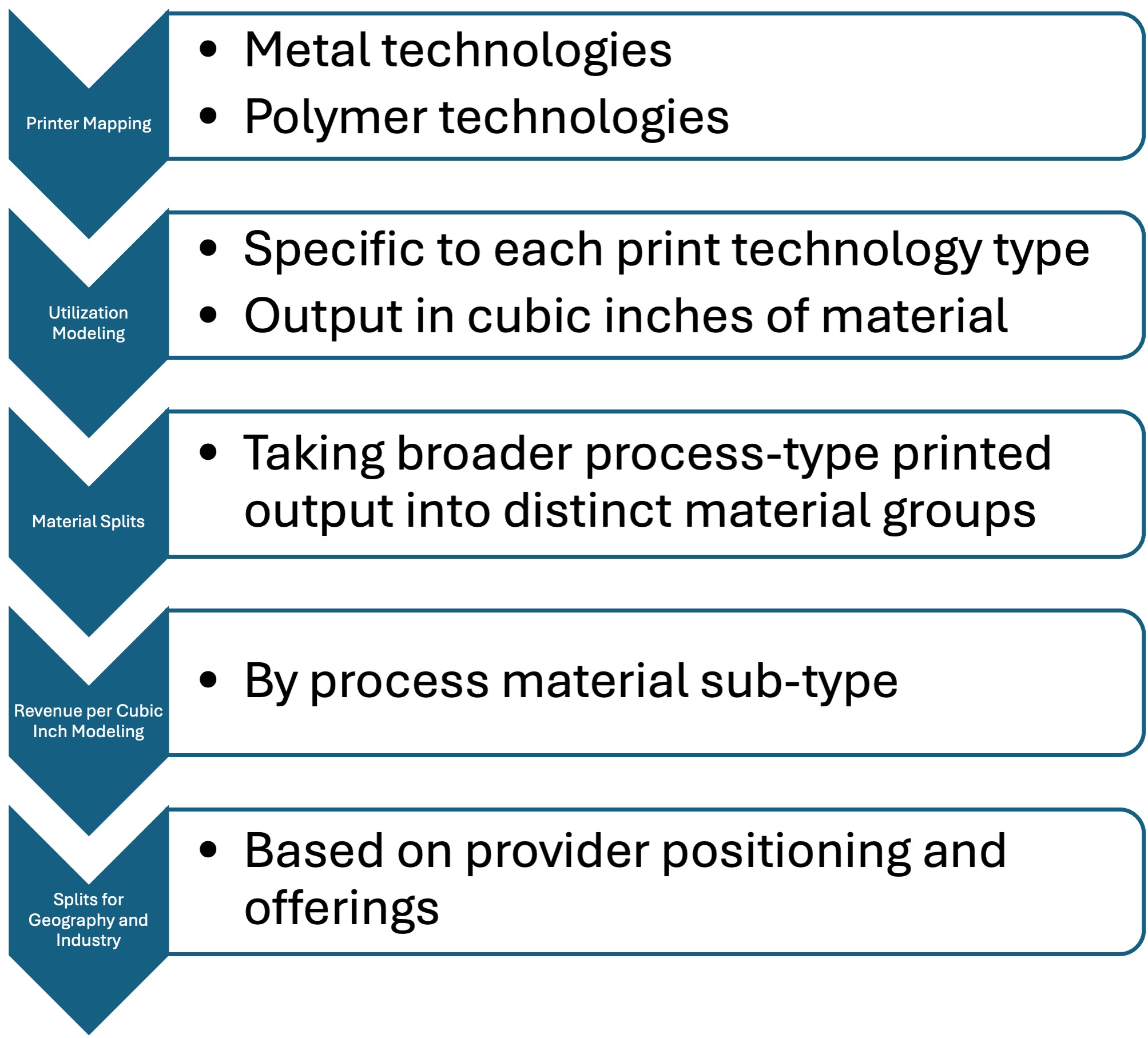
Visualization summarizing the logical flow of the Services 2.0 model. Image courtesy of AM Research.
AM Services Growth Strategies Based on Market Trends
Our upcoming major market advisory report on the additive print services market encompasses our research efforts in this area to help companies build strategies aligned with market realities. Opportunities exist to build a business aligned with either of the two growth paths, and both appear valid, with growth backed by real evidence.
However, capitalizing on that growth isn’t necessarily easy, and requires thoughtful planning and information, which is part of the ‘why’ behind our upcoming study and market modeling project.
We can already see some strategic takeaways forming, even at this relatively early stage of our research. Each of the two growth drivers in the market can be characterized by different end customer needs and demand dynamics.
In the “early-stage user” growth path, we expect that a particular business model would be more advantageous, aligning with the common theme of needing a broad set of possible additive solutions, as well as the ability to fully take each one of those possible solutions beyond just prototypes and into the area of parts truly capable of serving a production purpose. This growth area will continue to demand relatively high mix, and maybe at best only medium volumes, and will leverage the ability to get good parts into users’ hands quickly while staying ready to adapt to an ongoing state of uncertainty that has plagued many industries over the past six years.
This means the classic rapid prototyping business model is still somewhat relevant, at least in its dynamic nature. But it needs to evolve to reliably and cost-effectively produce functional parts that can withstand the rigors of use across a variety of industries. Parts that are ‘good enough for a prototype’ will no longer get the job done, and this adds a significant layer of complexity for many existing players in this niche.
In the “scale production” growth path, it’s obvious that contract manufacturers that are adept in additive technologies, and also have industry-specific expertise and connections, will be in high demand. Existing contract manufacturers can’t just add additive machines and assume their traditional manufacturing solutions can complement them. They also need some degree of additive-specific application development skills to fully create efficiencies of scale at cost levels that make the projects work in the first place.
Here, we see AM specialists who have developed real industrial systems powered by specially designed additive parts and materials – such as additive heat exchangers, or additive jet propulsion, and so on – have an opportunity also to become a service provider for other manufacturers or government organizations to be able to leverage both expertise and production capacity at scale.
AM Research is currently building its new Services Market 2.0 model, with the final report and model data expected later this year.
Print service providers and other industry stakeholders interested in contributing to the research are encouraged to contact AM Research here: info@additivemanufacturingresearch.com
Preorder by November 1st to receive the current discounted rate. After that, the preorder price increases.
Learn more about the AM Services Markets 2026–2035 report and preorder →
Subscribe to Our Email Newsletter
Stay up-to-date on all the latest news from the 3D printing industry and receive information and offers from third party vendors.
Print Services
Upload your 3D Models and get them printed quickly and efficiently.












You May Also Like
Oxidation Used to Create Self Lubricating CCA’s
Oxidation affects many substances but can also be beneficial. Aluminum, for example, forms a passive oxide film that helps it resist seawater. NAB is often used in ships and forms...
3D Printing News Briefs, September 26, 2026: Bioceramic Implants, 3D Concrete Printing, & More
In this weekend’s 3D Printing News Briefs, we’ll start with an integration between PanOptimization and AMCM, before moving on to healthcare news from KLS Martin and Lithoz, and then UltiMaker...
Malping Wants to Offer FGF PEEK as a Service
Germany-based Malping, located in Neuhausen auf den Fildern, is moving into more high performance materials for Material Extrusion. The service operates FGF and FDM high-temperature material printers, and offers parts,...
Why Beam Control Could Redefine the Future of EB-PBF
In Part 1, Ulf Lindhe examined how advances in beam control, point melting strategies, and process monitoring are changing the way engineers think about electron beam powder bed fusion (EB-PBF)....