Material Hybrid Manufacturing is 3D Printing Conformal Batteries for Drones


Since the beginning of the decade, it seems like at least once a year, there will be a story about VC funds pouring money into some previously unknown startup that has figured out a new way to 3D print batteries. So far, from what I can gather, there still hasn’t been a ton of commercial success for any of the companies claiming to have hit the nail on the head with their respective proprietary processes. But it’s easy to understand why the dream persists: if you could use additive manufacturing (AM) for batteries, it would open up a wholly new frontier for supply chain autonomy.
Yet, there’s good reason to hope that the latest company in the spotlight for its AM battery process may have differentiated itself with its core value proposition. Material Hybrid Manufacturing was co-founded by Gabe Elias — also the company’s CEO — whose work for both legacy (Mercedes) and disruptor (Rivian) auto brands taught Material what it shouldn’t be trying to print.
After initially planning to target the EV space, Elias and the rest of the Material team quickly realized that car batteries don’t provide the best opportunities for leveraging AM’s advantages. The conformal geometries that can be achieved with the company’s Hybrid3D platform simply aren’t necessities for spacious automotive bodies. On the other hand, objects that tend to come in much smaller packages, like drones and wearables, represent the perfect product-market fit for what the Hybrid3D can do.
At the beginning of January, Material raised $7.1 million in a seed round, not long after receiving a $1.25 million Air Force contract. The company will work with Performance Drone Works to demonstrate a proof-of-concept that Material claims can increase energy density by 50 percent, enabling users with the flexibility to either increase flight range or decrease the weight of the battery pack.
In an article in IEEE Spectrum, Elias explained, “Things are shrinking, so we’re shrinking around it. Electronics are becoming embedded, consolidated, optimized, and batteries are the only part of the equation that’s being left behind.
“We’re turning energy storage into a subsystem, just like all the other subsystems…The more complex the pack, the more value we capture from part consolidation and system integration, so those applications actually carry higher margins for us.”
What Material Hybrid Manufacturing is doing reminds me a bit of Kupros, Inc., whose founder, Ian Ramsdell, I interviewed at the end of last year. As Ramsdell told me last year about his company’s unique metal filament that’s compatible with cheap desktop machines, “The best part of what we do, for me, is that by opening up the design possibilities, we’re ultimately opening up the design imagination of the end-users, as well.”
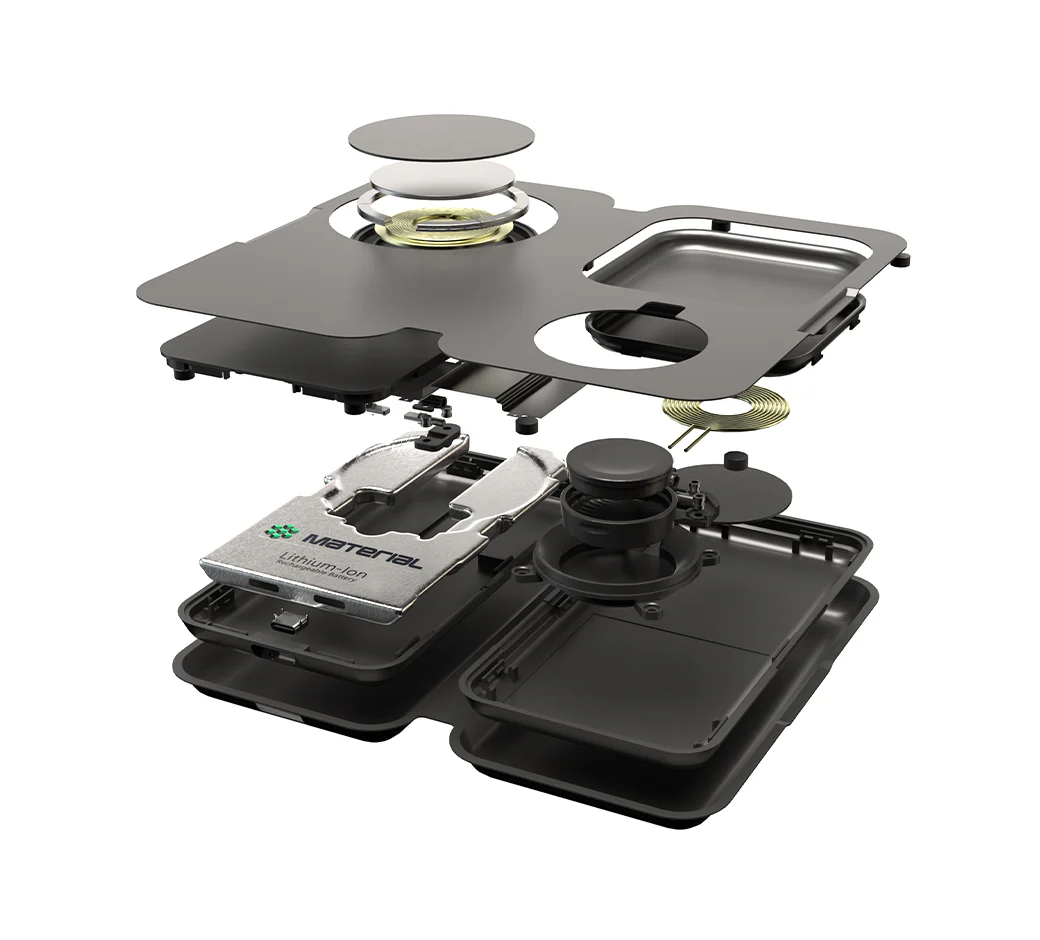
Image courtesy of Material and Nimble
Material seems to be doing much the same with its tech, and it’s worth pointing out that the company is already succeeding with some commercial applications, including foldable chargers that Material made in partnership with tech accessory brand Nimble. This is precisely the sort of activity the Pentagon wants to see from the emerging generation of dual-use startups garnering R&D contracts.
If Material is able to translate its tech into a deployable platform, the company could provide one of the last missing pieces of the puzzle needed to truly scale the U.S. military’s autonomous frontline drone production ambitions. Even without ruggedized Hybrid3D systems, though, Material’s business model has the potential to significantly enhance the Pentagon’s ability to build up the capacity for domestic drone output.
Going back to the idea of changing how product designers think, the greatest changes in the drone market in the near future may come on the civilian side. Given how untapped this market still is, we can expect new ideas to come and go at a rapid pace throughout the rest of the 2020s, as consumer preferences determine the trajectory of a new industry in real time. The ability to print conformal batteries at scale could become a pivotal factor in deciding how that story unfolds.
Featured image courtesy of Material Hybrid Manufacturing
Subscribe to Our Email Newsletter
Stay up-to-date on all the latest news from the 3D printing industry and receive information and offers from third party vendors.
Print Services
Upload your 3D Models and get them printed quickly and efficiently.













You May Also Like
3D Printing News Briefs, October 10, 2026: Drones, WAAM, Ceramics, & More
We have a packed 3D Printing News Briefs for you this weekend! First, America Makes celebrated the recent National Manufacturing Day with 3D printed drones, and then it’s on to...
3D Printing News Briefs, October 3, 2026: Hypersonics, Hotends, & More
We’re starting off with defense in this weekend’s 3D Printing News Briefs, as Titomic was awarded a $5 million U.S. defense contract, and VulcanForms announced a partnership with Specter Aerospace...
The Part Is Only Half the Story: Why 3D Printing Needs a Digital Thread
A 3D printed part can generate a lot of information. The challenge is keeping track of it. Manufacturers need to know which design was used, what material went into the...
Advanced Manufacturing at IMTS 2026: 3D Printing and AI and Drones, Oh My!
Last week’s International Manufacturing Technology Snow (IMTS) in Chicago welcomed over 90,000 attendees to the jungle that is McCormick Place. With over 1.17 million square feet of exhibit space, and...