UAS Additive Strategies Shows How Fast Drone Manufacturing Is Changing


The recent UAS Additive Strategies online event, hosted by 3DPrint.com and Additive Manufacturing Research (AM Research), brought together leaders from across the additive manufacturing (AM) and drone industries to discuss one of the industry’s biggest challenges, how to manufacture drones at scale. Companies including EOS, HP, Prusa Research, Stratasys, Firestorm Labs, DrukArmy, and representatives from the U.S. Army shared how they see AM shaping the next generation of drone production.
One theme that came up during the event was that scaling drone production will require more than simply adding more printers or producing more parts.
“UAS leaders are borrowing from the automotive playbook. They’re looking at how the automotive industry achieved scale, precision, and repeatability, and asking how those same ideas can be applied to drones,” said David Krzeminski, Business Development Manager for Polymer at EOS, during the event’s keynote presentation. “Scale isn’t just about producing more parts. It’s multidimensional. Materials, software, manufacturing processes, and the broader ecosystem all need to work together to support drone production.”

David Krzeminski, EOS, during the UAS Additive Strategies online event. Image courtesy of EOS.
Kalani Ripley, Director of Additive Manufacturing for Defense at Prusa Research, said desktop 3D printers are also changing how manufacturers think about scaling production.
“One of the biggest advantages of additive manufacturing is flexibility. If one machine fails, you can swap it out and keep production running. Instead of relying on one large industrial system, manufacturers can add five, 10, 20, or even 100 printers as demand grows. For the cost of one high-end industrial machine, you can deploy around 40 production-ready Prusa printers,” Ripley pointed out.
That challenge is becoming more urgent as drone production grows. Scott Dunham, Executive Vice President of Research at AM Research, said production volumes are expected to grow dramatically over the next decade, creating new opportunities for additive manufacturing.
“In UAS, we’re talking about roughly 17 to 18 million drones being produced this year. That’s nearly 900 million parts, and we’re projecting that figure to approach 2 billion parts over the next decade,” Dunham said. “Geopolitical urgency, supply chain fragility, and regulatory uncertainty have all come together to make additive manufacturing a much more attractive solution than it was just a few years ago. Military adoption is fast-tracking additive manufacturing into the core of the drone market, but that’s important for the commercial sector as well because it establishes additive manufacturing in an entirely new way.”

Scott Dunham from AM Research during the UAS Additive Strategies online event. Image courtesy of 3DPrint.com.
As demand grows, speakers agreed that manufacturers will need production methods that can keep up with rapid design changes. Unlike many traditional manufacturing processes, 3D printing allows companies to update designs quickly without waiting for new tooling, making it well suited for drone production. Today, it’s already being used to manufacture end-use airframes, housings, brackets, ducts, sensor mounts, RF components, and lightweight structural parts.
Emily Levin, Unmanned Systems Application Engineer at HP, said the company has seen that transition firsthand: “We saw early on that additive manufacturing would play a critical role in drones, so we built a dedicated UAS team to work closely with the industry,” Levin said. “Today, more than 30 OEMs are producing drones with HP technology, and we’ve gone from getting airframes into people’s hands to helping manufacturers scale to tens of thousands of drones. It’s not only possible—it’s commercially viable.”
That rapid growth is also changing how drones are developed. Joris Peels, Executive Editor and Vice President of Consulting at 3DPrint.com and AM Research, said the industry has moved beyond simple innovation and into rapid product development.
“Ukraine will probably make around eight million FPV drones this year. Costs have fallen from about $2,000 to roughly $180. That’s not just innovation anymore. It’s product development,” Peels said. “We’re seeing drones being developed for specific targets, specific ranges, and specific payloads. It’s really product development and market segmentation happening in real time.”
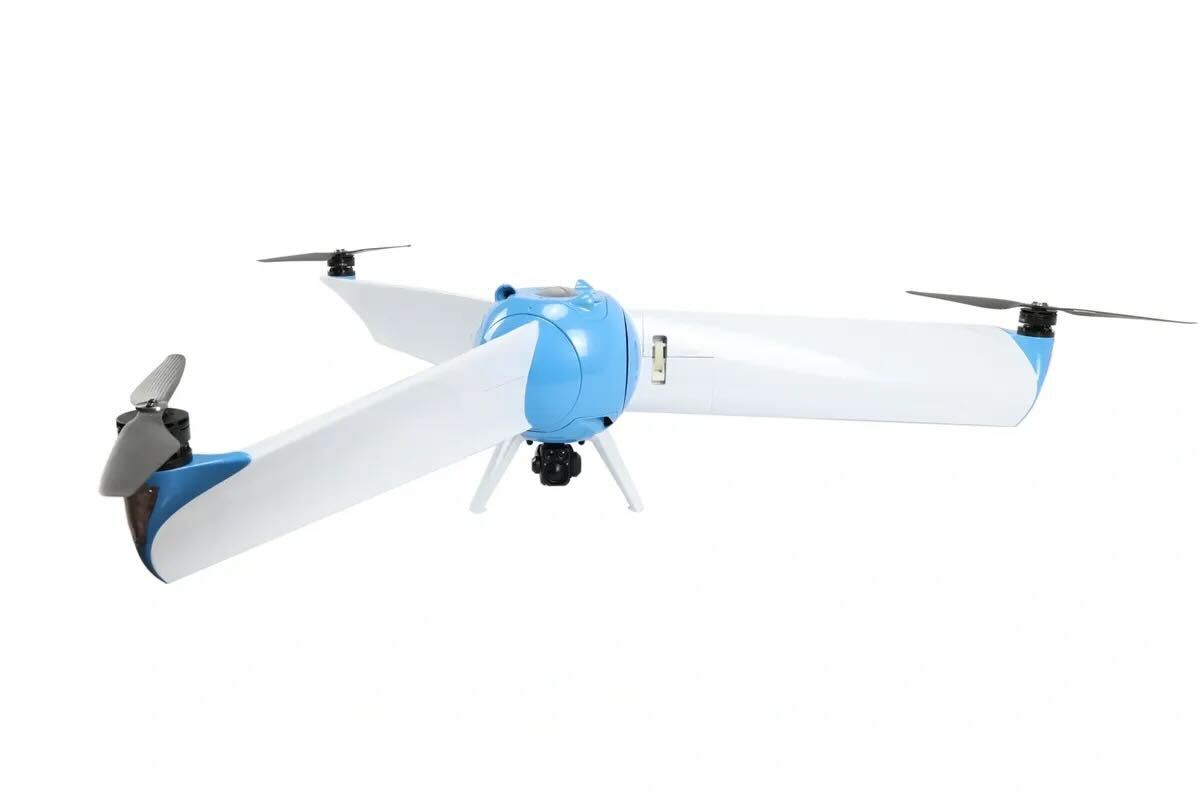
Trio is the first commercial spinning-wing UAV with vertical take-off and landing capability, with up to two hours of stable hover. Image courtesy of Prusa Research.
Dunham moderated a panel on tactical drones, which he called “one of the most relevant segments.” He asked the panelists what additive is offering, or could offer, this class of drone.
“All the benefits of additive really apply – the rapid iteration, the mission-specific payloads, the lightweight structuring, the reducing tooling, the mitigation of traditional tooling costs,” said Conrad Smith, Global Director, Aerospace and Defense for Stratasys.
James Humann, Mechanical Engineer, U.S. Army DEVCOM Army Research Laboratory, said one of the first times he ever seriously used additive was to “put quadcopters in the hands of Marines.”
“The most interesting result of combining additive manufacturing with UAVs was showing the Marines that they could modify these themselves,” Humann explained. “We would get feedback very quickly from war games, and they would want lighter payloads or whatever the case may be. We showed them that they could actually do this, you can make a simple CAD file or find an existing one on Thingiverse or wherever, and we can show you how to print this so that tomorrow, for the next exercise, you’ll have the modified drone that you want.”
Alexandre Donnadieu, Chief Industrial Strategy Officer at KrateoSky, agreed with Smith, specifically on iteration velocity and being able to quickly modify and adapt the drones to what’s needed.
“The speed of innovation is where I think additive manufacturing can make the biggest difference. I’ve seen in Ukraine big underground factories with a room filled with 3D printers that are running constantly. This is very exciting to see.”
A panel on strategic drones, moderated by Howie Marotto, Principal ADDvisor® of Strategy and Integration, The Barnes Global Advisors, discussed getting to the next level of scaling additive for drones.
“The application has grown from ‘Oh, that’s intriguing,’ to ‘That material has this capability, where does it fit into production?’ It has to be economical, and designed in accordance to that trade,” said Steve Fournier, Technical Director, Additive & Converging, General Atomics Aeronautical Systems. “Nobody cares about additive if it doesn’t serve the mission of the platform.”

Ian Muceus, Firestorm Labs, at UAS Additive Strategies 2026. Image courtesy of 3DPrint.com.
Ian Muceus, the Co-Founder and CTO of Firestorm Labs, mentioned looking at how additive can actually improve something that’s already pretty good, like a carbon fiber drone frame. It’s strong enough as is, but what happens if you break an arm off? The company used its DfAM and materials knowledge to create a frame “that’s a little more offset” and ended up being about 75g lighter than the original carbon fiber one.
Neil Glazebrook, CEO of GBI Group LLC, says that additive is just another tool in the tool chest, like CNC machining, and that often, the decision to pick one technology over the other can come down to financial reasons. He mentioned really seeing additive “take over for drones” at the start of the Ukraine war, which I think is true for a lot of people.
The final panel, moderated by Dave Dietrich, Director, Hardware Sales and Support, PADT, was about manufacturing on the edge. A perfect example was a 3D printed decoy antenna for drones that DrukArmy CEO Jake Volnov showed everyone.
“You can’t just sit in the office and imagine that. You need to talk to the people in the fox holes,” he said.
Dietrich noted that Ukraine has become a real world laboratory for rapid innovation and production, and asked the panelists what manufacturing practices should be reconsidered in light of this. Are all the extra requirements and regulations really necessary? What are some of the shortcuts?
“We have seen more desire for engineering demonstration, and data to support performance, but because these are unmanned, it’s far less stringent than if you were to try to put additive parts onto a commercial plane,” said Dan Fernback, Vice President, JuggerBot 3D, which works with drones in some of the higher UAS group numbers. “The bureaucracy is not totally eliminated, but it’s made it easier to move quickly.”
Spencer Koroly, Business Development Operationalization Manager, Phillips Federal, said that for the lower UAS groups, they’re seeing more certifications for the electronics on drones than for the 3D printed airframes.
“As far as doing course correction, what we’ve seen is we’re slowly moving towards the Ukrainian direction. Build something that fits the mission and meets the requirements, and then adapt very quickly on the mechanical components. But even for MRO components, the federal government has been pushing heavily toward the right to repair,” Koroly said.
“There’s a big push towards getting replacement parts, get the equipment working again, and we’ll work through the certification on the back end if we need to.”
Although much of the discussion focused on defense, speakers also emphasized that the commercial opportunity is expanding quickly. Matt Kremenetsky, Senior Research Analyst at AM Research, said some of the biggest opportunities may come from industries looking to improve worker safety.
“Growing drone adoption through the end of this decade will likely be strongest in industries looking to reduce the number of workers exposed to dangerous jobs. That means inspecting power grids, bridges, nuclear facilities, mining operations, and oil and gas sites.”

Matt Kremenetsky at UAS Additive Strategies 2026. Image courtesy of 3DPrint.com.
According to AM Research, AM in drones represented roughly $140 million in 2025 and could approach $900 million by 2034, making drones one of the fastest-growing production markets for industrial 3D printing.
The event covered every topic related to 3D printed UAVs. Speakers talked about everything from desktop 3D printers producing tactical drone parts to industrial metal additive manufacturing, along with distributed production, battlefield logistics, and supply chain resilience. For an industry looking for its next major production opportunity, many speakers made the case that drones are already it.
Subscribe to Our Email Newsletter
Stay up-to-date on all the latest news from the 3D printing industry and receive information and offers from third party vendors.
Print Services
Upload your 3D Models and get them printed quickly and efficiently.













You May Also Like
3D Printing News Briefs, August 29, 2026: Prosthetics, Pelvic Implants, Capillaries, & More
In this weekend’s 3D Printing News Briefs, America Makes announced the winner of its GOTHAAM Project Call. Then it’s all about healthcare 3D printing news, with Stratasys and Limbitless Solutions...
3D Printing News Briefs, July 11, 2026: Fundraiser, Strategic Guide, Dentures, & More
In this weekend’s 3D Printing News Briefs, we’re starting with relief efforts for the earthquakes that hit Venezuela last month. Then we’ll move on to a new white paper from...
3D Printing News Briefs, June 4, 2026: Anniversary, Maritime, Marine Organisms, & More
In today’s 3D Printing News Briefs, Snapmaker is celebrating 10 years with a series of updates. XJet is collaborating with eqops for sales and support across the UK and Ireland,...
3D People Case Study Details Development of 3D Printed POV Camera Rig
A POV, or Point of View, camera rig, is a wearable support system that helps filmographers capture first-person footage, making the images more immersive. Some good examples of movies shot...