Beyond Generative Design: Can AI-Driven 3D Printing Truly Deliver on Precision?


Artificial Intelligence (AI) has brought a new look to the hardware engineering domain. Using generative design algorithms, engineers put performance parameters and weight constraints together and the program generates complex, natural-looking topologies that are strong but lightweight. But when these designs become tangible parts, challenges arise: AI is great for creating the perfect design but without state-of-the-art fabrication systems these geometries cannot be made.
Traditional manufacturing methods, such as standard milling, struggle with deep undercuts, internal lattices, and complex cavities in generative structures. While 3D printing provides the geometrical freedom to replicate organic contours layer by layer, industrial-grade applications demand high-precision performance. Navigating this transition requires tight integration of additive technologies with smart post-processing workflows.
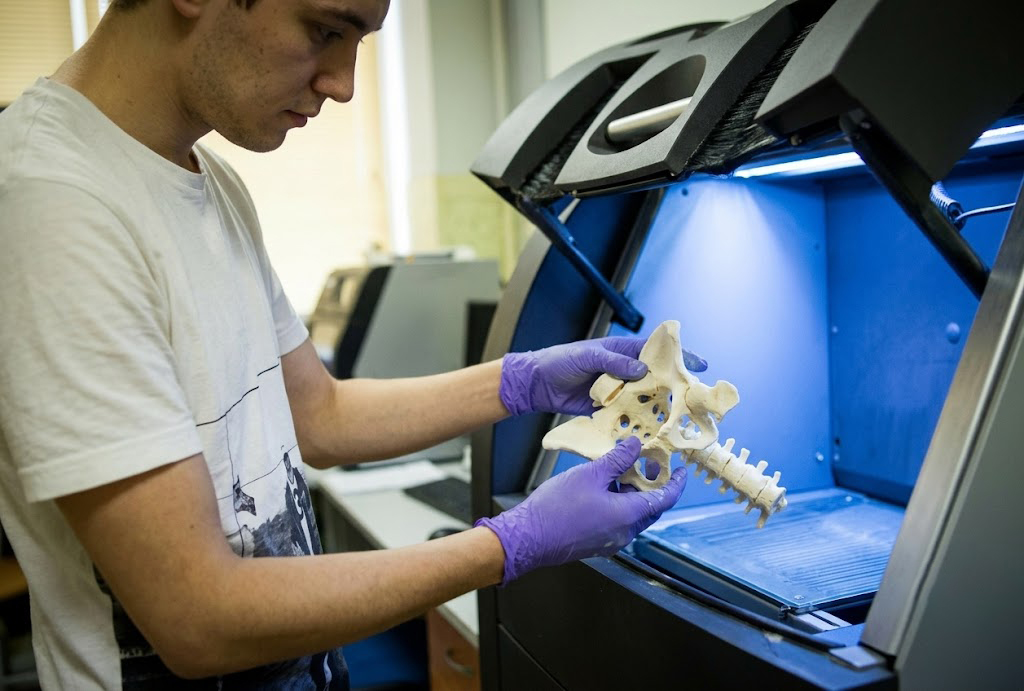
Engineers evaluating an AI-generated digital twin before advancing to physical production. Image courtesy of LS Manufacturing.
Unlocking Geometric Freedom: The Power of Advanced 3D Printing
If industrial AI-designed products have to go through mass production, industrial additive manufacturing capabilities need to be utilized as fully as possible. Advanced rapid prototyping technologies, like Selective Laser Sintering (SLS) and Stereolithography (SLA), offer the ability to create products with internal channels, honeycombed lattices, and consolidated assemblies that used to be impossible to manufacture.
On the other hand, it is best to note that printing the raw near-net shape is just the first stage. Modern high-tech industries impose extreme tolerance demands, so the only way additive manufacturing would meet these is if it is complemented with precise finishing tasks. An example is that pairing 3D printed engineering plastics with high-velocity CNC machining services is one way to guarantee that critical functional interfaces, threaded inserts, and mating surfaces are manufactured in micro-precision with tolerances up to +/- 0. 005 mm as well as retain the weight-saving benefit of an original AI design.
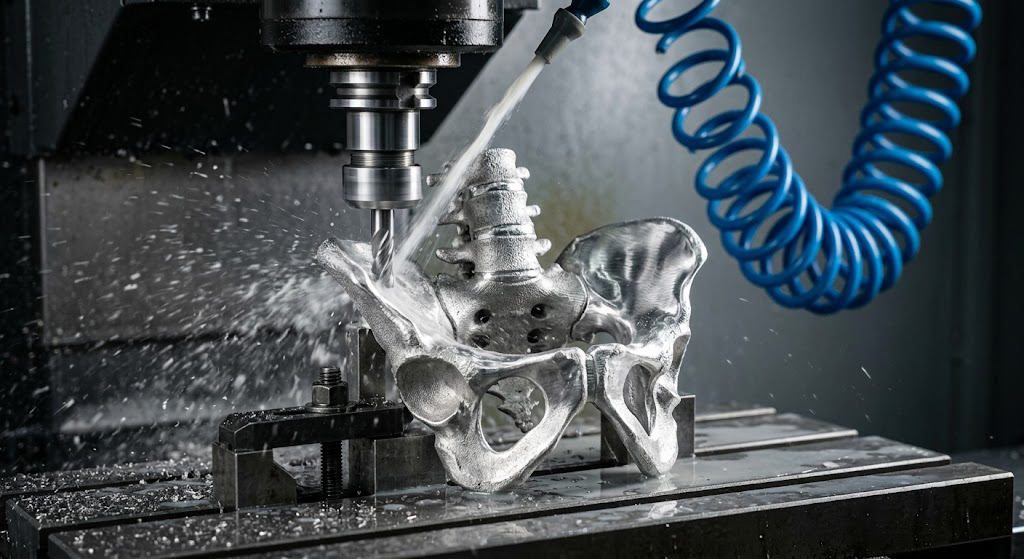
An industrial 3D-printed component showcasing intricate generative design features. Image courtesy of LS Manufacturing.
The Multi-Process Synergy: Balancing Complexity and Micro-Precision
By bypassing the upfront tooling costs associated with traditional setups, modern industrial additive manufacturing allows hardware teams to remain completely agile. If the AI model undergoes further optimization, the digital file can be updated instantly. However, the ultimate success of these parts relies on how seamlessly the additive and subtractive phases communicate.
Instead of viewing these processes individually, an integrated manufacturing process guarantees that the coordinate systems of the 3D printer and the CNC milling machine match up perfectly. This precise integration allows the toolpath of face milling, drilling, and reaming to be followed precisely when the part is taken from the 3D printer to the CNC milling process, keeping the design intent as created by the AI algorithm intact.
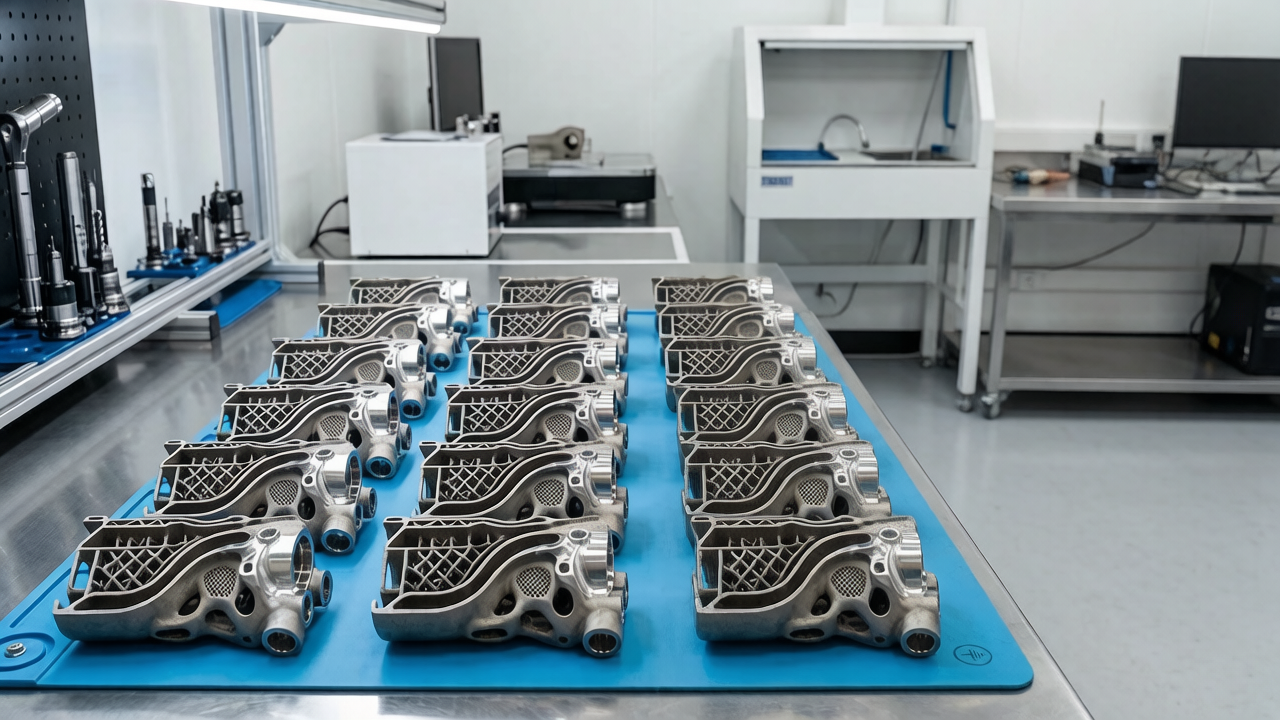
A batch of identical components featuring lightweight internal lattices after an industrial production run. Image courtesy of LS Manufacturing.
Scaling Up: From Prototyping to Bridge Production
Hardware teams that are responsible for developing next-gen devices must be aware of partner companies that can support them with the help of scalable 3D printing services. These partner companies are key for hardware teams to go from proving a concept in initial development stages to the actual production of the final product.
Production Lifecycles for AI-Optimized Components:
Concept Proofing
Primary Process: Desktop SLA / FDM Printing
Core Benefit: Low cost, fast geometric validation
Typical Batch Volume: 1 – 5 units
Functional Prototyping
Primary Process: Industrial SLS / SLA Printing
Core Benefit: Isotropic mechanical properties, complex cavities
Typical Batch Volume: 5 – 20 units
Bridge Production Run
Primary Process: Hybrid (Industrial 3D Printing + CNC)
Core Benefit: Zero tooling costs, high-precision mating features
Typical Batch Volume: 50 – 500+ units
Thanks to the efficiency gains of this hybrid approach, a business can do fast product redesigns or redesigns that will not cause the parts to be assembled wrongly. Working closely with a specialized team that offers the combination of industrial 3D printing and advanced post-machining will keep your hard-wares cycle of development going smoothly, cheaply and effectively from the first printed layer to the last manufactured one.
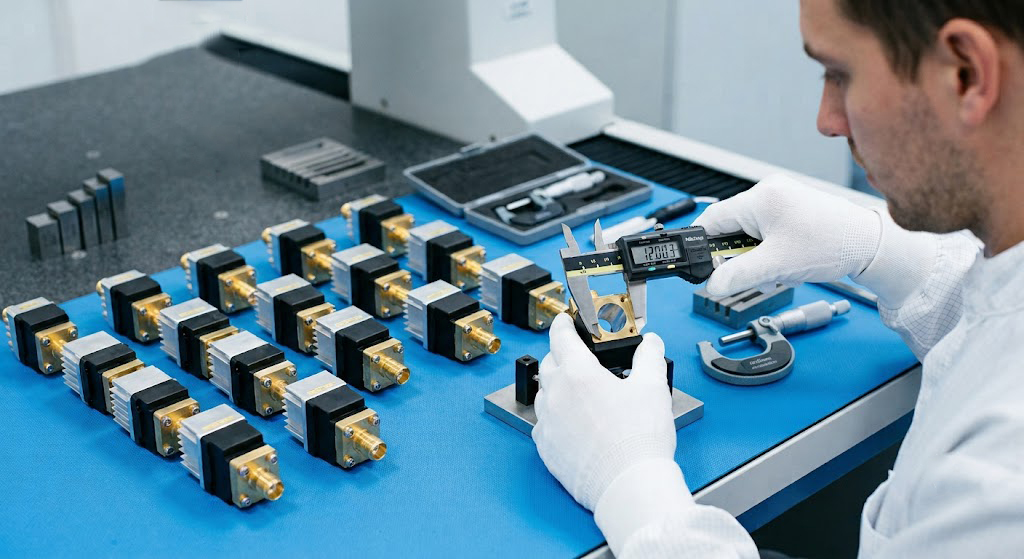
Functional components undergoing strict dimensional inspection to guarantee tight tolerances. Image courtesy of LS Manufacturing.
Empowering Adaptive Innovation with LS Manufacturing
When the lifespan of industry products is constantly getting shortened, the engineering teams that stand out the most are the ones that link AI-generated digital designs with top-tier physical production. To thrive in this environment means that we need to go beyond regular desktop printing and embrace high-end, industrial-grade manufacturing solutions.
By pairing cutting-edge additive manufacturing processes with precise CNC machining services, LS Manufacturing empowers innovators to transform their most complex generative pixels into market-ready precision parts.
Subscribe to Our Email Newsletter
Stay up-to-date on all the latest news from the 3D printing industry and receive information and offers from third party vendors.
Print Services
Upload your 3D Models and get them printed quickly and efficiently.













You May Also Like
AM & National Competitive Advantage, Part One: the Real Problem with US Manufacturing
The problem with US manufacturing is the productivity growth rate. Depending on the source, US manufacturing productivity has either been flat or slightly declined since 2010. Before going any further...
Advanced Manufacturing at IMTS 2026: 3D Printing and AI and Drones, Oh My!
Last week’s International Manufacturing Technology Snow (IMTS) in Chicago welcomed over 90,000 attendees to the jungle that is McCormick Place. With over 1.17 million square feet of exhibit space, and...
Let the Games Begin! Xi Throws Down the Advanced Manufacturing Gauntlet
Sangmin Lee went to TCT Asia back in March and reported on the event for 3DPrint.com. He wrote two articles arguing that China’s AM industry looks “ready to scale.” This...
What 3D2GO Says About 3D Printing’s Growth in Southeast Asia
The Philippines offers an interesting case study in how 3D printing can develop in Southeast Asia, and Manila-based 3D2GO helps illustrate it. 3D printing in Southeast Asia doesn’t have to...