New Study Shows Electronics Could Be Manufactured Directly in Space

A team of researchers from Auburn University and NASA Marshall Space Flight Center has successfully demonstrated a new additive manufacturing (AM) process that could allow astronauts to manufacture electronic components directly in space. Published in npj Advanced Manufacturing, the study showed that conductive silver and copper structures can be produced in microgravity using a dry, ink-free printing process. The researchers say the work could help make on-demand electronics manufacturing possible during future space missions.
Astronauts have already used 3D printers in space to make tools and replacement parts. Electronics are a different challenge. Many of the methods being explored today rely on liquid materials, which can be difficult to work with in weightlessness and are not always practical for use in space.
The project is the result of several years of work led by Auburn University researcher Masoud Mahjouri-Samani, who also founded NanoPrintek, a startup focused on dry nanoparticle manufacturing technologies. In 2022, NASA awarded the team $1.5 million to develop and test the system for use in space environments.
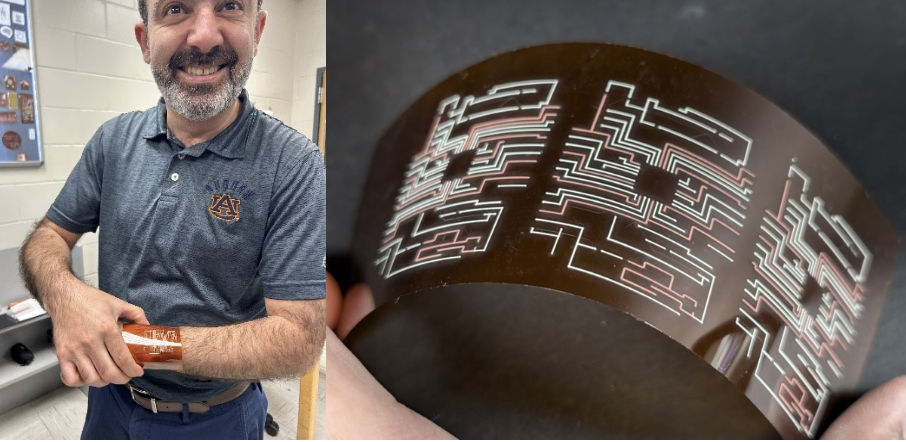
Auburn’s Masoud Mahjouri-Samani tries a 3D printed electronic device. Image courtesy of NanoPrintek.
To solve this, researchers developed what they call a dry additive nanomanufacturing platform, or Dry-ANM. Instead of printing with inks, the system creates tiny metal particles (or nanoparticles), places them on a surface, and then sinters them together to form conductive structures. The process uses silver and copper, two of the most common materials used in electronics. The machine itself is pretty compact—roughly the size of a small appliance—measuring about 60 centimeters on each side, and combines particle generation, printing, and sintering in just one system; this is an important feature for future space missions where room is limited.
Unlike many conventional 3D printing systems, the platform generates the metal nanoparticles during the manufacturing process itself rather than relying on pre-made inks or powders. The technology was designed to avoid some of the challenges associated with liquid-based manufacturing systems, making it particularly attractive for use in space.
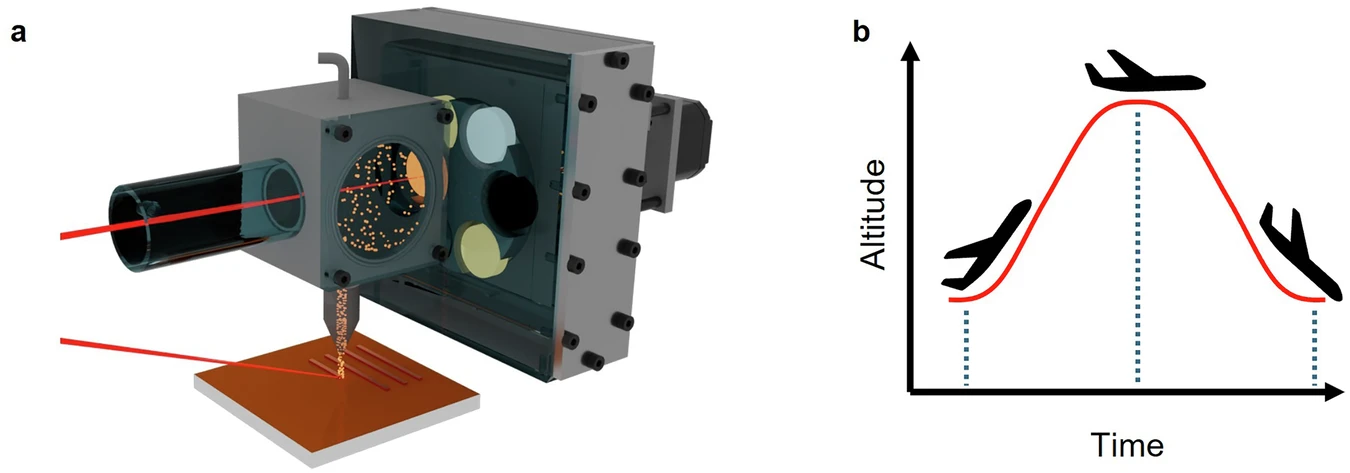
Dry-ANM Microgravity Printing Campaign. Image courtesy of Mahjouri-Samani et al., npj Advanced Manufacturing (2026).
The team tested the technology during a two-day series of parabolic flights, which create short periods of weightlessness. Across 50 separate microgravity sessions lasting about 25 seconds each, the researchers successfully produced conductive metal structures and observed the process in microgravity. The team used the system to create silver and copper features, including antennas and other conductive patterns.
The flights were carried out as part of a NASA-supported campaign first announced by Auburn researchers last year. The paper published this month provides the first detailed look at how the system performed in microgravity.
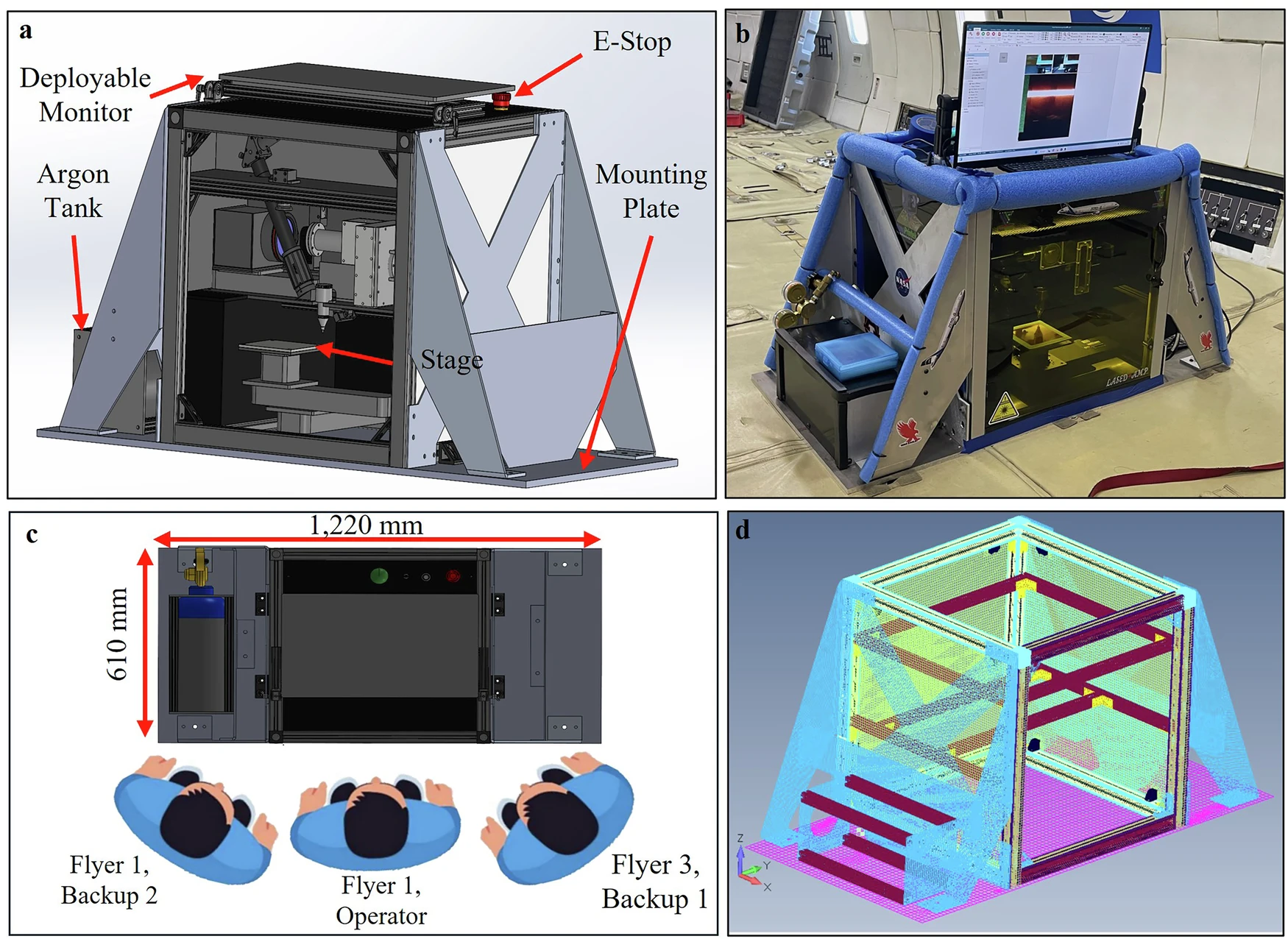
Payload Design and Analysis including printer system layout, installed payload, operator ergonomics, and FEMAP model. Image courtesy of Mahjouri-Samani et al., npj Advanced Manufacturing (2026).
One of the key findings was that the metal particles behaved differently in microgravity than they do on Earth. Even so, the team was able to adjust the process and continue producing functional metal features during the tests. According to the paper, they believe further refinements could improve the technology’s performance even more. The researchers also noted that the platform has previously been used with additional materials, including zinc oxide, indium tin oxide, and dielectric materials, suggesting it could eventually be used to manufacture more complex electronic systems.
What makes this research interesting is not simply that electronics can be printed in space. The technology could eventually allow crews to make custom sensors, repair damaged systems, and produce replacement electronic components on demand. Instead of carrying large inventories of spare parts, future missions could potentially fabricate what they need when they need it.
The researchers say this could be particularly valuable for missions beyond Earth orbit. A trip to Mars, for example, could take months, making replacement parts difficult to get. If something breaks, astronauts could make their own replacement parts, instead of waiting for supplies from Earth.
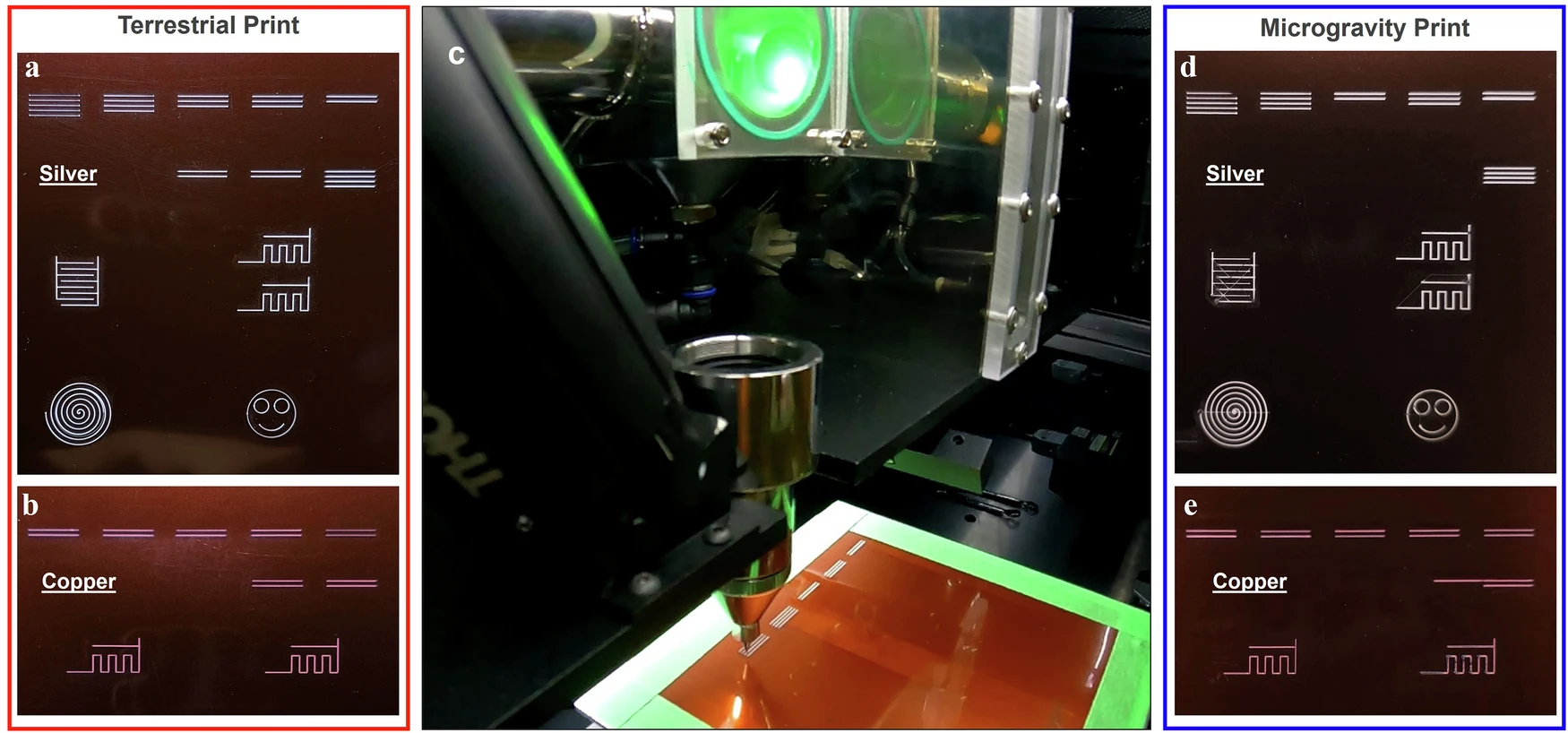
Printer in operation under microgravity showing the particle generation (green color in chamber), particle delivery through the nozzle, and sintering and printing process in real time. Image courtesy of Mahjouri-Samani et al., npj Advanced Manufacturing (2026).
This is not the first time 3D printed electronics have been involved in space research. Researchers have previously sent 3D printed electronic components to space for testing, and several groups have explored ways to manufacture electronics in orbit. However, making the materials needed for those devices in microgravity is still a big challenge. To explore that problem, the researchers focused on the manufacturing process itself. Their experiments showed that conductive metal structures could be created during repeated periods of weightlessness. Unlike many printed electronics systems, which rely on liquid materials, the Auburn-developed platform uses a fully dry process, eliminating one of the challenges associated with manufacturing in space.
The timing of this research is really good. NASA’s Artemis II mission completed its flight around the Moon earlier this year, and Artemis III is scheduled for 2027 as the agency works toward longer-duration missions deeper into space. So it’s easy to see that as astronauts travel farther from Earth, replacing damaged equipment becomes quite difficult. Technologies that allow crews to manufacture electronic components on demand could help support everything from sensors and communications hardware to critical spacecraft systems. After all, producing electronic components where they are needed, rather than launching every replacement part from Earth, remains one of the long-term goals of in-space manufacturing.
Subscribe to Our Email Newsletter
Stay up-to-date on all the latest news from the 3D printing industry and receive information and offers from third party vendors.
Print Services
Upload your 3D Models and get them printed quickly and efficiently.













You May Also Like
3DPOD 316: Beehive’s Gordie Follin on 3D Printed Engines and More
Gordie Folin had deep experience in engineering at Pratt & Whitney, GE, and GE Aviation before becoming the Chief Product Officer at Beehive Industries. Among his achievements, he served as the...
3DPOD 315: Dirk Simon, from BASF to Farsoon to FKM, and now Square New Business
Dirk Simon had already spent years in the chemicals industry before joining and pioneering BASF‘s 3D printing effort. We get to hear how that firm looked at 3D printing and...
Printing Money Episode 42: Q2 2026 Public Markets 3D Printing Earnings Analysis with Troy Jensen, Cantor
Welcome to Printing Money Episode 42. Troy Jensen (Managing Director, Cantor) returns, joining Danny Piper (Managing Partner, NewCap) to review Q2 2026 publicly traded 3DP/AM company earnings reports. Troy’s quarterly...
3DPOD 314: Debinding, Sintering, and Metal Binder Jetting with Stefan Joens, Elnik Systems and DSH Technologies
Stefan Joens of Elnik Systems sells ovens. Their debind and sintering equipment powers a lot of high-volume binder jet and MIM production. We learn about Elnik and its origins. But...