Eplus3D & UCL Rocket Test New LOX IPA Engine


Eplus3D has worked with UCL Rocket on liquid rocket engines. Right now, they’re working on a regenerative liquid oxygen (LOX) and isopropyl alcohol (IPA) liquid-cooled architecture. These rockets use IPA as a coolant before igniting it along with the liquid oxygen in the combustion chamber. The cryogenic engine (because the LOX is cooled to under minus 183 degrees to stay liquid) uses the temperature difference between the LOX and the heat created by combustion to insulate the rocket and keep it from, in effect, melting itself during combustion. Through the use of the very dense LOX, it can take lots of fuel, which is also very efficient and could burn for very long periods. If you get the additive portion of this engine architecture right, then it could be a comparatively very inexpensive engine to run and make. So far these engines have been the realm of university research teams; however, UCL Rocket is going out on a very exciting but perhaps high-payoff limb here.
UCL Rocket, by the way, is the University College London Rocket team. The team says that the new architecture is more complex than their previous engine, causing more heat fluxes and temperature differences. The previous engine was made out of CuCrZr on the EP-M400S. Previously, the N₂O engine underwent a 5 kN hot-fire test for the Race 2 Space competition. This competition is sponsored by the UK’s space agency, UK space companies, and the general UK-based space ecosystem. It aims to increase “the number and diversity of highly-skilled graduates taking STEM subjects and entering the space industry.” I’m sure that their work will help many Chinese students with their degree qualifications and startups.
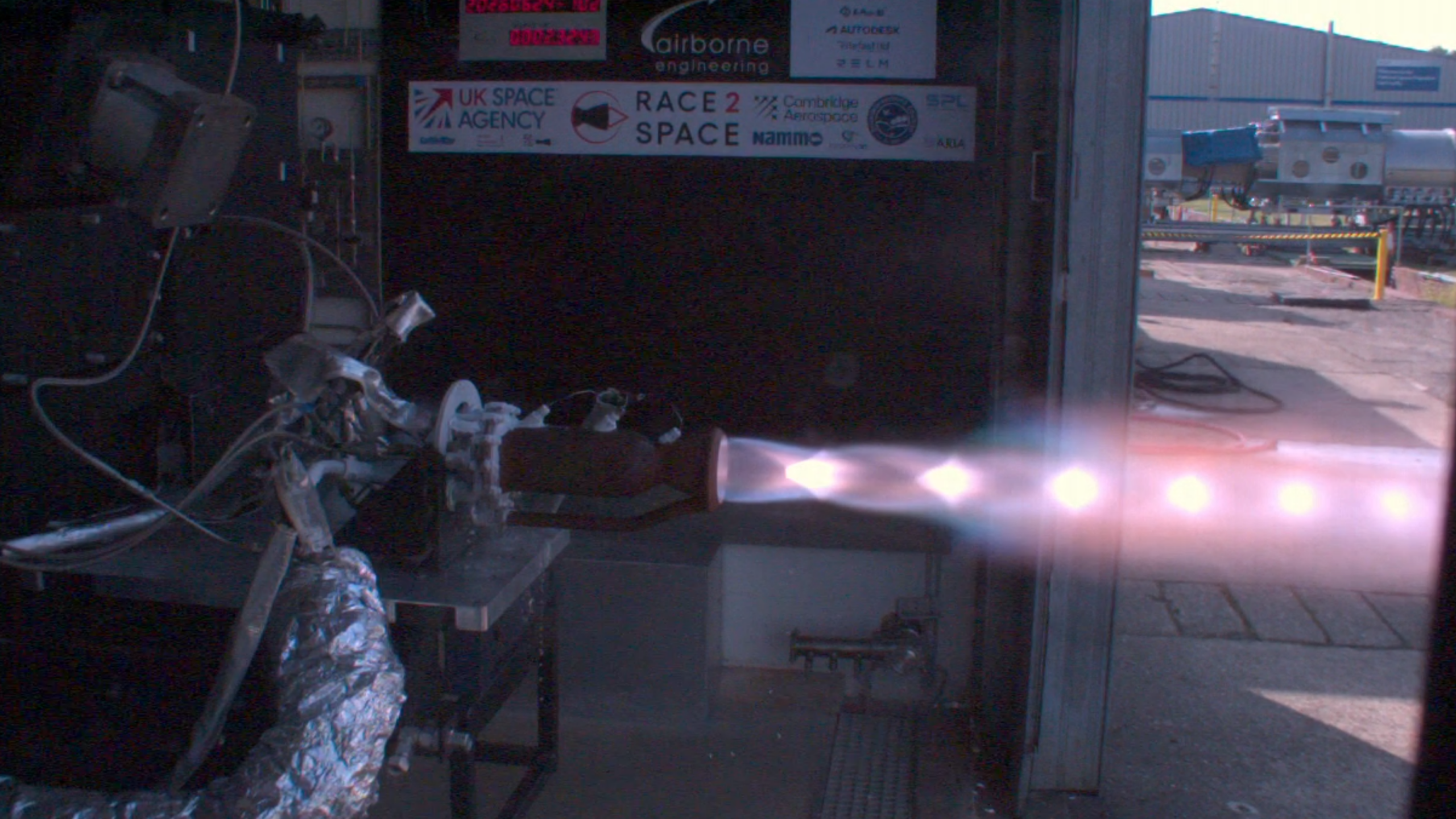
Hot-fire testing of the 7 kN LOX / IPA engine. Image courtesy of Eplus3D.
Now the 7 kN LOX / IPA engine has been hot-fire tested. The engine has 57 cooling channels and is also made of CuCrZr on an EP-M300. The project also used the EP-MC400, which, of course, is important here in getting all the powder out. The team found that “33% of the active coolant channel area was obstructed by metallic swarf generated during the final subtractive post-machining phase. This unforeseen issue was not part of the original test objectives.” Swarf is a conventional machining term for dust or chips left behind in or on workpieces. This, of course, could have been ameliorated by using Extrude Hone or REM, but I’m guessing they weren’t available to play this game.
Instead, they reduced the throttle by half and added a 2% PDMS fuel additive. The chamber lasted through the test and was not warped. The team said that, “better understand combustion chamber behavior, cooling sensitivity, cleanliness requirements, and the importance of process control across printing, post-machining, cleaning, inspection, assembly, and testing.” They also stated that, “Eplus3D helped UCLR move from advanced design concepts toward test-ready propulsion hardware and the validation of its cryogenic engine concept.”
This also must be seen as an immense victory for the Chinese Ministry of State Security. A bottle of Kweichow Moutai for all of its 600,000 employees; I suggest that the UCL team change the name of their future rockets from Excelsior to something more appropriate like Burgess, Maclean or Philby. This is staggeringly naive of them. The UK’s space initiative is behind globally, and the country does not have a sovereign space capability. Britain has cut itself off partially from a lot of European projects, research and commercial initiatives. It should be extra careful with what it does develop in competitions and research. It only has so much research and VC funding to go around. A UK-based launch startup is at the moment not really on the cards since the failure of Orbex. The UK government reportedly blocked a last-ditch effort of German firm The Exploration Company to save Orbex. Now its government is helping to fund its student rocket teams working with Chinese firms. If they were making cars or solar what’s-nots, we could argue about the soundness of this as industrial policy. But given the national security and defense implications here, and the blocking of the Orbex sale, the UK should rethink how it handles research funding and how it wants to play a role in space.
Subscribe to Our Email Newsletter
Stay up-to-date on all the latest news from the 3D printing industry and receive information and offers from third party vendors.
Print Services
Upload your 3D Models and get them printed quickly and efficiently.













You May Also Like
3D Printing Financials: 6K Additive Reports Record Quarter as Demand Grows for U.S.-Made Metal Powders
Demand for metal powders made in the United States continues to grow, particularly from aerospace and defense customers. That was one of the biggest takeaways from 6K Additive‘s (ASX: 6KA)...
What I Learned from a Luleå Study on Absorbance in Metal AM
A few weeks ago, I visited Professor Alexander Kaplan at Luleå University of Technology. Originally from Austria, Kaplan has spent more than 20 years at the university working on the...
Hadrian and Fortastra Bet on Automated Factories to Fix Satellite Production Bottlenecks
Demand for satellites continues to grow, and manufacturers are looking for ways to build spacecraft faster without affecting performance. One way to do that is to involve manufacturing companies earlier...
Beyond Thermoplastics: Why JuggerBot Is Betting on Hybrid AM
For years, thermoplastics have been the workhorse of additive manufacturing (AM). They are pretty easy to process, available, and compatible with many of today’s industrial 3D printers. From prototypes to...