
3D Printing News Briefs: May 7, 2026: Metal Powder Bed Fusion, Surgical Plates, & More

In today’s 3D Printing News Briefs, we’ll start with a strategic collaboration to advance next-generation metal additive manufacturing (AM), before moving on to funding for surgical research. We’ll end with 3D printed components for LiDAR research.
Eplus3D, Rosswag, & Qualloy Sign MOU to Advance Next-Gen Metal AM
Industrial metal AM solutions provider Eplus3D announced a strategic collaboration with qualloy, a supplier of high-quality metal AM powders, and Rosswag Engineering, a division of the family-owned company that focuses on metal AM. The three signed a Memorandum of Understanding (MOU) to work on advancing next-generation metal AM solutions and supply chains. Per the MOU, they will combine Eplus3D’s large-scale industrial metal powder bed fusion printers with qualloy’s metal powders and Rosswag’s expertise in metal processing, heat treatment, machining, and testing to create an integrated manufacturing ecosystem. Rosswag will invest in an 8-laser Eplus3D EP-M550 system, qualloy powder designed for Eplus3D printers will be qualified and made available with validated process parameters and powder specifications, and all three companies will take part in joint material qualification and parameter development. In this way, they plan to validate industrial-grade AM process performance, and develop user-ready applications.
“By combining our large-scale, industrial LPBF systems with Rosswag’s application expertise and qualloy’s material excellence, we are creating a fully integrated ecosystem that significantly lowers the barrier for true serial additive manufacturing,” said Enis Jost, Deputy General Manager, Eplus3D Tech GmbH. “This collaboration is not just about technology, but about delivering validated, production-ready solutions with great part pricing that enable our customers to scale with confidence.”
Durham University Researcher Gets Funding for Surgical Plate Research
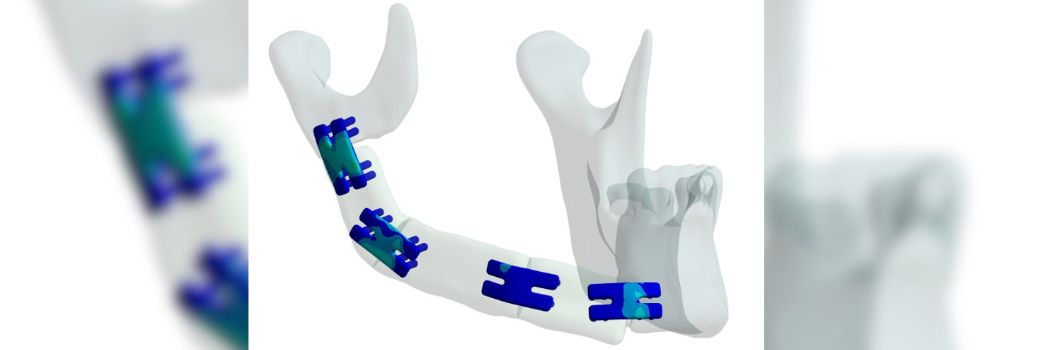
Dr Alessandro Borghi, an early career researcher in the Durham University Department of Engineering, will receive £125,000 in funding from the Academy of Medical Sciences to support his work in optimizing the design of 3D printed custom surgical plates used in facial reconstruction surgeries. To repair the kind of jaw damage caused by oral cancer or trauma, surgeons will perform mandibular reconstruction. This typically means replacing the damaged section of jaw bones with bone taken from the patient’s lower leg and held in place with metal implants. These implants are normally bent by the surgeons during surgery to match the patient’s jaw shape, but there can be complications with this method. By using smaller mini plates, the stress is distributed more evenly across the healing bone, and surgeons can use 3D printing and virtual surgical planning to make custom plates that match the patient’s specific anatomy.
However, bone healing can be delayed if these plates are too rigid. Dr. Alessandro, a Fellow of the university’s Wolfson Research Institute for Health and Wellbeing, is working to adjust the stiffness and shape of 3D printed surgical plates to optimize healing. He will use the funding, which is part of the Academy’s Springboard program for early career researchers, to come up with practical guidelines for 3D printing patient-specific mini plates. Dr. Alessandro will use advanced computer simulations and existing models to investigate the performance of different designs in keeping the healing bone in place, as well as how they distribute stress and support long-term healing. Then, partner hospitals will determine the effectiveness of his designs by testing them in real surgical procedures, assessing their ability to improve patient outcomes.
IAP Uses BigRep’s 3D Printing for Atmospheric Modeling Systems in LiDAR Research

Climate change, space missions, and weather forecasts all depend on precise atmospheric data. To get it, scientists use a remote sensing method called LiDAR (Light Detection And Ranging) to shoot laser pulses from the ground to the edge of space, then analyze the backscattered light to measure and monitor temperature, metals, wind, and other particles over time. Some of the best places to deploy LiDAR systems are in remote regions like the Arctic and high-altitude mountains, but it’s not easy to deploy them in these extreme environments. Researchers at the Leibniz Institute of Atmospheric Physics (IAP) in Germany are working to make LiDAR more deployable, but instead of building observatories in these unforgiving places, they’re developing compact, cost-effective, remote mobile systems that run autonomously. In order to compress this instrument, while integrating the necessary technologies (optical system, lasers, telescopes, detectors, etc.), the IAP team turned to large-format 3D printing from BigRep.
The IAP team is using two BigRep ONE 3D printers, which have a build volume of 1 cubic meter, to build custom parts in-house. BigRep has an open materials system, so in addition to using its verified filaments like flexible TPU, IAP can also use compatible materials as well. An onsite BigRep DRYCON helps the institute with drying, controlled storage, and annealing of filaments. Some of the parts the team prints include the LiDAR system’s outer housing, structural components, the compressor, an optical table mounted inside the system, insulation, and custom enclosures for electrical systems. Because the LiDAR system was so experimental and iterative, 3D printing was really the best choice, and the technology will also make it easier to get replacement parts in the future. Working as part of an international network, IAP’s compact LiDAR systems with 3D printed parts will be deployed in locations like the Canary Islands and Switzerland, and there’s already one operating in northern Norway.
Featured image courtesy of BigRep
Subscribe to Our Email Newsletter
Stay up-to-date on all the latest news from the 3D printing industry and receive information and offers from third party vendors.
Print Services
Upload your 3D Models and get them printed quickly and efficiently.













You May Also Like
Metal 3D Printers for the Desktop Are Finally Starting to Feel Like Desktop Products
FDM 3D printing is becoming increasingly accessible, yet metal 3D printers designed for everyday desktop use remain rare on an ordinary workbench. The real challenge is not making a metal...
3D Printing Financials: 6K Additive Sales Rise as Aerospace and Defense Demand Grows
6K Additive (ASX: 6KA) grew rapidly in the first half of 2026 as demand for its metal powders increased, particularly from aerospace and defense customers. The newly public company also...
When Data Becomes the Differentiator: Qualified Material Data is Changing the Future of Structural Additive Manufacturing
For years, additive manufacturing has promised engineers greater design freedom. The challenge wasn’t printing the part—it was proving the part belonged on an aircraft. Designing a lightweight bracket or consolidating...
Amaero Builds U.S. Metal Powder Capacity for Additive Manufacturing
For metal additive manufacturing (AM) to grow in the United States, companies need more than printers. They also need a reliable supply of the powders that go into those machines....























































