Dawn Aerospace Raises $25 Million as 3D Printing Helps Power Reusable Spaceflight Ambitions

The race to build the next generation of reusable spacecraft just got another boost. Dawn Aerospace has landed $25 million in Series B funding to help scale its reusable space transportation business. The company, now valued at $195 million, is betting that reusable vehicles will help reshape how often (and how affordably) we reach space.
The new funding will support the expansion of Dawn’s satellite propulsion business, continued development of its Aurora reusable spaceplane, and work on Loop, the company’s planned in-orbit satellite refueling network. Dawn is targeting a Loop demonstration in 2028.
For the additive manufacturing (AM) industry, the funding points to a growing trend: many of the most ambitious space startups are building critical hardware with 3D printing.
Based in New Zealand and the Netherlands, Dawn Aerospace already has one foot in space. Unlike many space startups that are still pre-revenue, Dawn already generates revenue through its satellite propulsion business. Its propulsion systems are flying on dozens of spacecraft, providing revenue while the company develops something much more ambitious: Aurora, a reusable spaceplane.
Unlike traditional rockets, Aurora is designed to take off from a runway, reach the edge of space, land back on a runway, and fly again with far less downtime between missions. The long-term goal is to make access to space look less like an occasional rocket launch and more like regular aircraft operations.
“As a cash-flow positive company, raising capital is about accelerating the growth of programs we have extremely high conviction in, and that our customers are desperate for,” said Stefan Powell, CEO of Dawn Aerospace.

Aurora in flight during one of Dawn’s test campaigns. Image courtesy of Dawn Aerospace.
Behind the scenes, Dawn has been using 3D printing to develop critical space hardware, including rocket engine technology developed through projects with the European Space Agency (ESA).
The announcement comes as investors continue to back companies working to make spaceflight cheaper and more routine. Reusability has become one of the industry’s biggest trends, helping cut launch costs and increase the number of missions. While companies like SpaceX have helped make reusable rockets a reality, Dawn is betting that the next step is a reusable spaceplane that operates more like an aircraft than a traditional launch vehicle.
For many space companies, 3D printing has become much more than another manufacturing tool. It helps teams move from design to testing faster, while also making it possible to produce lightweight parts that would be difficult to manufacture any other way. For Dawn Aerospace, those benefits are especially important. Reusable spacecraft need to be as light, reliable, and efficient as possible. AM makes it easier to refine critical components and reduce the number of parts in a system, helping simplify production while improving performance.
The Series B round follows Dawn’s $20 million Series A in 2022, which helped the company expand its satellite propulsion business and continue development of its spaceplane program. With the latest investment, Dawn has now raised at least $45 million in equity funding as it works to scale both businesses. The round was led by U.S.-based Balerion Space Ventures, with participation from both existing and new investors, including Japan’s ANA Future Frontier Fund, backed by airline giant All Nippon Airways (ANA), Japan’s largest airline, as well as entrepreneur and entrepreneur and angel investor Tim Ferriss, who previously backed companies such as Uber, Shopify, Facebook, and X. As part of the investment, Balerion General Partner Dan Wallman will join Dawn Aerospace’s board of directors.
The company is also aiming for Aurora to become the first vehicle to fly above the Kármán line—the internationally recognized boundary of space—twice in a single day in 2027. If successful, it would mark another step toward Dawn’s goal of making spaceflight operate more like commercial aviation.
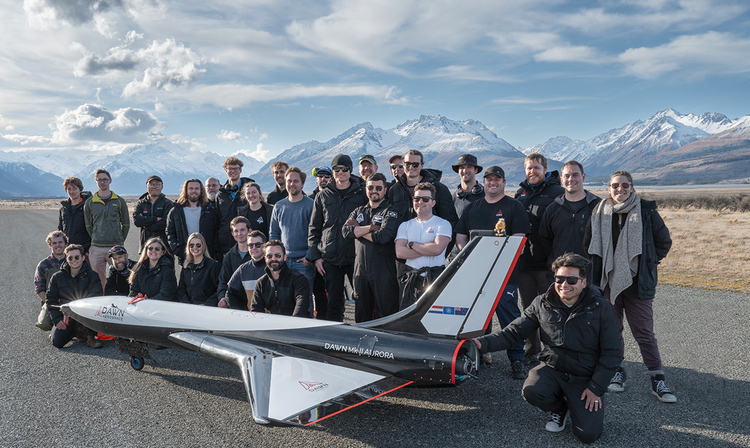
The team behind Aurora, next to the rocket-powered aircraft, the first New Zealand-designed and -built aircraft to fly supersonic. Image courtesy of Dawn Aerospace.
Subscribe to Our Email Newsletter
Stay up-to-date on all the latest news from the 3D printing industry and receive information and offers from third party vendors.
Print Services
Upload your 3D Models and get them printed quickly and efficiently.













You May Also Like
AM & National Competitive Advantage, Part One: the Real Problem with US Manufacturing
The problem with US manufacturing is the productivity growth rate. Depending on the source, US manufacturing productivity has either been flat or slightly declined since 2010. Before going any further...
Advanced Manufacturing at IMTS 2026: 3D Printing and AI and Drones, Oh My!
Last week’s International Manufacturing Technology Snow (IMTS) in Chicago welcomed over 90,000 attendees to the jungle that is McCormick Place. With over 1.17 million square feet of exhibit space, and...
Let the Games Begin! Xi Throws Down the Advanced Manufacturing Gauntlet
Sangmin Lee went to TCT Asia back in March and reported on the event for 3DPrint.com. He wrote two articles arguing that China’s AM industry looks “ready to scale.” This...
What 3D2GO Says About 3D Printing’s Growth in Southeast Asia
The Philippines offers an interesting case study in how 3D printing can develop in Southeast Asia, and Manila-based 3D2GO helps illustrate it. 3D printing in Southeast Asia doesn’t have to...