Will Desktop Firms Push Shoe 3D Printing Forward?

Recently, Bambu Lab announced that it was working with FORMISM by SCRY on releasing shoes. These six designs will be shared and printable through its Makerworld platform. Using the platform, you can size the shoe, choose colors, and then print them in TPU on your printer. Now Makerworld has started crowdfunding for the new Persona Footwear package, which has raised $8,000 so far. The company also wants to make a foam 3D printing version available later this month. The company is also working on an open-source shoe effort by Presq.

Creality, meanwhile, has been working on 3D printed shoes for a while. The company has breathable anti-slip shoes that it has tested and released. The Dragon Seal and Dragon Crown models are a bit stylistically challenged, but they look like a credible shoe design. You can also buy the Aerorise 3D printed sneakers for $159 directly from the company. Creality also has a download platform and tools, such as the Sermoon P1 3D scanner, which could see it develop a complete shoe toolkit.
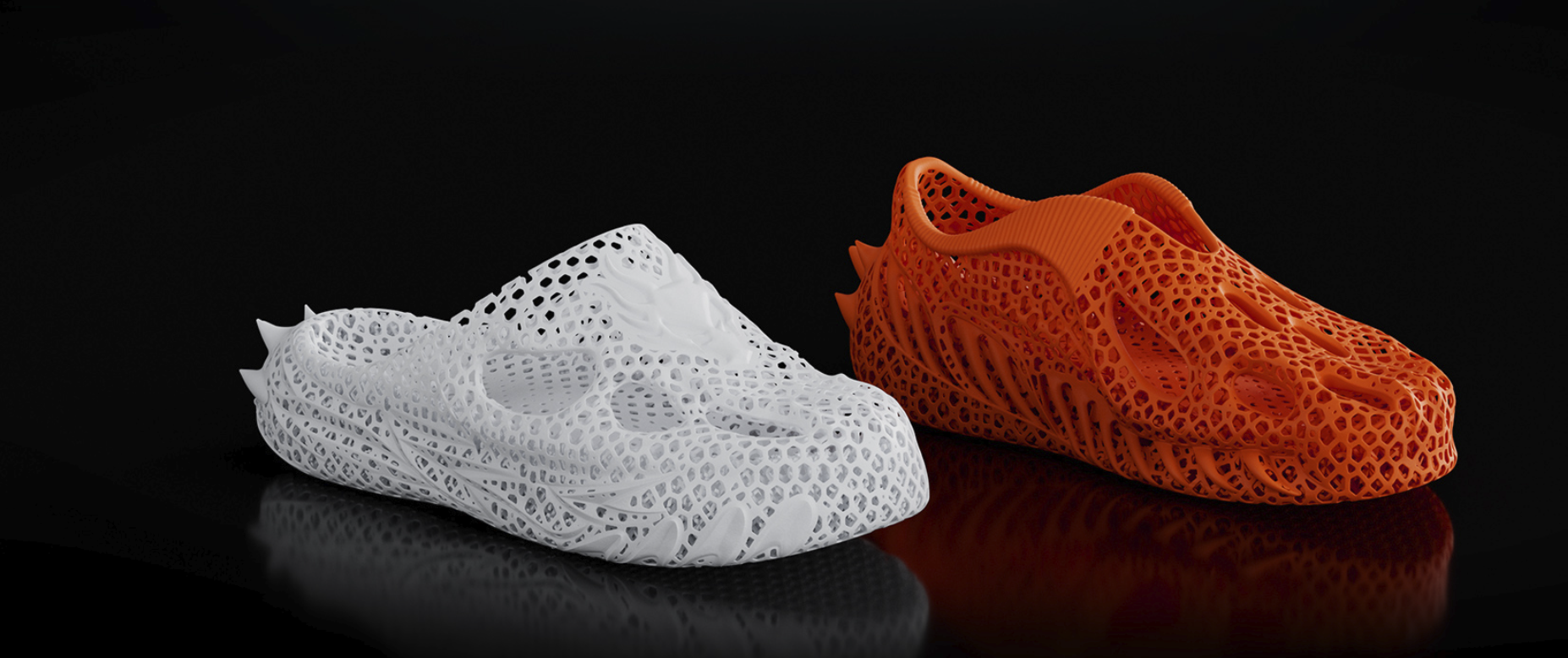
Creality 3D printed shoes. Image courtesy of Creality.
Aside from this, there are the Blackbelt-type specialized printers, such as Podoprinter, which are designd for podiatrists and insoles, but could be used for shoes, and small printers that could be used for shoes, such as the Ideaformer. There are also developments, such as Recreus’ new filament/nozzle standard, that are encouraging.
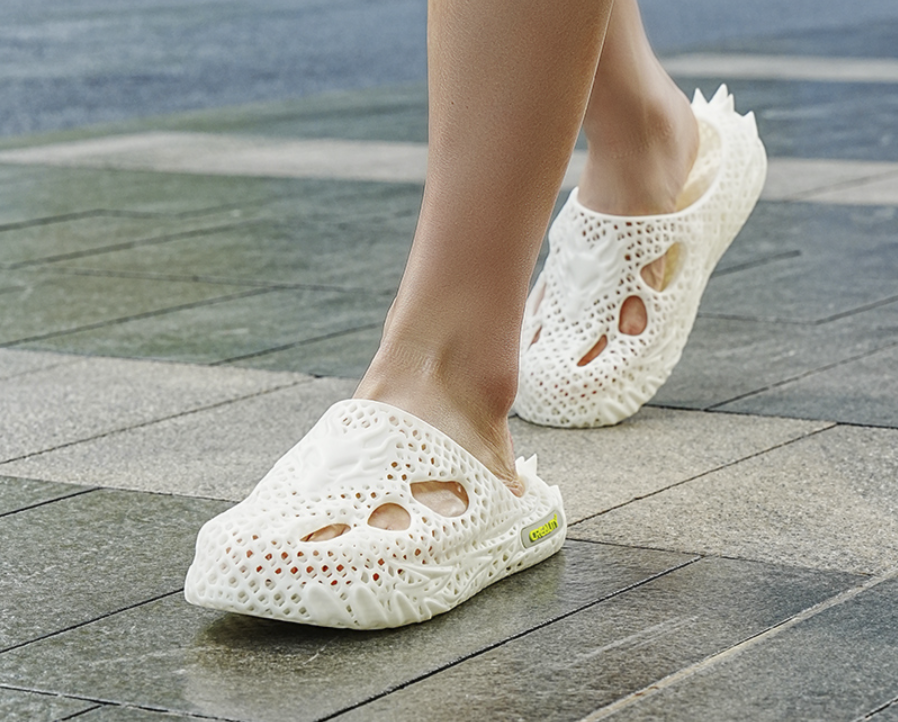
Creality 3D printed shoes. Image courtesy of Creality.
In orthotics and prosthetics, 3D printing is growing, with Brent Wright, for example, developing a polar-based 3D printer that could work very well for prosthetics and orthotics. Along with workflow solutions for orthoses, this is seeing tens of thousands of insoles being printed worldwide.
Rival Paths
So there are several simultaneous paths being explored. The O&P industry is continuing to print orthoses and build a business case for 3D printing insoles. This is helping grow the sole 3D printing business in a down-to-earth, functional, cost-effective approach. The O&P business seems to be gravitating towards industrial units designed for orthoses, higher-end TPU-optimized desktop systems coupled with workflow software, and the use of inexpensive systems such as the Bambu A1. There is real volume here and interest from established orthotics companies.
Meanwhile, there are a number of specialized TPU-optimized 3D printers hanging in there. A belt architecture that works well with TPU is, in some ways, a superior architecture and very inexpensive as well. Perhaps these systems would be a path forward that could surpass the gantry systems, which are optimized for non-elastomeric materials. These systems, coupled with something like Recreus’ new filament standard, are actually the most logical way to increase production in shoes.
Zellerfeld has completely owned the 3D printing narrative for shoes. Going from enabling luxury brands to now being a YouTube for shoes was brilliant. The company really manages to keep itself relevant and is driving the narrative. Zellerfeld has developed its own platform, slicing software, and machines. It is thought that the company has significant VC funding to power its rise. It’s really Zellerfeld’s race to lose at this point. Other platforms, such as Hilos, are not part of the conversation currently.
Of course, New Balance, Adidas, and every other shoe brand have dipped their toe into shoe 3D printing as well. They seem to be on the back foot at the moment. Although hundreds of thousands of 3D printed shoes have been made and sold, they seem to have stalled a bit. A reinvigorated effort from one of the major shoe players would be good for Carbon, EOS, HP, and the other OEMs. This is especially true since all the other shoe printing efforts look centered around Material Extrusion.
Material extrusion, in my mind, is the most logical, cheapest, and best technology to make shoes with. It’s cheaper, can produce variable-density insoles, can use a wide range of materials, and is recyclable. Creality and Bambu seem to have realized this and seem to be positioning themselves to be relevant in the space.
Creality and Bambu have the resources, revenue, platforms, and extrusion expertise to really do meaningful work in this space. But, how important are elastomers to their overall efforts? Will we see new printers that combine the advances of the Carbon and K2 with advances in TPU printing? Will there be dedicated shoe-printing models with the latest architecture? If they do this, then they will be super relevant. Even without it, TPU printing on the H2C and A1s works well enough for many users.
This seems like a defensive move. Bambu and Creality are vying to build the biggest cloud manufacturing solution, the biggest collection of 3D printed models, and the easiest customization tools, along with perhaps a host of peripherals such as scanners. Both firms want to duke it out, but are not just doing this through their machines. They realize just how enabling download platforms and software can be. At the same time, the easier that 3D printing becomes, the more useful their 3D printers will become, and the more people will be motivated to use them. The overall utility of 3D printing is being increased by Creality’s scanners and Makerworld. Coupled with customization tools and parametrization, this could really move our market forward.
Zellerfeld, therefore, is a threat to Creality and Bambu because it would provide for a rival platform for shoe creation and, subsequently, perhaps much else. Zellerfeld takes away the need to own a 3D printer, while MakerWorld makes it more useful to own one. Therefore, developing a credible shoe offering using its printers is something truly important to Creality and Bambu. As long as the average Joe can print about as well as Zellerfeld, then the Zellerfeld platform will not outmaneuver them in the future. The shoe market could be a lever to dominate 3D printing or to increase the total amount of the printable at the same time. We will watch this space closely to see who is winning and why.
Subscribe to Our Email Newsletter
Stay up-to-date on all the latest news from the 3D printing industry and receive information and offers from third party vendors.
Print Services
Upload your 3D Models and get them printed quickly and efficiently.











You May Also Like
Why Superior, Affordable Chinese AM Machines Are a Great Chance for the Industry
Additive Manufacturing is entering a decisive phase. Consolidation is no longer a future scenario; it is happening now. Across polymers and metals, companies are under intense pressure to become profitable,...
The Future of Metal Parts for Aerospace and Defense
Aerospace and defense manufacturing is entering a pivotal era. The demands placed on metal parts have never been higher, driven by rising performance expectations, increasing system complexity, and an operating...
Xometry President Sells $1.7M in Shares in Pre-Planned Transaction
After a strong year for its stock, Xometry (Nasdaq: XMTR) is back in focus after a recent insider share sale. The transaction has also renewed interest in how investors are...
Velo3D’s Space Hardware Win Comes Just Weeks After $30 Million Capital Raise
A new spacecraft manufacturing milestone from Velo3D (Nasdaq: VELO) is drawing attention not only for its technical importance, but also for the timing. On January 5, 2026, Momentus announced that...