HP Webinar Unpacks the Future of Digital Orthotics and Prosthetics Workflows



The orthotics and prosthetics (O&P) industry is at a turning point. For much of its history, the process of designing and producing devices like braces, orthoses, and prosthetic limbs has relied on skilled craftsmanship, an intensive, manual process built on legacy methods. But today, more clinics and labs are exploring digital workflows powered by 3D printing to improve efficiency, personalization, and patient outcomes.
Digital tools promise faster turnaround, less labor, and better patient fit. But shifting from traditional workflows isn’t easy; training, cost, and system integration often slow adoption.
On September 30, HP will host a free 30-minute webinar titled Digital O&P Workflows: The Good, The Bad, and The Considerations to address these questions head-on. The session will take a look at what works, what doesn’t, and what clinics need to know before going digital.
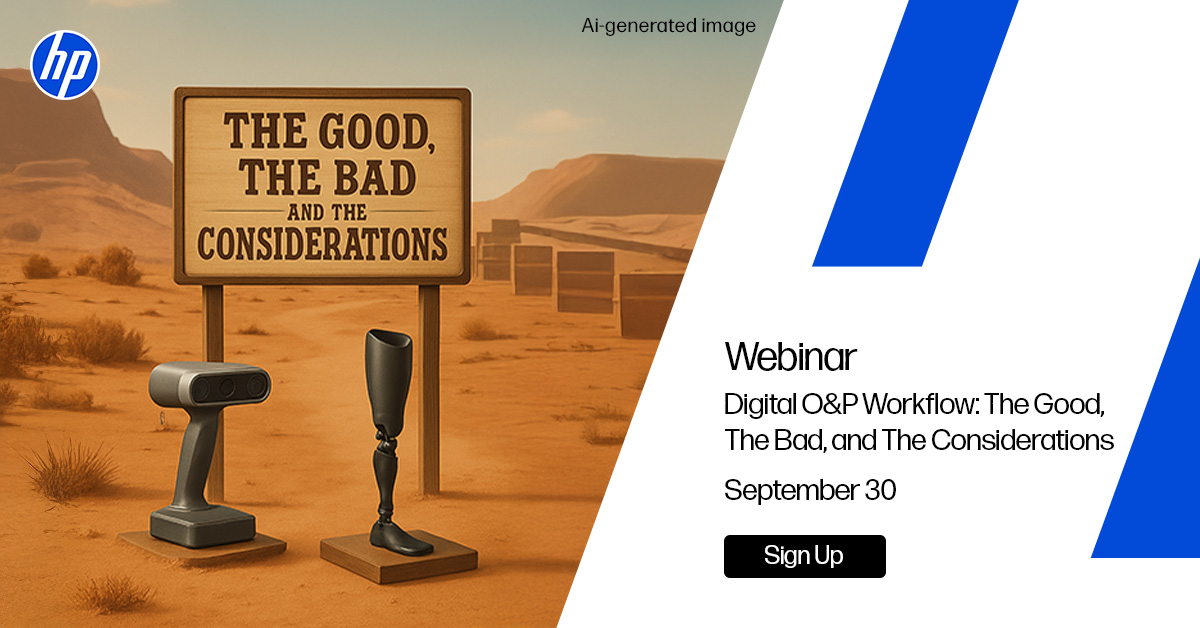
Unlike promotional sessions that highlight only the upside, this webinar aims for an open, balanced discussion, looking to cover both the opportunities and the challenges.
On the positive side, digital tools can make operations smoother and reduce manual work. With HP’s 3D printing platforms, clinicians gain more design freedom and can create devices that are customized for each patient, improving comfort and fit. But the transition isn’t always easy. Many clinics encounter difficult learning curves, high upfront costs, or compatibility issues with older systems, all of which can slow adoption and make the transition feel overwhelming.
On top of that, there are important factors to plan for early on, like regulatory requirements, staff training, and the long-term scalability of new processes. Looking ahead, emerging tools like AI-powered scanning, cloud-based platforms, and fully integrated digital ecosystems could accelerate the move toward more personalized, efficient care in O&P.

Dustin Kloempken.
The webinar will feature Dustin Kloempken, a 3D Printing Application Engineer at HP with years of hands-on experience in additive manufacturing, whose career took shape in the aftermath of the 2008 financial crisis. Since then, his work has spanned multiple sectors, from testing the effectiveness of 3D printed O&P devices against traditional methods to designing large-scale robotic grippers to partnering with research institutes on new applications for additive manufacturing in lighting. That depth of experience positions him to offer a grounded view of where digital O&P stands today.
Kloempken will be joined by moderator Joris Peels, Executive Editor of 3DPrint.com and Vice President of Consulting at Additive Manufacturing Research (AMR), known for his sharp insights into both the business and technology of 3D printing. The session will wrap up with a live Q&A, giving attendees the chance to pose their own questions.
Why HP is Leaning Into O&P
HP has been a major force in 3D printing with its Multi Jet Fusion (MJF) technology platform, used across industries from automotive to consumer goods. But in recent years, healthcare has become one of its most promising frontiers.
In O&P specifically, HP’s printers make it possible to produce lightweight, durable, and highly customized devices at scale. Traditional methods require skilled technicians to shape, mold, and adjust devices by hand, a process that can be both time-consuming and inconsistent. By digitizing design and production, labs can cut delivery times, improve accuracy, and provide patients with devices that better match their anatomy and lifestyle.
However, this has even more to do with access. By adopting digital workflows, clinics can serve more patients in less time. This is an important advantage as global demand for O&P services continues to rise.
This shift also reflects a broader trend across healthcare, where precision and personalization are becoming the standard. But unlike other sectors, O&P is deeply tied to craftsmanship and tradition, making the transition a cultural as well as technical shift. That tension (between tradition and innovation) is exactly what this webinar aims to delve into.

For practitioners, lab managers, or anyone considering the shift to digital, the message will be practical: what’s worth adopting now, what hurdles to expect along the way, and how to prepare as the field keeps evolving.
The session, Digital O&P Workflows: The Good, The Bad, and The Considerations, will take place on September 30, 2025. It runs for 30 minutes followed by a live Q&A. Anyone interested in the future of digital O&P workflows can register here.
Images courtesy of HP
Subscribe to Our Email Newsletter
Stay up-to-date on all the latest news from the 3D printing industry and receive information and offers from third party vendors.
Print Services
Upload your 3D Models and get them printed quickly and efficiently.













You May Also Like
Impossible Objects Closes $40M Series B
The Pentagon, along with deep-pocketed collaborators in the private sector, is urgently coordinating the buildup of all the elements necessary for a domestic US drone supply chain. Even so, those...
The 3D Printing Opportunity in UGVs
In 2024, IperionX partnered with fastener firm Vegas Fasteners to jointly make fasteners for the US Army Ground Vehicle Systems Center (GVSC). That DEVCOM component has been hit by funding...
$51 Million Revenue VMP Wants to Become a Leading Additive Manufacturing Metal Powder Producer
Chinese powder producers have traditionally had little impact on the additive manufacturing market. Typically, they offer low-cost powders without much in the way of settings or application support. But China’s...
IperionX Gets $11.5M Army Boost to Make Titanium Fasteners in the U.S.
IperionX is going to get another $11.5 million, potentially up to $25.4 million, of an existing SBIR Phase III with the Army (Task Order W911QX26FA097). The award covers low-cost titanium...