The University of Utrecht: “3D Printing Could Change Who Gets to Become a Manufacturing Power”

For decades, manufacturing has mostly been controlled by countries with huge factories, lower labor costs, and industrial systems that took years, sometimes decades, to build. But Utrecht University human geographers Nicola Cortinovis and Joric Donnet believe 3D printing could start to change some of that.
In a new study, they found that countries adopting 3D printing technologies are becoming more competitive with traditional manufacturing economies, especially in exports. Their main argument is that additive manufacturing (AM) lowers some of the barriers that have historically made it difficult for developing economies to build strong manufacturing industries of their own.
The findings come from a paper titled 3D Printing and the Geography of Production, published in the journal Technological Forecasting and Social Change. The researchers describe 3D printing as a technology that could gradually reshape the “geography of production,” meaning where products are made and which countries are able to compete in manufacturing.
For a long time, manufacturing has favored countries that could afford giant factories, expensive machinery, and large-scale production systems. Traditional manufacturing usually requires a major investment before production can even begin. 3D printing changes part of that equation because companies can produce parts directly from digital files, often with much smaller manufacturing setups and lower upfront costs. And that could be important for countries trying to grow their industrial base.
According to the researchers, developing economies may not need to follow the exact same path that older manufacturing powers took over the last century. Instead of spending decades building massive factory ecosystems, some countries could move more quickly into advanced manufacturing by adopting digital production technologies such as AM.
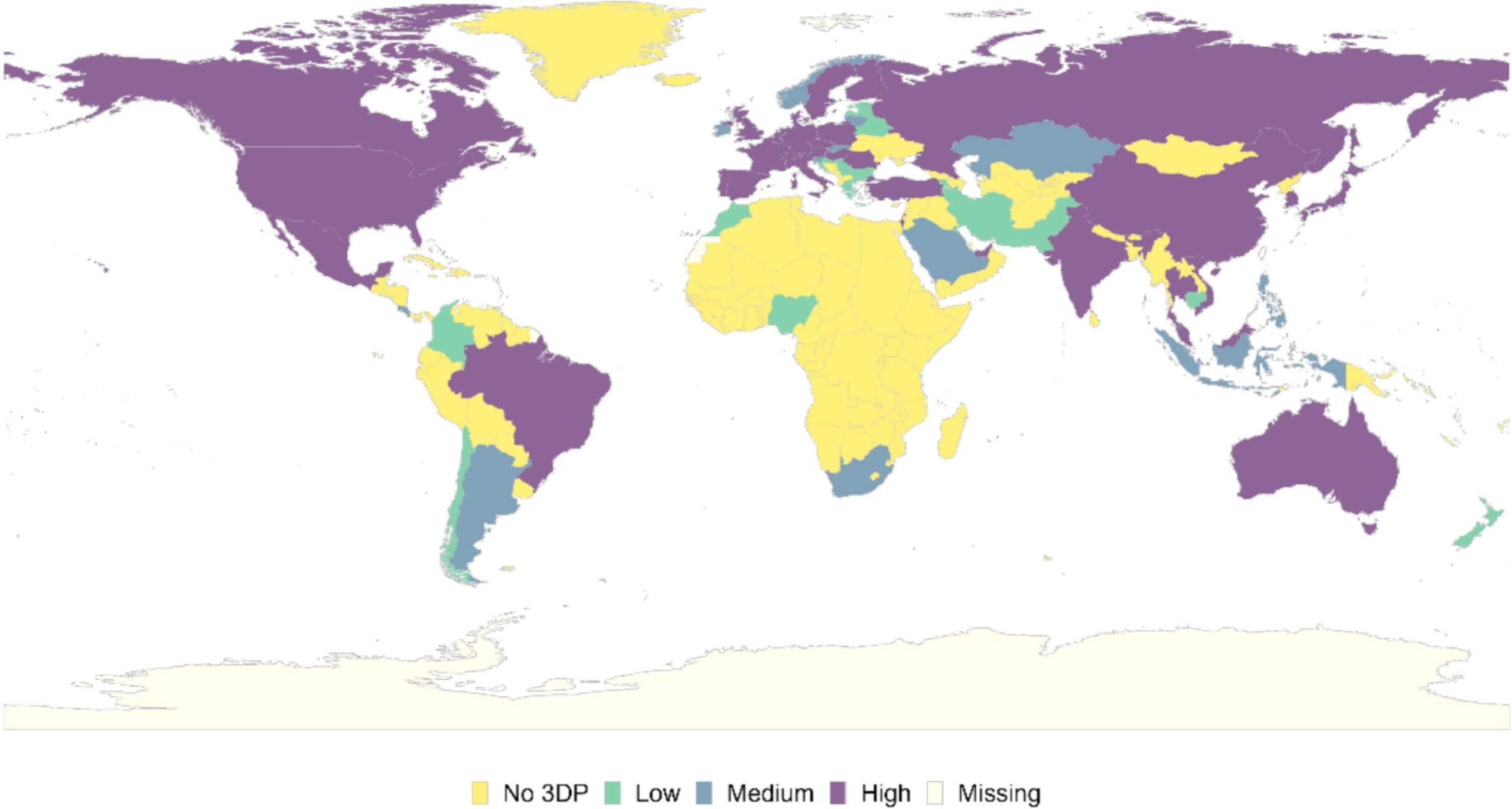
The map reports the spatial distribution of different levels of 3D printing adoption (low = 1 million USD, medium = 5 million USD, high = 10 million USD) across countries. Image courtesy of Utrecht University.
The researchers point to industries like aerospace, healthcare, automotive, and industrial manufacturing as areas where 3D printing could help countries move into higher-value production. In aerospace, companies like General Electric already use 3D printing to make lighter engine components. Ford has also used AM to print tools on demand across multiple facilities.
In healthcare, 3D printing is now widely used for products like hearing aids, dental aligners, implants, and surgical models. Because many of these products are produced in smaller volumes and rely more on digital design than giant factory lines, countries do not always need the same massive industrial infrastructure that traditional manufacturing required.
The hearing aid industry is one example. Today, nearly all hearing aids are made using 3D printing, according to earlier research cited alongside the study. As production became more digital and customized, countries like Mexico and Vietnam gained manufacturing market share in the sector.
Another major point in the study is that 3D printing could help bring manufacturing closer to home. Instead of relying entirely on large overseas factories and long global shipping routes, companies can produce parts closer to where they are actually needed. That can help shorten supply chains, reduce shipping costs, and lower dependence on major manufacturing hubs.
The idea became especially important during and after the COVID-19 pandemic, when supply chain disruptions exposed how vulnerable centralized manufacturing systems could become. People inside the AM industry have discussed these possibilities for years. But the Utrecht University study tries to connect those ideas directly to economic competitiveness and export performance.
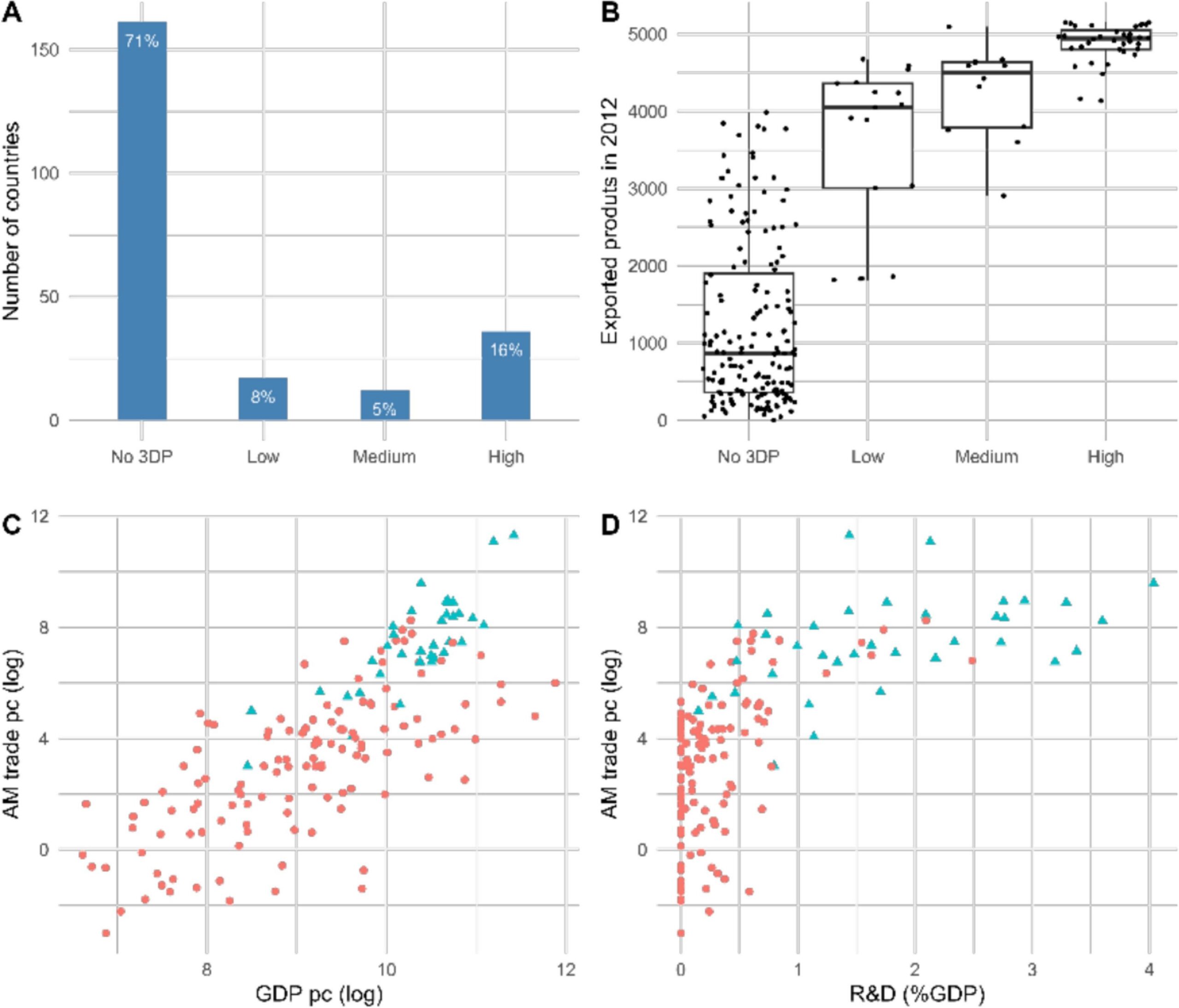
Distribution and characteristics of countries across levels of 3D printing adoption. Image courtesy of Utrecht University.
The researchers argue that countries integrating more 3D printing into industrial production are already starting to show export results closer to more established manufacturing economies.
The timing is also important
Over the last few years, trade tensions, tariffs, reshoring efforts, and supply chain concerns have pushed many governments to rethink manufacturing strategy. At the same time, AM has continued moving beyond prototyping and into real production environments.
Today, industries like dental, aerospace, medical devices, and defense are already using 3D printing to make finished parts that people actually use. That does not mean traditional factories are going away. Most manufacturing is still done the conventional way. But for products that need customization, smaller batches, or more complex designs, 3D printing is becoming a more useful option.
For developing economies, this could open a different path into manufacturing. Instead of trying to compete head-to-head with countries that spent decades building massive factory networks, they may be able to focus on smaller, specialized areas of production built around digital manufacturing and 3D printing.
The researchers are not suggesting that 3D printing will suddenly replace traditional manufacturing. Traditional manufacturing is still going to dominate large-scale production for a long time. But the researchers believe 3D printing could help smaller and developing economies compete in ways that were much more difficult before.
Instead, the study points to what the authors describe as a possible shift in the “geography of production,” where manufacturing activity could gradually spread beyond the countries and regions that have traditionally dominated industry. According to the study, the bigger change may not be the printers themselves, but how digital manufacturing could slowly reshape where products are made around the world.
Subscribe to Our Email Newsletter
Stay up-to-date on all the latest news from the 3D printing industry and receive information and offers from third party vendors.
Print Services
Upload your 3D Models and get them printed quickly and efficiently.













You May Also Like
UniFormation S10 Heads to Kickstarter with an Integrated Resin Printing and Post-Processing System
UniFormation will launch its S10 desktop resin 3D printer on Kickstarter on October 22, 2026, with pledges starting at $999. The S10 integrates printing, washing, and drying, allowing a print...
Creality Goes Pro with Sermoon P1S 3D Scanner
From making millions of value-engineered Prusa clones, Creality really has aggressively pivoted to more complex machines. The company has made strides forward in software, and the Ender’s of yore is...
Stratasys Showcases 3D Printed Automotive Applications & New Printer at IMTS 2026
Just ahead of last week’s International Manufacturing Technology Show (IMTS) in Chicago, Stratasys launched the F870, a new large-format, production-grade FDM 3D printing platform designed to drive industrial manufacturing at...
Creality Launches SPARKX i8 on Indiegogo, Bringing Fastest, No-Purge-Waste Printing
Creality announces the launch of the multi-color 3D printer SPARKX i8 on Indiegogo, at an early-bird price of $309 (MSRP $399) starting from Sept. 21. Designed for ultimate user experience,...