US Continues to Transfer Expeditionary 3D Printing Know-How to the Pacific


At this year’s Balikatan event, an annual joint exercise hosted by the Philippines military with participation from Western allies, the US military trained Filipino troops in expeditionary manufacturing enabled by 3D printing and other digital production processes. A group of advanced manufacturing specialists known as ‘The Forge’, representing the US Army’s Hawaii-based 25th Infantry Division, taught their partners in the Pacific how to manufacture in a warehouse in the jungle, a skill that the US service members themselves had only begun acquiring the previous year.
As I noted in my story about that event, the geography of that instance of tech transfer is anything but accidental, with Indo-Pacific Command (INDOPACOM) prioritizing a buildup of deployable additive manufacturing (AM) capabilities in China’s neck of the woods. The primacy of that theme was just reinforced by the US military’s announcement that it recently supplied Marines stationed in Okinawa with a new production system called the Advanced Integrated Mobile Machine Shop (AIMMS).
Developed by US Navy civil engineers from Naval Surface Warfare Center (NSWC) Carderock’s Advanced Manufacturing Branch, and only just completed in February 2026, AIMMS is a containerized unit that in photos appears to leverage a Phillips Additive Hybrid unit, comprised of a Haas CNC mill and laser metal deposition (LMD) from brands including Meltio. The Phillips Additive Hybrid has become a standard choice for the US Navy thanks to its deployability, validated by its installation on US Navy vessels.
While that doesn’t mean that soldiers will be riding around in AIMMS — which can be transported via attachment to a tactical vehicle — and printing parts on-the-go, its mobility does mean that it can be taken from place to place far more quickly than would a fixed installation. In addition to enabling resupply of critical parts close to the point-of-need, that also suggests the possibility of moving the same unit around for training purposes.
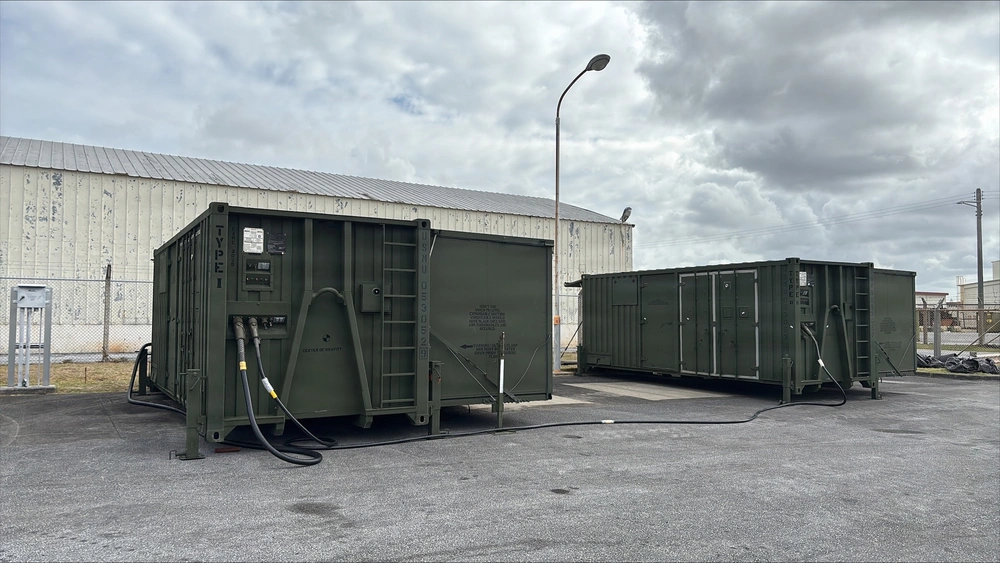
A built-in training curriculum is certainly part of the appeal of containerized manufacturing, with DVIDS noting that getting service members up to speed on the basics of AIMMS takes about a week and a half, which is becoming something of a standard timeframe for introducing US military personnel to digital manufacturing techniques. And the training sessions are just as valuable to the engineers responsible for producing the equipment: according to DVIDS, Carderock is using feedback from initial trials at both Okinawa and Camp Pendleton to shape future versions of the system.
Notably, Phillips announced just last week that the company will be participating in the 2026 edition of RIMPAC, the world’s largest international maritime exercise, held in the Pacific. Phillips will specifically be demonstrating the Additive Hybrid system at the event, suggesting that the AIMMS delivery to Okinawa is part of that context.
The relationship between the US and Japan surrounding industrial policy is a topic I keep coming back to for a variety of reasons, and it seems relevant here as well. Japan is the US’s major partner in RIMPAC, and it would appear that, just as US troops shared their expeditionary manufacturing know-how with their Filipino counterparts back in March, the US will be sharing that same knowledge base with its Japanese allies over the course of the next month.
Now that AM-enabled distributed manufacturing is becoming a reality, rather than simply a theory, it will be particularly interesting to track the shift in the pace of development, above all since more and more users are gaining the capability over the range of a genuinely distributed geography. Japan, for instance, is precisely the economy that should be able to take the newfound technical skill and run with it.
Images courtesy of DVIDS
Subscribe to Our Email Newsletter
Stay up-to-date on all the latest news from the 3D printing industry and receive information and offers from third party vendors.
Print Services
Upload your 3D Models and get them printed quickly and efficiently.











You May Also Like
3D Printing Financials: Tekna’s Revenue Up 61 Percent YOY
As my recent post about tungsten demonstrates, critical materials are like an avatar for the current dynamics shaping the global economy. This presents an opaque mix of challenges and opportunities...
3D Printed Prosthetics Have Come a Long Way. HP and DyeMansion Look at What’s Next
3D printing has made it easier to produce prosthetics and orthotics tailored to individual patients. But making that work on a larger scale comes with its own challenges. For companies...
3D Printing Financials: Nikon’s Digital Manufacturing Revenue Grows 77% as Sam O’Leary Moves to Supervisory Board
Nikon (TYO: 7731) just announced its earnings for Q2 (fiscal year ending March ’27), and we learned that the digital manufacturing business grew revenue by 77 percent to ¥17.4 billion...
The AM Production Gap Is Real. So Is the Progress
Additive manufacturing (AM) has become very good at proving what is possible. Companies can print complex metal parts, reduce weight, combine multiple components into one, and produce designs that are...