Vienna Team Works to End Trial-and-Error in Hybrid 3D Printing Workflows

A new research project shows how 3D printing and machining can finally work in sync. Led by researchers at the Vienna University of Technology in Austria (TU Wien), the project aims to plan and optimize every step of hybrid manufacturing, from 3D printing to machining, before production even begins.
A team of engineers from TU Wien’s Institute of Production Engineering and Photonic Technologies (IFT) developed smarter ways to combine additive and subtractive manufacturing (or machining) processes in a single, streamlined workflow. If done right, this hybrid manufacturing can save time, cut costs, and reduce waste, especially in factories that make large or complex parts.
3D printing and machining, which are often treated like two separate worlds, can be brought together in a way that’s actually practical for manufacturers.
From Metal Wire to Finished Part
The research focused heavily on Wire Arc Additive Manufacturing (WAAM), a technique used to 3D print large metal parts using welding wire. WAAM is ideal for creating big, heavy-duty components, but those parts still need to be milled or smoothed out afterward. That’s where things often get complicated and expensive, the experts explain.
According to the team, they found ways to predict how each 3D printed part would behave before printing even begins. Using digital simulations, they could estimate how the part would shrink, where it might warp, and how much material would need to be removed.
They also tested machine hammer peening, a technique that smooths and strengthens the surface of a printed part before it’s machined. They combined it with other treatments like shot peening, which uses small metal balls to toughen the surface, and Hirtisation, a chemical process that removes rough edges and leftover powder. The combination led to more uniform and durable parts.
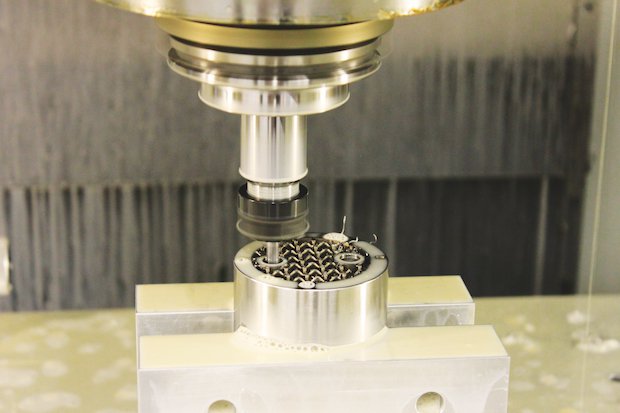
Thread milling an additively manufactured component. Image courtesy of Imperial Machine Co.
IFT’s big contribution was a simulation model that helps factories plan printing and machining in advance. This includes calculating how much extra material needs to be printed to allow for finishing, where stresses or rough spots might appear, and how to machine the part more efficiently afterward. The result is less material waste, shorter machining time, and fewer surprises.
Making It Work for Small Manufacturers
While hybrid manufacturing sounds high-tech, the project was designed with small and medium-sized companies (SMEs) in mind. Many of these businesses are interested in 3D printing but don’t have the resources for complicated workflows or expensive quality control setups.
The IFT team worked directly with 15 Austrian companies to test and validate real-world applications, making sure the tools they developed could actually be used in day-to-day factory settings, including approaches for the seamless integration of WAAM processes into existing production lines. The goal was always to make hybrid manufacturing more affordable, scalable, and practical.
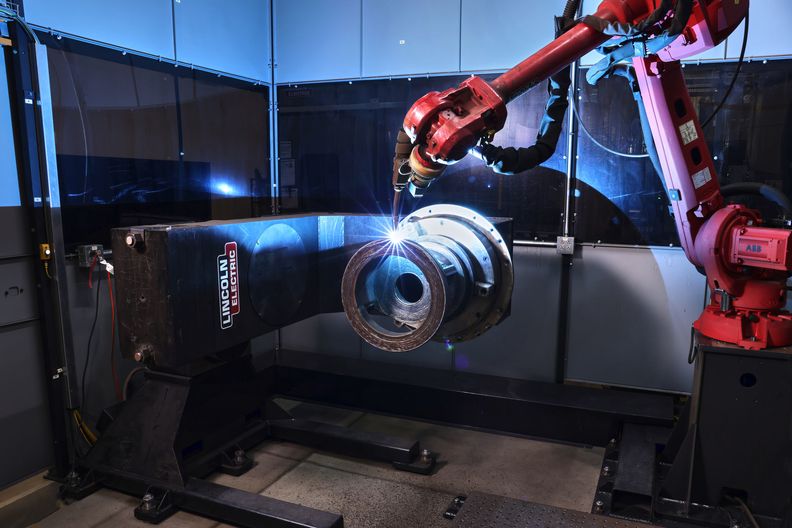
A robotic welder builds a piece of equipment layer by layer using its wire-arc additive manufacturing process. Image courtesy of Lincoln Electric.
Another part of the project focused on creating a smart software system that can adjust how machines move based on real-time sensor data. This system, described as a CAM rule engine, is linked to a central database that collects information from every step of the manufacturing process. Together, they help factories move closer to fully automated, data-driven production.
A Team Effort Across Europe
This work was part of a larger international effort called Advanced Processing of Additively Manufactured Parts – Phase II (Ad-Proc-Add II), a research project focused on improving how 3D printing and machining work together in real factory settings. The project brought together teams from Austria, Germany, and Belgium, including universities, industry groups, and research institutes. Partners like the Institute for Machine Tools at the University of Stuttgart, the Institute for Machining Technology at TU Dortmund, and KU Leuven in Belgium all contributed to making hybrid manufacturing faster, smarter, and easier to adopt.
What’s more, industry groups like the ecoplus Mechatronics Cluster and Research Association for Mechanical Engineering (FKM) in Germany helped turn the research into real tools that companies can actually use in their factories.
It was funded by national innovation agencies from each country, with strong backing from Austria’s Research Promotion Agency and Germany’s Ministry for Economic Affairs and Climate Action.
This project proves that 3D printing and machining can work together in a smarter, more practical way, so that 3D printing is not isolated from the rest of the factory floor. In the end, it will help connect additive and subtractive processes, making them usable for everyday manufacturers.
The findings will be presented at the World Machine Tool Exhibition (EMO) 2025 in Hanover, one of the world’s biggest trade fairs for industrial manufacturing.
Subscribe to Our Email Newsletter
Stay up-to-date on all the latest news from the 3D printing industry and receive information and offers from third party vendors.
Print Services
Upload your 3D Models and get them printed quickly and efficiently.













You May Also Like
3DPOD 316: Beehive’s Gordie Follin on 3D Printed Engines and More
Gordie Folin had deep experience in engineering at Pratt & Whitney, GE, and GE Aviation before becoming the Chief Product Officer at Beehive Industries. Among his achievements, he served as the...
3DPOD 315: Dirk Simon, from BASF to Farsoon to FKM, and now Square New Business
Dirk Simon had already spent years in the chemicals industry before joining and pioneering BASF‘s 3D printing effort. We get to hear how that firm looked at 3D printing and...
Printing Money Episode 42: Q2 2026 Public Markets 3D Printing Earnings Analysis with Troy Jensen, Cantor
Welcome to Printing Money Episode 42. Troy Jensen (Managing Director, Cantor) returns, joining Danny Piper (Managing Partner, NewCap) to review Q2 2026 publicly traded 3DP/AM company earnings reports. Troy’s quarterly...
3DPOD 314: Debinding, Sintering, and Metal Binder Jetting with Stefan Joens, Elnik Systems and DSH Technologies
Stefan Joens of Elnik Systems sells ovens. Their debind and sintering equipment powers a lot of high-volume binder jet and MIM production. We learn about Elnik and its origins. But...