Sintavia Buys AMCM Metal 3D Printer with nLight Lasers

Additive manufacturing (AM) service specialist Sintavia recently received a $10 million investment and is already putting the funds to use. The company has purchased a twin-laser AMCM M290-2, equipped with dual 1.2 kW lasers supplied by nLight.
“We welcome this new addition to our fleet of printers. Over the coming years as we develop and apply this new technology, we expect to be able to print our components at layer thicknesses of 150µm or more without losing any material properties, thus greatly increasing the output of our installed printers. The best part of the nLIGHT system, once it is fully tested, is that it can be retrofitted on other existing EOS and AMCM printers with minimal new equipment,” said Sintavia´s CEO Brian Neff.
“We can think of no better home for the first dual nLIGHT system in the U.S. than Sintavia. With their vertically integrated additive manufacturing capabilities, including extensive testing labs, they are well-suited to help develop and expand the capabilities of the nLIGHT laser beam shaping technology,” said Martin Bullemer, Managing Director of AMCM.
Sintavia has not yet disclosed whether a particular client, material, or application will be the primary focus of these printers. However, through beam shaping, the company aims to double or even triple the layer thickness of its builds. This approach is also expected to significantly reduce troublesome condensate, with Sintavia claiming that nLIGHT’s lasers can cut condensate production by 70%. Given that condensate byproduct can consume roughly a third of the powder, this reduction is substantial. Less condensate means more reusable powder, improving process economics. Additionally, more fully melted layers could result in stronger parts with enhanced properties, such as higher creep strength. This could be a key advantage for Sintavia in manufacturing components like propellant tanks for aerospace applications or pressure vessels in general.
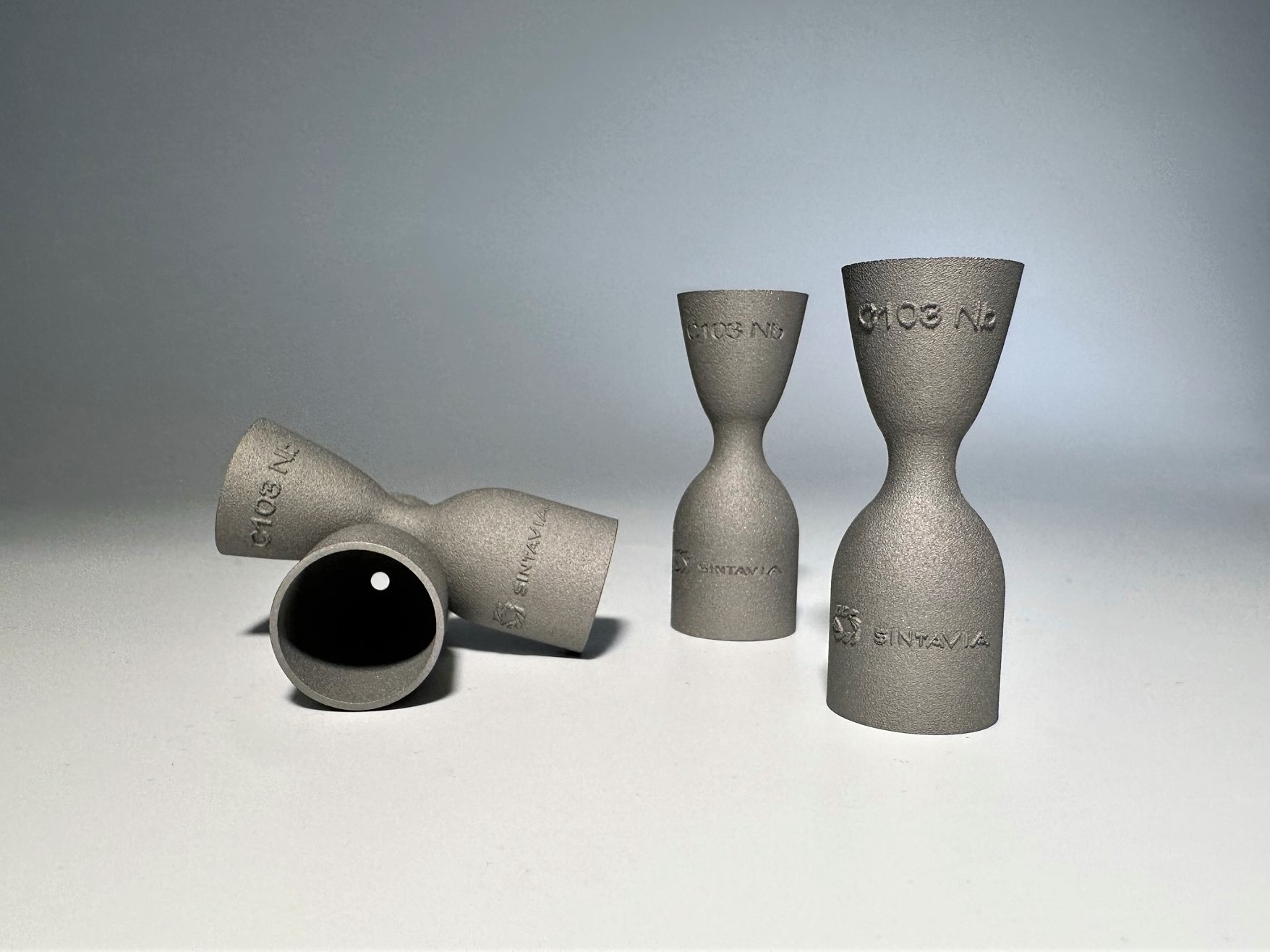
Sintavia AM parts for aerospace. Image courtesy of Business Wire.
Given Sintavia’s demanding clients and the complex parts it produces, the company is a dream client for nLight. Its work on submarines—including its collaboration with Bechtel on an impeller—along with its extensive aerospace clientele, provides endless opportunities. The submarine sector alone could sustain the AM industry for years if more parts could be successfully transitioned to AM.
Sintavia has invested heavily in its equipment, particularly in large-scale machines, including two SLM NXG XII 600s and three AMCM M4K-4s. This gives the company not just substantial capacity but also one of the largest fleets of large-format AM machines. Combined with its extensive qualification and quality assurance efforts, Sintavia holds a highly enviable position.
Few firms—such as Mimo Technik, I3DMFG, ADDMAN, and Incodema3D—can match this level of capability and scale. Even with tens of millions in funding, it would take years to build up the necessary capacity, certifications, and expertise that these firms have developed. Now, Sintavia is evolving from a service provider to a full design-to-production partner for defense and aerospace companies, focusing on heat management components such as heat exchangers and pumps.
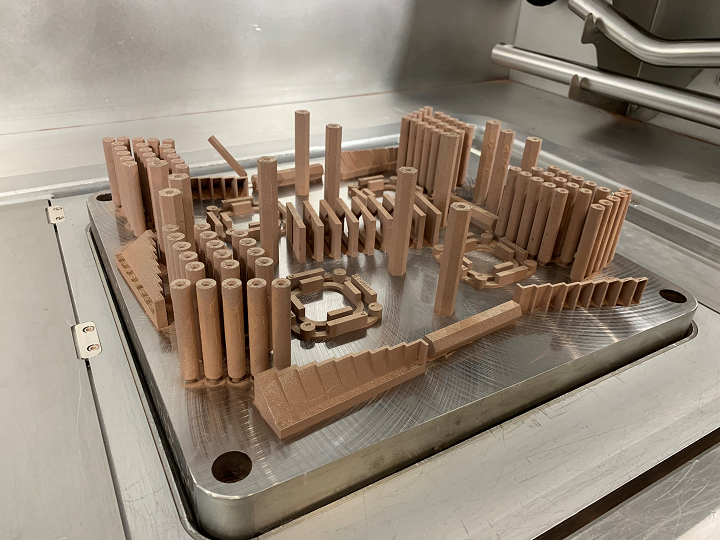
Copper parts 3D printed by Sintavia.
While other companies, such as Endeavor 3D, position themselves as contract manufacturers (albeit with ITAR compliance) or take a broader approach to defense, Sintavia is further specializing. This is a strategic move, as it enhances the company’s expertise, making it a highly valuable and sought-after partner in the industry. By concentrating on parts that deliver the most value to customers, Sintavia is focusing on the biggest potential payoffs. Sounds logical, right? Yet, no one else is doing it.
As a result, Sintavia is becoming more like Conflux and less like a typical 3D printing service. Overall, this is a smart approach. However, it does make the company highly dependent on a few key defense contracts and programs, which could be risky given the ongoing uncertainties surrounding the U.S. government. Nevertheless, by making bold investments and specializing, Sintavia is demonstrating how, with sufficient determination and capital, service providers can evolve into manufacturers of some of the highest-value additive parts in the world.
Subscribe to Our Email Newsletter
Stay up-to-date on all the latest news from the 3D printing industry and receive information and offers from third party vendors.
Print Services
Upload your 3D Models and get them printed quickly and efficiently.













You May Also Like
Stratasys Showcases 3D Printed Automotive Applications & New Printer at IMTS 2026
Just ahead of last week’s International Manufacturing Technology Show (IMTS) in Chicago, Stratasys launched the F870, a new large-format, production-grade FDM 3D printing platform designed to drive industrial manufacturing at...
3D Printing Financials: $28M in China, U.S. Deals and a Metal AM Comeback
Money continues to go into additive manufacturing (AM). From a $30 million raise for a Chinese metal 3D printing company to new funding for naval AM and a European company...
Stratasys Wins $27.6M in Patent Case Against Bambu Lab; Bambu Challenges Verdict
Update, September 21, 2026: This article has been updated with a statement from Bambu Lab responding to the verdict, along with additional information about the company’s ongoing patent challenges against...
AMAsia Pulse: AM Investment Picks Up Across Asia-Pacific
The first half of September brought fresh investment and expansion activity across Asia-Pacific’s additive manufacturing sector. China’s Xinjinghe secured funding for an aerospace AM hub, South Korea’s Lincsolution outlined plans...