Kupros Launches Cu29 V2, Announces Process for Embedded Electronics from Desktop FFF & FDM

In addition to its more traditional uses, the centrality of copper to an unusually large number of high-growth industries has led more than a few observers to argue that it could be the key industrial metal of the 21st century. At the same time, supply-side uncertainty has recently driven copper prices to all-time highs.
While that presents a massive economic challenge, it also represents a big opportunity for the additive manufacturing (AM) industry to demonstrate that AM can help improve efficiency in production workflows that depend on copper. That’s true, moreover, for areas of the AM value chain utilizing the lowest-cost desktop machines, not only for users of industrial systems targeting serial production. For instance, Indiana-based Kupros, Inc. makes an all-metal, conductive filament called Cu29, which can be printed on consumer desktop FFF/FDM machines. Kupros also provides services supporting users’ adoption of the material.
Aiming to lower the barrier-to-entry for electronics 3D printing, Kupros just launched Cu29 V2, the second-generation of the product, with an initial batch of 90 kilograms that already looks to be sold out. Meanwhile, the company is also developing a patent-pending workflow for expanding use of Cu29 beyond printing conductive traces. Kupros is going after even more complex applications, including embedded electronics, conformal antennas, sensors, and really any use case where AM seems like a good fit for electronics. According to Kupros, it has sent “Cu29-enabled sensor test articles” to Oak Ridge National Laboratory (ORNL), which will evaluate the results.
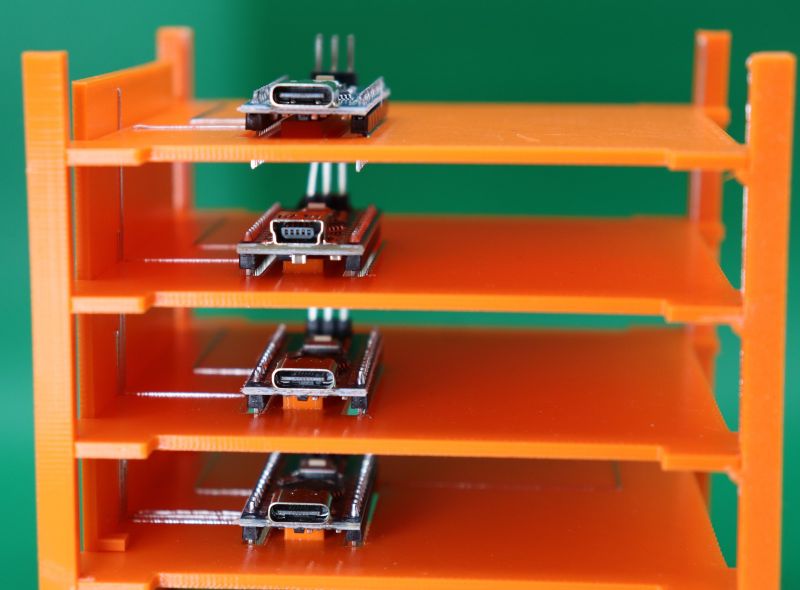
If you’re attending Fed Supernova 2026 (Austin, Texas, August 18-20) or J-DAMMIT 2026 (Harrisburg, Pennsylvania, August 25-27), you can learn more about Kupros and Cu29 in person. You can also read an interview I did last year with the company’s founder, Ian Ramsdell, a veteran Navy officer.
In a press release about Kupros, Inc.’s release of Cu29 V2, as well as its ongoing work on a patent-pending workflow for 3D printed electronics on desktop FFF and FDM printers, Ramsdell, who also serves as the company’s CEO, said, “V1 proved that this was possible,” Cu29 V2 is about making it easier for engineers to actually deploy. We spent the last year printing, breaking things, rebuilding them, listening to our early adopters, and understanding where the workflow created friction. V2 represents everything we learned from putting the first generation into the hands of real users.
“[The new workflow] is where the technology becomes much bigger than filament. Our objective has always been to change how electronics are manufactured. If you can introduce conductive pathways and electronic components directly during a standard FDM/FFF workflow, the printer stops being only a mechanical manufacturing system. It begins becoming an electronics manufacturing platform.”
I recently wrote about how the US Army DEVCOM Armaments Center was testing remote 3D printing for drone electronics repair at a recent exercise in the Indo-Pacific. One piece of feedback from the Marines participating in the drone repair challenge was that they want an automated solution for all-in-one electronics maintenance diagnostics and 3D printed electronics components, which can be used in rugged operating conditions.
Sciperio, the sister company to nScrypt, was the private sector partner working on the drone repair project with DEVCOM and the Marines. Since nScrypt has worked with Cu29, and since FFF/FDM machines are highly adaptable to the sorts of use cases the military is demanding, Kupros would seem like a good candidate to contribute to a diagnostic/repair tool. In any case, the exercise illustrates the rise of demand signals for low-cost, 3D printed embedded electronics.

From a longer term perspective, I think the education market could be another perfect match for Cu29. If reshoring is going to succeed in the US — and that appears to be a gigantic “if” — one of the biggest factors in determining that success involves maximizing the number of college-age and K-12 students who go on to work in manufacturing. That requires getting those future members of the workforce to become genuinely interested in manufacturing.
You know what American kids care about? Electronics, and very little else. While that has of course led to some very bad outcomes, most notably addictions to social media, the potential flip side is that an interest in electronics could be channeled into more constructive pathways, like education in valuable lifelong skills. Electronics aren’t going anywhere, but instead of an entire generation hoping to someday be paid by people who watch them play video games, maybe the future workforce can be encouraged to leverage their interest towards acquiring useful technical capabilities.
Images courtesy of Kupros, via LinkedIn
Subscribe to Our Email Newsletter
Stay up-to-date on all the latest news from the 3D printing industry and receive information and offers from third party vendors.
Print Services
Upload your 3D Models and get them printed quickly and efficiently.













You May Also Like
3D Printing Financials: $28M in China, U.S. Deals and a Metal AM Comeback
Money continues to go into additive manufacturing (AM). From a $30 million raise for a Chinese metal 3D printing company to new funding for naval AM and a European company...
Let the Games Begin! Xi Throws Down the Advanced Manufacturing Gauntlet
Sangmin Lee went to TCT Asia back in March and reported on the event for 3DPrint.com. He wrote two articles arguing that China’s AM industry looks “ready to scale.” This...
TCT Shenzhen 2026 Preview: What 80+ Side Events Reveal About China’s AM Market
Exhibitor lists tell you who is investing in floor space. Conference programs can tell you something different: what the market is ready to talk about. That makes TCT Shenzhen 2026...
3D Printing Market Hits $4.48B After Six Straight Quarters of Growth
The additive manufacturing market continued to grow in the second quarter of 2026, adding another quarter to what is becoming a much more consistent expansion for the industry. Worldwide revenue...