Reichenbacher Adds Metal 3D Printer Unpacking to Solukon’s Automated Depowdering Tech

Key to enabling the adoption of additive manufacturing (AM) in mass manufacturing is automation, as detailed in the “Automation and Additive Manufacturing: Opportunities and Markets” report from SmarTech Analysis. Yet, at this point in the industry’s evolution, there are still just a handful of firms dedicated to post-processing automation. About 80 percent of post-processing providers are 3D printer makers themselves. Among the leading players in metal AM post-processing is Solukon, whose depowdering technology has been used by customers in such high-performance industries as energy, space, and even particle physics.
Now, the German firm is taking its technology a step further by partnering with CNC machine maker Reichenbacher Hamuel GmbH to release a system that combines unpacking and depowdering phases into a single system. Altogether, the solution is meant to improve the efficiency and reduce the manual labor for metal laser powder bed fusion (LPBF).
Reichenbacher’s Emerging Role in 3D Printing
With 220 employees, Reichenbacher, is a globally recognized name in CNC processing centers and a subsidiary of the SCHERDEL Group. In turn, the parent company is a metal forming automotive business that is a market leader in piston ring springs. SCHERDEL boasts about 6,300 workers across some 29 locations around the world and annual sales revenues of €649 million, as of 2021.
Reichenbacher has been involved in additive since 2020, offering both granulate-based thermoplastic extrusion and LPBF. Developed with Hans Weber Maschinenfabrik GmbH, the ECO-Hybrid can both 3D print and mill plastic parts with 5-axis machining. For LPBF, the company offers two different systems, the smaller AMS 400 and the large-format AMS 800, with four 1kW lasers and a build volume of 800 x 800 x 500 mm. With a built-in handling system for transferring the built plate to the discharge station, the AMS 800 features one key element of the new technology developed with Solukon.
Post-processing Metal 3D Printed Parts
Typically, the post-processing of metal parts includes a series of time-consuming and labor-intensive steps. The process begins with the extraction of a 3D printed part from a ‘powder cake’ inside a container, followed by vacuuming and clearance of excess powder. The part is then moved to a Solukon system to automate the removal of unfused metal powder from the internal structure of the part.
The collaboration between Reichenbacher and Solukon aims to streamline this process by integrating both steps into one automated procedure. This novel system employs Solukon’s SFM-AT1000-S machine along with the SPR-Pathfinder software, developed with Siemens and then bought by Solukon. The software is designed for programmable two-axis rotation, adjustable vibration, and possesses a high-frequency knocker to aid in the removal of stubborn powder clumps.
-
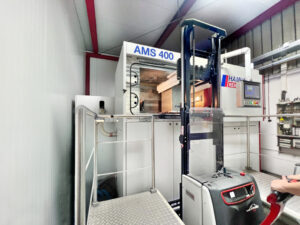
- A forklift removing a part from the Reichenbacher AMS 400 LPBF system
-
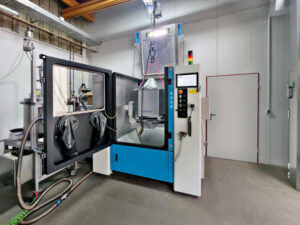
- and placing it into the Solukon SFM-AT1000-S depowdering system.
Within this combined unpacking and depowdering station, the entire container holding the printed part is loaded directly into the SFM-AT1000-S. The box, designed with a removable bottom and sides, is rotated upside-down to automatically discharge the initial loose powder. This material is then directed into an external material preparation station.
Once the box frame is removed, the Solukon system accesses the part for cleaning using SPR technology and SPR-Pathfinder software. The software, through the part’s CAD file, calculates the most efficient motion sequence for the Solukon system, optimizing the powder removal process.
“The SFM-AT1000-S with box unpacking is a project with a high degree of automation. Furthermore, it demonstrates how flexibly our systems can be used for individual customer solutions. We are happy to support Reichenbacher in their project unpacking boxes of laser-melted metal parts. This is how, together, we create a real competitive edge for Reichenbacher’s customers,” said Andreas Hartmann, CEO and CTO of Solukon.
“With Solukon, we once again have a system in our portfolio that has a truly unique selling point and makes us stand out in the area of postprocessing against standard solutions on the AM market. This puts Reichenbacher in a position to map the entire 3D printing process chain. We thank Mr. Hartman and team for their openness and fast execution of the project,” said Dr. Alexander Kawalla-Nam, Head of Additive Manufacturing for Reichenbacher.
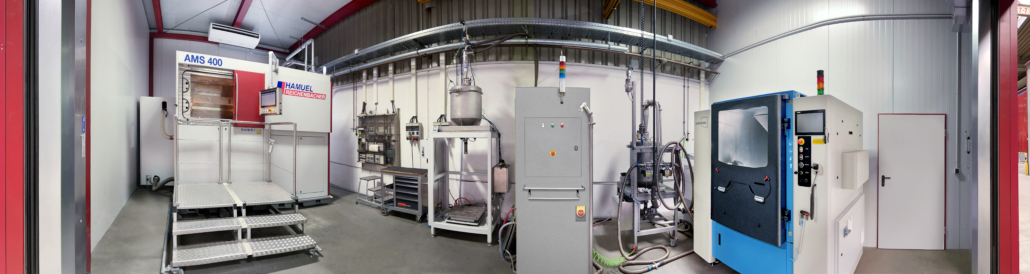
The SFM-AT1000-S, capable of combined unpacking and depowdering, is now offered by Reichenbacher, with Solukon acting as the system vendor. The system has already been field-tested successfully by a leading manufacturer of steel molds for the concrete industry. Given the high value of metal AM parts, technologies like those offered by these two partners will be crucial to standardizing automation across the industry. As it stands, we see large consortium projects like IDAM featuring BMW developing novel approaches. However, it will be the more readily available solutions offered by Reichenbacher and Solukon that drive widespread adoption and an AM post-processing industry that’s worth $1.3 billion by 2031, according to the “Post-Processing for Additive Manufacturing: Market Analysis and Forecast” report from SmarTech Analysis.
Subscribe to Our Email Newsletter
Stay up-to-date on all the latest news from the 3D printing industry and receive information and offers from third party vendors.
Print Services
Upload your 3D Models and get them printed quickly and efficiently.













You May Also Like
3D Printing News Briefs, October 10, 2026: Drones, WAAM, Ceramics, & More
We have a packed 3D Printing News Briefs for you this weekend! First, America Makes celebrated the recent National Manufacturing Day with 3D printed drones, and then it’s on to...
10 Years of Multi Jet Fusion: Onsite at HP’s Vancouver, Washington Facility
At this year’s RAPID event in Boston, HP Additive Manufacturing Solutions celebrated ten years in the additive manufacturing (AM) market. The company ushered in the milestone with several innovations, including...
PharmaTher Plans U.S. Network to 3D Print Medicines on Demand
3D printing medicines has often been tied to the idea of personalization, basically making a pill in the right dose, shape, or drug combination for a patient. PharmaTher is now...
3D Printing News Briefs, September 17, 2026: 3D Printed Boat, UAS Development, & More
We’ll start with maritime manufacturing in this week’s 3D Printing News Briefs, and continue on to defense 3D printing. We’ll end with funding for Tripo AI. Read on for all...