3D Printed Aircraft Sensors Could Make Flying Safer and Cheaper

The Madrid-based IMDEA Materials Institute is developing new, embedded sensors that allow for real-time monitoring of aircraft in flight. To place them within critical components, the team has relied on 3D printing. As a result of this unique technology, we could one day fly more safely, due to better predictive maintenance and the ability to inform maintenance crews of problems before such issues result in a devastating crash.
3D Printing Aircraft Sensors
 Dubbed the “Digital method for imprOved Manufacturing of next-generation MultIfuNctIOnal airframe parts (DOMMINIO)” project, the work is funded by the Horizon 2020 research program. Under DOMMINIO, the IMDEA team 3D printing parts embedded with carbon nanotube fibers. The piezoresistive properties of the carbon nanotubes can be used to generate data that can then be used to monitor the part.
The use of additive manufacturing (AM) could reduce assembly cost, while limiting the need for an obscene number of wires to connect the sensors together. Aircraft have between 70 and 300 miles of wire on board, with around 100 to 400 wiring harnesses keeping them in place, so adding more would not be ideal. Meanwhile ,any reduction in this wiring will reduce seat mile costs, making newer aircraft more desirable to buy. The new sensors are also very light and consumer comparatively little energy.
IMDEA Materials researcher Moisés Zarzoso noted, “The sensors are being designed to be made from these fibres, which are incredibly light compared to existing materials and which also consume very little energy. They are also 3D-printable and, given that they are CNT fibres, they can be easily embedded into a component manufactured from traditional carbon fibre, which is a very common material in aircraft production.”
From Sensors to Digital Twins
Key to the project is the use of digital twins, in which simulations of aircraft are created to mirror the physical assets. IMDEA is a leader in this computing-intensive area, using the information garnered from embedded sensors to create a digital copy of the physical part. Zarzoso explained:
“They are called digital twins because they are very accurate digital models that are updated during the whole life cycle, replicating the physical part or component within the aircraft in real-time. Through its embedded sensor, the physical part is able to communicate directly with engineers on the ground. If, for example, you had an impact during flight from hailstones, information relating to any possible damage to the part would be recorded by that sensor and then sent automatically to its digital twin. Using that information, the simulations that we are developing will be able to analyze the risk that a potential impact could induce in the structural integrity of the component, and to determine its remaining lifespan.”
Improving Aircraft Maintenance by 3D Printing Smart Sensors
With this technology, not only can airlines fly more safely, but they can also save costs in a variety of ways, including: more accurate maintenance intervals, signaling of problems before they cause flight delays, and the monitoring and analytics of components. Real-time monitoring in and of itself can allow for a completely new way of looking at aircraft maintenance that is sensor-driven, rather than the schedule-driven methods used today.
Event-based signaling could become an important piece of airframe and plane component monitoring. Protocols could be developed to look out for telltale signs of impending failure or to conduct specific monitoring in the face of different events. In-flight knowledge of faults might even let crews land aircraft preemptively, cutting short a flight that may have crashed hours later due to key component failure.
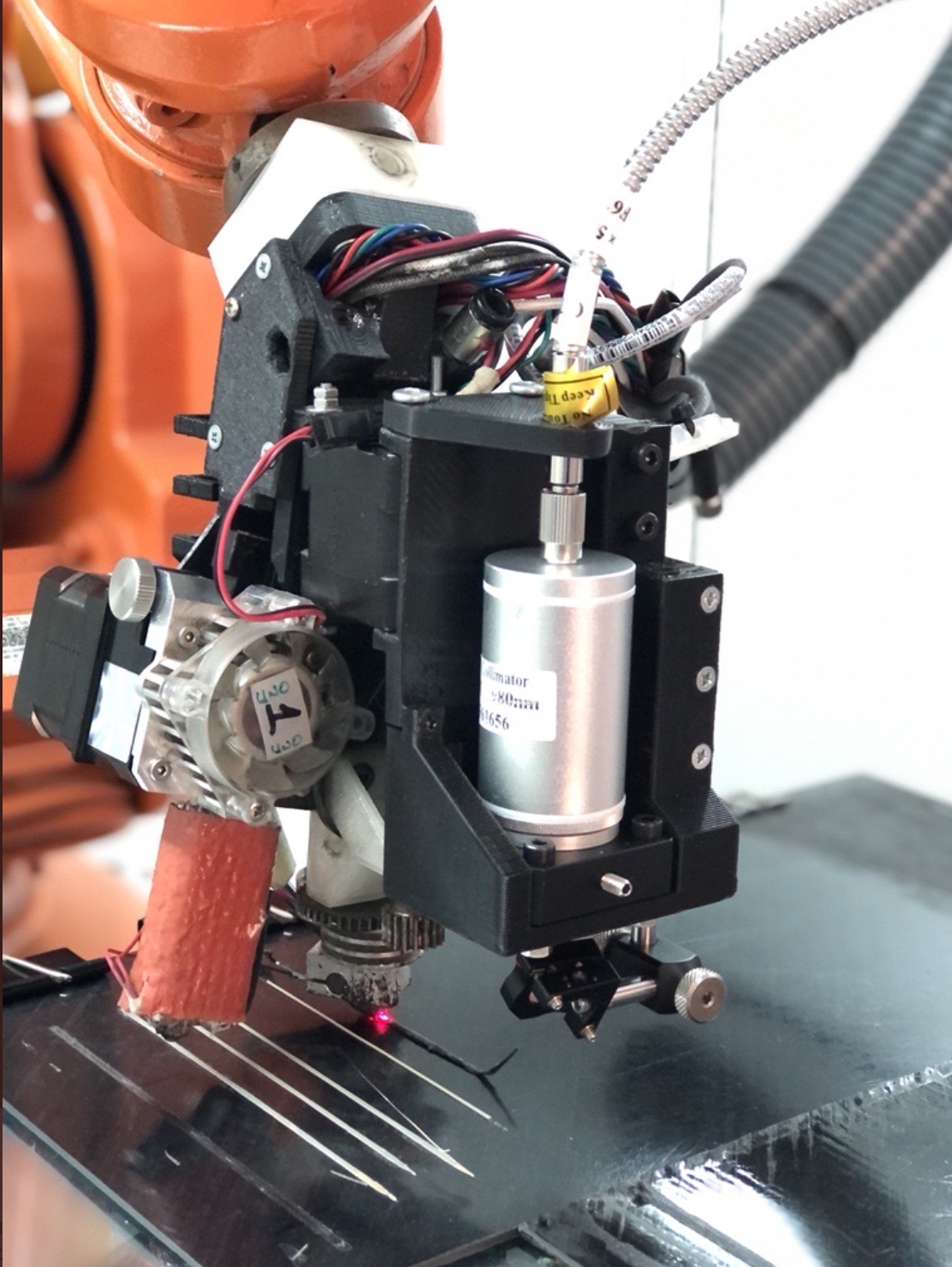
A lot of parts on aircraft are now 3D printed composites. Embedding carbon nanotubes while manufacturing components with robotic arms would seem to fit well into the overall workflow. In particular, if we look at Arris, Impossible Objects, and others, we could see how 3D printed sensor components might be integrated into aircraft parts. Even for metal elements, it would be possible to integrate sensors using something like Fabrisonic’s ultrasonic AM, which does not use heat to print objects, so that sensors can survive the manufacturing process. A number of nano printing companies could also provide 3D printed sensor components for strain, vibration, pressure or more.
IoT has long been a buzzword. It is still unclear if everything will be connected at all times to the internet via sensors. However, what is clear is that embedded sensors make sense for high-value and critical objects or processes, such as dams or aircraft. For these kinds of objects 3D printing can provide a cost effective path to making integrated sensor packages and embedding them in our world.
Subscribe to Our Email Newsletter
Stay up-to-date on all the latest news from the 3D printing industry and receive information and offers from third party vendors.
Print Services
Upload your 3D Models and get them printed quickly and efficiently.











You May Also Like
Colorado School of Mines’ First Satellite Campus is Part of ASTRO’s AM Hub in Guam
As I posted about last month, the Guam Additive Materials and Manufacturing Accelerator (GAMMA), a joint project of the Applied Science and Technology Organization (ASTRO) America and the Government of...
3D Printing News Briefs, November 29, 2025: Submarine Industrial Base, Running Shoe, & More
In this weekend’s 3D Printing News Briefs, we’ve got more news from Dyndrite, which has launched the NXG Slice Viewer for Nikon SLM Solutions. Farsoon Europe has news to share...
Formnext 2025: New Metal PBF 3D Printer, Serial Production Applications, & More
It’s Day 2 of Formnext 2025, where over 800 exhibitors from around the world have converged in Frankfurt for Europe’s premier additive manufacturing (AM) trade show. From exciting new printers...
Aibuild and Reichenbacher Hamuel Ink Partnership
Aibuild will partner with Reichenbacher Hamuel to bring to market multi-axis CNC hybrid tools with AI toolpathing. Aibuild is well known, of course, as a 3D printing software firm that connects...