Colorado School of Mines’ First Satellite Campus is Part of ASTRO’s AM Hub in Guam


As I posted about last month, the Guam Additive Materials and Manufacturing Accelerator (GAMMA), a joint project of the Applied Science and Technology Organization (ASTRO) America and the Government of Guam, expects to be operational starting in Q1 next year. ASTRO, Guam’s Governor Lou Leon Guerrero, and a host of other stakeholders held the ribbon-cutting ceremony on November 6 to celebrate one of the major milestones for an effort that has been in the works for nearly five years.
Now, the Colorado School of Mines (Mines) is announcing a related milestone of its own, the opening of its first satellite campus, which will be located on the grounds of the University of Guam (UOG), and, according to Mines, will be “a key component” of ASTRO’s work on GAMMA. In addition to being Mines’ first satellite campus, Mines also states that this is in fact “the first-ever satellite campus of a mainland university” on Guam, with the first cohort of students expected to begin classes in the Fall of 2026.
Mines has a uniquely extensive history with AM, having established the Alliance for the Development of Additive Processing Technologies (ADAPT) in 2016, in partnership with founding stakeholders like Lockheed Martin and Ball Aerospace (now part of BAE Systems). ADAPT will partner directly with the UOG satellite campus, where students can specialize in AM through elective courses from the Mines Additive Manufacturing Interdisciplinary Graduate Program.
ASTRO America has already invested $5 million in the program, and, contingent upon the Navy’s decision on a planned option related to the initiative, ASTRO may invest an additional $12 million. Students will take introductory classes from UOG for the first two years of their education, with Mines instructors at the satellite campus providing AM-focused mechanical engineering coursework in the final two years.
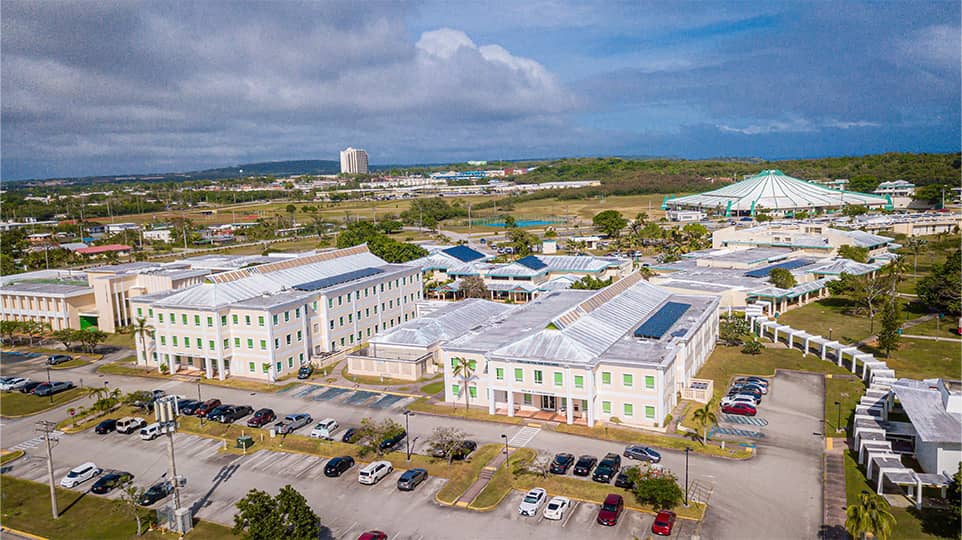
The University of Guam campus. Image courtesy of UOG.
In a press release about the Colorado School of Mines’ opening of an AM-focused satellite campus on Guam, the university’s president, Paul C. Johnson, said, “We’re excited for this new partnership because of what it offers students, the universities and the U.S. military. The students receive the opportunity to earn a Mines degree in Guam, and the University of Guam and Colorado School of Mines benefit from the investment in state-of-the-art advanced manufacturing facilities and closer ties to the U.S. military and supporting industries in the Pacific — both of which will benefit from the graduates, innovation and capabilities that grow out of this strategic partnership. Mines is a leader in [AM], and this partnership builds on that and extends the global reach and impact of that program.”
Joy Gockel, Associate Professor of Mechanical Engineering and Executive Director of ADAPT, said, “Collaboration with the University of Guam and the GAMMA Applications Center offers an exciting opportunity to expand the breadth and impact of our [AM] research. Together, we can advance application-driven innovations that enhance supply chain resilience and accelerate the development of next-generation [AM] technologies.”
This has been a fascinating project to watch unfold over the last few years, and I love that this is the direction it’s taken. As I mentioned in my post last month on the ribbon-cutting ceremony, I think GAMMA should be viewed as a model that can be replicated elsewhere, and I’m sure that’s at the front of ASTRO’s mind.
The partnership with Colorado School of Mines makes that possibility all the more feasible because there are plenty of other universities across the U.S. that would benefit from similar collaborations. ASTRO also already has experience working with other universities on this sort of thing, having launched AM Forward Florida with multiple higher education institutes in the state.
In this context, I think a worthwhile approach that ASTRO could take would be to work with universities to develop accelerated vocational training programs with technical schools, community colleges, and even high schools. Again, there are many organizations out there that ASTRO could partner with to implement such a plan.
It’s also worth standing back and acknowledging that when a university as distinguished as Colorado School of Mines made the decision to open its first satellite campus, it did so with the goal of advancing AM as a top priority. This is no small endorsement of AM’s viability, and is only the latest evidence that research universities are critical to the future of AM commercialization.
Featured image courtesy of ASTRO America and the Colorado School of Mines
Subscribe to Our Email Newsletter
Stay up-to-date on all the latest news from the 3D printing industry and receive information and offers from third party vendors.
Print Services
Upload your 3D Models and get them printed quickly and efficiently.













You May Also Like
3D Printing Financials: 6K Additive Reports Record Quarter as Demand Grows for U.S.-Made Metal Powders
Demand for metal powders made in the United States continues to grow, particularly from aerospace and defense customers. That was one of the biggest takeaways from 6K Additive‘s (ASX: 6KA)...
Hadrian and Fortastra Bet on Automated Factories to Fix Satellite Production Bottlenecks
Demand for satellites continues to grow, and manufacturers are looking for ways to build spacecraft faster without affecting performance. One way to do that is to involve manufacturing companies earlier...
Beehive Industries Invests $70M in Ohio to Support Its Advanced Manufacturing Buildup for Propulsion
Beehive Industries and the state of Ohio have each been killing it in the metal 3D printing game. Naturally then, it was only logical for Beehive and Ohio to combine...
IperionX Raises $50 Million to Expand U.S. Titanium Production
IperionX has raised about $50 million through a public offering to speed up the commercial rollout of its U.S. titanium manufacturing business. The company sold 2.275 million shares at $21.98...