
Aibuild and Reichenbacher Hamuel Ink Partnership

Aibuild will partner with Reichenbacher Hamuel to bring to market multi-axis CNC hybrid tools with AI toolpathing. Aibuild is well known, of course, as a 3D printing software firm that connects robot arms, toolheads, software, and toolpathing to let people make their own polymer and metal 3D printers and other machines. Reichenbacher Hamuel is less known, but it shouldn’t be; the storied firm is a high-end builder of machine tools. The company manufactures large CNC machining centers, whole automated lines, and has two LPBF printers, a hybrid DED repair cell, a hybrid 3D printer, and a material extrusion machine on the market. Reichenbacher also manufactures a wide range of custom machines and lines. Their deep experience and abilities make this a very significant partnership indeed.
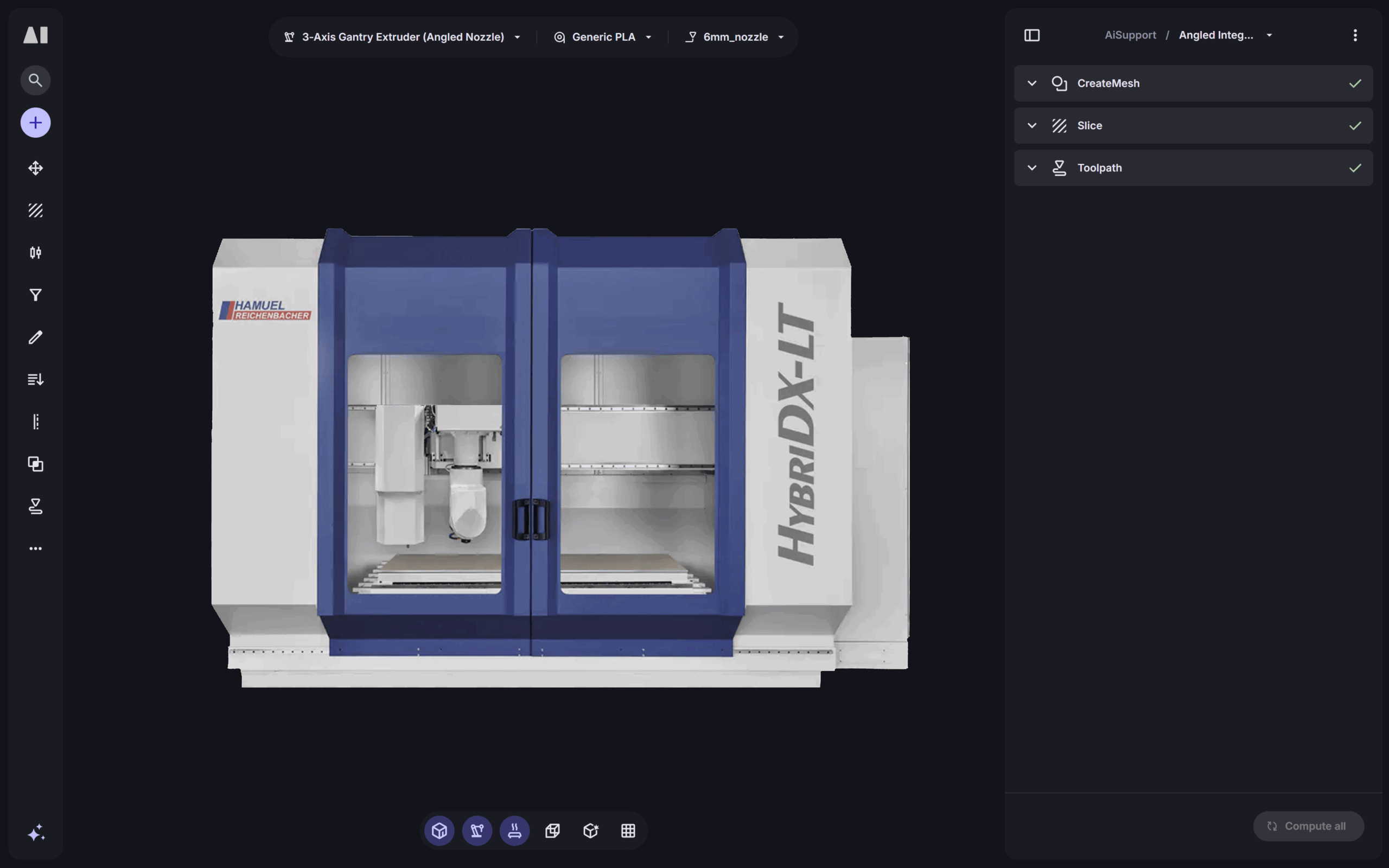
Aibuild software for the Hybrid machine from Reichenbacher Hamuel (in partnership with Aibuild). Image courtesy of Aibuild.
Aibuild COO Michail Desyllas said,
“Our partnership with Reichenbacher represents a pivotal convergence of hardware excellence and intelligent software automation. Reichenbacher’s hybrid machines are exceptional platforms for custom manufacturing, and by integrating our AI-driven toolpath and thermal simulation capabilities, we’re enabling manufacturers to achieve unprecedented levels of precision, efficiency, and flexibility in complex component production.”
Meanwhile, Dr. Alexander Kawalla-Nam, Head of Additive Manufacturing Technologies of Reichenbacher Hamuel, stated,
“This partnership marks the beginning of a new era in manufacturing — where intelligence, precision, and creativity converge. At Reichenbacher, we have always believed that the future of production lies in uniting the physical and digital worlds. By combining our hybrid machine and CNC milling expertise with Aibuild’s AI-driven automation, we are turning that vision into reality. Together, we are creating systems that think, adapt, and optimize in real time — enabling manufacturers to move beyond conventional limitations and reimagine what’s possible in industrial-scale production. It’s not just about making parts; it’s about reshaping how ideas become reality.”
And Aibuild CEO Daghan Cam mentioned that,
“The convergence of Aibuild’s platform with Reichenbacher’s proven hardware excellence creates something genuinely transformative, For SMEs and specialized manufacturers operating in DACH and across Europe, this partnership delivers the tools needed to compete with larger manufacturers while maintaining the flexibility and customization that defines their market position.”
I’m a huge fan of both Aibuild and Reichenbacher Hamuel. Furthermore, I really believe that the future of additive is in customized machines made specifically to produce certain part families in a particular material. A Tungsten machine is made specifically to produce CT collimators at scale. This means that specific things, such as the heavy plates of tungsten or the materials’ low density, can be optimized for. Meanwhile, a machine can be optimized to produce one row of collimators and turn around that one row as fast as possible or to push out multiple builds for higher productivity. For production, you could use a machine meant for many materials and use cases, but you risk paying too much for what you don’t need or not having key features that you do need. This move seems set to empower integrations, use cases, and customization that were heretofore not possible, and that’s a great thing. In the hybrid space, much of mold rejuvenation, component repair, and actual manufacturing is yet to be properly explored.
The pair shows how to reduce waste, production time, and complexity. Specifically for tooling, fixtures, architectural parts, and composites, the duo hopes to make more possible. They hope that Aibuild’s predictive software and optimization will marry with the distribution and reliability talents of Reichenbacher. It’s notable that Aibuild has Nikon as an investor, so it’s nice for the ecosystem that they are open to this kind of innovation that extends the capabilities of the market, but could be seen as competitive or perhaps just not related enough to LPBF.
In hybrid metal and hybrid polymer, the sheer volume of applications is extensive and potentially very profitable. From outdoor advertising, pools for super yachts, pump tracks, construction components, and more, there is a lot that needs to be explored. With this partnership, we could see a family of machines being developed that could meet that market’s needs.
Subscribe to Our Email Newsletter
Stay up-to-date on all the latest news from the 3D printing industry and receive information and offers from third party vendors.
Print Services
Upload your 3D Models and get them printed quickly and efficiently.













You May Also Like
The Money Behind AM: What to Watch at AM Investment Strategies 2026
For years, simply being a 3D printing company could attract attention from investors. New machines, new materials, faster speeds, and the promise of mass production were often enough to get...
3D Printed Football Helmets Are Amazing Business. They’re Also So Much More
NFL football is by far the most popular sport in the US, followed by college football (a state-of-affairs oddly similar to the fact that the world’s largest air force is...
Continuous Composites Wins Navy SBIR for 3D Printed UAVs
In a diversification effort, Continuous Composites has decided to seek work outside of the courtroom. The company that has been successful in defending its patent portfolio in composite 3D printing...
When Data Becomes the Differentiator: Qualified Material Data is Changing the Future of Structural Additive Manufacturing
For years, additive manufacturing has promised engineers greater design freedom. The challenge wasn’t printing the part—it was proving the part belonged on an aircraft. Designing a lightweight bracket or consolidating...























































