AUKUS Installs Metal Part 3D Printed on a Deployed Submarine Tender


In a project showcasing virtually every major theme that has been driving military interest in additive manufacturing (AM) over the last decade, sailors on the U.S. Navy’s Emory S. Land-class submarine tender USS Frank Cable 3D printed a metal component that was subsequently installed on the USS Vermont, a Virginia-class fast-attack submarine. Sailors on the Frank Cable used a hybrid system to print and machine “a stainless-steel hand wheel for a diesel fuel oil transfer valve” and then machine it, a process which took six days (just under five for printing and less than two for machining).
Once the part was finished, it was hand-delivered at Australia’s HMAS Stirling, a Royal Australian Navy (RAN) base, and finally, installed on the Vermont the day after. Captain Jason Deichler, commander of the U.S. Navy’s Submarine Squadron TWO, suggested it was a win for the Australia-UK-US (AUKUS) trilateral partnership, which revolves around fostering international cooperation between the three nations on issues related to emerging technologies, including new methods for producing nuclear submarine components.
AM has looked poised to play a major role in such cooperation, with cross-pollination between the U.S. and Australian AM industries accumulating more and more over the last several years, especially when it comes to hardware optimized for maritime manufacturing. But this is the most direct reference to date of AM’s relevance to the specific mission embodied in AUKUS.
According to the Department of War (DoW) news service DVIDS, representatives of the Australian Navy, as well as the UK’s Royal Navy Submarine Delivery Agency, “expressed interest in expanding their own AM capabilities” in response to the achievement. And the U.S. Navy’s AUKUS Program Office released technical data concerning the part to partner nations. The demonstration foreshadows expanded AM collaboration among the AUKUS nations, especially when it comes to submarine sustainment.
In a press release about the U.S. Navy’s successful delivery of a part 3D printed on an active submarine tender, which was then installed on a Virginia-class submarine, Captain Jason Deichler said, “This is exactly the kind of distributed, expeditionary manufacturing capability our Navy and Submarine Force is capable of performing. We proved that our Sailors can securely receive data, manufacture critical parts at sea, and deliver them across the Indo-Pacific — all in support of real-world submarine maintenance.
“This is more than just printing a part — it’s building the foundation of a resilient AUKUS industrial ecosystem that can support submarines wherever they operate.”
I hate to be so hyperbolic, but if you’ve been following the U.S. Navy’s buildup of its AM capabilities, as well as the equally important PR campaign that U.S. maritime base stakeholders have been engaged in alongside that buildup, this is the definition of a quantum leap. Distributed manufacturing, submarine MRO, AUKUS: all the long-term U.S. military AM objectives wrapped up in a neat package, with the only thing missing being drones.
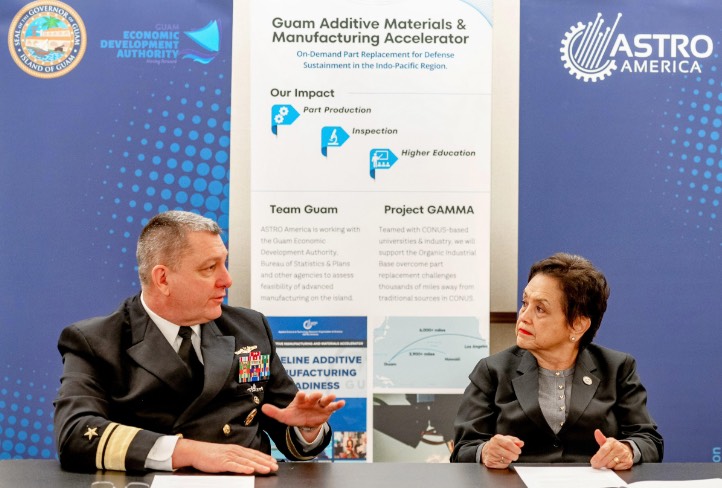
Rear Admiral Scott Pappano and Governor Lourdes A. Leon Guerrero in Early 2024. Image courtesy of ASTRO America.
The project should even benefit from ASTRO America’s ongoing work in Guam to build an AM accelerator on the island, as the Frank Cable is forward-deployed there, giving the work that the Navy has done with the submarine part an excellent opportunity to further the U.S. military’s AM workforce development goals. All in all, this is an ideal example of a strong AM case study, addressing many different challenges with a single solution.
While Australian companies like AML3D certainly stand to gain from the precedents established here, there is no shortage of U.S. companies that should benefit as well. And, from a longer-term and broader perspective, the core principles at work here can clearly be applied far beyond maritime contexts.
As I’ve noted before, U.S. naval vessels are no longer mere ships; they’re floating factories. The global manufacturing sector has barely begun to internalize all the countless implications embedded within this new reality.
Featured image of the USS Frank Cable courtesy of the U.S. Navy
Subscribe to Our Email Newsletter
Stay up-to-date on all the latest news from the 3D printing industry and receive information and offers from third party vendors.
Print Services
Upload your 3D Models and get them printed quickly and efficiently.













You May Also Like
AM Investment Strategies 2026 Sets the Stage for AMS 2027
AM Investment Strategies 2026 Nov. 5 · 12 p.m. ET · Free online event RESERVE YOUR SPOT ↗ A one-hour online discussion featuring some of the biggest names in 3D...
With Its Latest $200M Round, ICON May Be Running Away With the 3D Printed Construction Market
I used to view ICON, the Austin-based additive construction (AC) firm, as one of a handful of companies that could realistically consider itself the leader of the 3D printed construction...
How Should Businesses Build New Business? Dirk Simon Weighs In — Part 1
Dirk Simon had deep experience in materials and chemistry before joining the 3D printing industry. Instrumental in BASF and Farsoon’s market introduction, Dirk has spent a lot of time thinking...
3D Printing Services Near $2.5B as AM Market Shifts Beyond Hardware
The additive manufacturing market may be growing again, but one of the more interesting numbers behind that recovery has little to do with selling 3D printers. AM services generated nearly...