Bangladesh: Brac University Student Centers Thesis Around 3D, 4D & Even 5D Printing in Medicine


Fatema Tuz Zohra Moonmoon has submitted a thesis, ‘Possibilities of 3D & 4D printing technologies for personalized medicine’ to Brac University, exploring the ways digital fabrication may continue to impact the medical field.
While medicine has always been an area of incredible breakthroughs, innovation, and even what many refer to as miracles, scientists and doctors still have infinite obstacles to surpass when it comes to improving the quality of life for patients, saving lives, and fighting disease. 3D printing has offered new insight and efficiency, allowing for better diagnosis and treatment of medical conditions with 3D printed models and devices, as well as paving new avenues for the training of medical students, surgeons, and offering pre-operative planning devices too.
Oral medications are an area still rife with challenges for meeting the needs of patients, too, and scientists have fabricated numerous vehicles via 3D printing for offering patient-specific treatment regarding dosages, time-release, shapes, sizes of pills, and more.
“3D printing enables customers to design and create their individual items without producing huge waste,” states the author. “Presently through development of ‘4D printing’ it is anticipated that this technique will be able to bring socio-economic change in the following decade.”
Moonmoon is certainly not alone holding the opinion that 3D printing is expected to transform pharmaceuticals, centered around patient-specific treatment—allowing for personalization that can even span as far as multi-drug combinations.
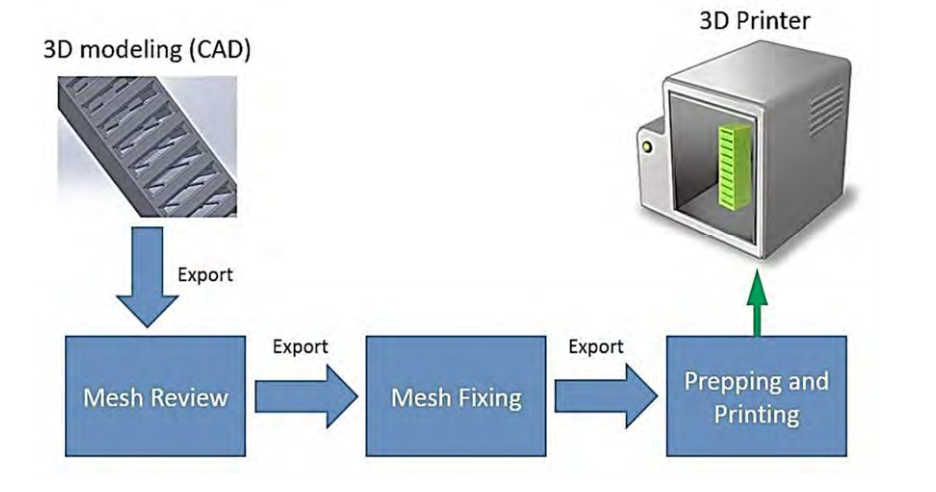
3D Printing Process (Kilicarslan, Ilhan, Inal, & Orhan, 2018)
Printlets are becoming increasingly popular as scientists experiment with digital fabrication, and Aprecia Pharmaceuticals rocked the news headlines in 2016 when the FDA approved Spritam, the first 3D printed tablet—developed for epilepsy patients. Data provided by the author states that “The worldwide 3D printed medicinal devices market is expected to grow at a CAGR of 18.1% during the forecast period 2017– 2027.”
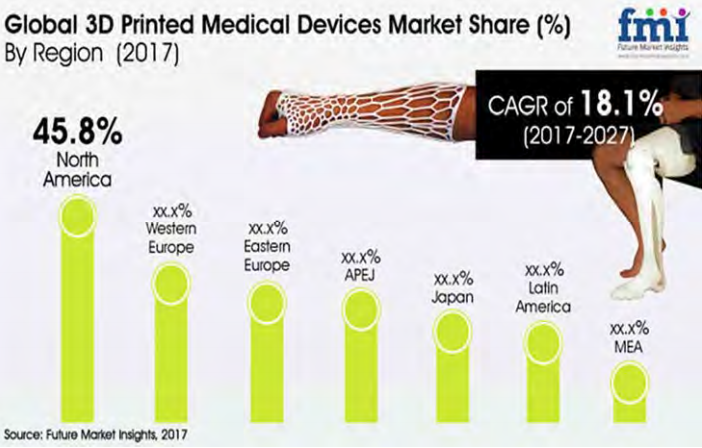
Global 3D Printed Medical Devices Market Share (%)(Trenfield, Goyanes, et al., 2018)
Moonmoon separates medical 3D printing into four categories:
- Organ models to aid in surgical treatment analysis
- Permanent non-bioactive implants
- Fabricating local bioactive and biodegradable scaffolds
- Directly printing tissue and organs
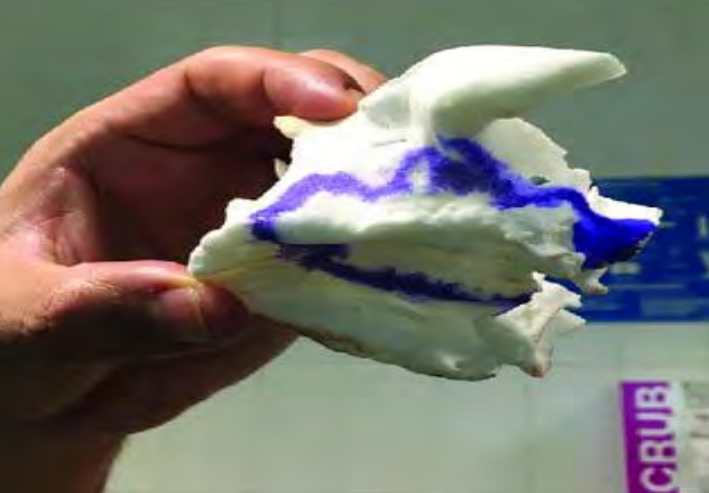
3D Printed Maxillary Bone (Nguyen, Narayan, & Shafiee, 2018)
Bioprinting has become a tremendous area of research, showing great potential for the eventual fabrication of human organs—meaning that patients can avoid the rigors of waiting lists and the continued risk of organ rejection (as the implanted cells are their own. So, where does 4D printing fit into all this, you may wonder? Taking digital fabrication to an all new elevated level of magic, users can create materials and products that morph to their application. Usually triggered by environmental factors like temperature or moisture, 4D materials deform and then return to their original state.

Diagram by Jean-Claude Andre, 2016
For medical applications:
“The medications will be able to customize according to the patient’s need. It will enable specialists to tailor the exposure and dosage levels of drug for individual patients,” states the author.
“With the help of an external stimulus, shape-memory materials (SMM) can restore their form even after twisting. Once triggered by temperature, moisture or by light enactment utilizing illumination, SMP can change their unique shape from one to several shapes (Gillaspie et al., 2016). On the other hand, the SMPs can be magnetically induced into thermoplastics by integrating nanoparticles. SMPs have revealed abundant utilizations in biomedical applications, small scale electromechanical systems and self-deployable structures.”
SMPs also offer the potential for biocompatibility and biodegradability, along with the ability to customize depending on the medical application.
“Now as the technology advances; in near future 5D printed ODF might be possible too. 5D printing is another new part of additive manufacture. It differs from 3D printing in a way that its print head has the ability to move 5 degrees,” states the author in conclusion. “It also enables to produce bended layers. So, the problems with 3D printed medicine might be overcome with the 5D printing technology in the near future. This innovation might be able to satisfy this essential prerequisite. In this way there is a lesser requirement of crude material when contrasted with 3D printing for making inserts of a similar quality.
“4D, 5D printing can give more useful results in drug testing, as we’ll be able to print models that reproduce aspects of human organs, such as heart muscles or parts of the liver. This is important, because even promising animal tests don’t guarantee a drug fit for human use.”
What do you think of this news? Let us know your thoughts; join the discussion of this and other 3D printing topics at 3DPrintBoard.com.
Source / Images: ‘Possibilities of 3D & 4D printing technologies for personalized medicine’]
Subscribe to Our Email Newsletter
Stay up-to-date on all the latest news from the 3D printing industry and receive information and offers from third party vendors.
Print Services
Upload your 3D Models and get them printed quickly and efficiently.













You May Also Like
Q5D and Molrix To Supply US Army With Harness Robots
Q5D Technologies and Molrix will offer their advanced harness production manufacturing units to the US Army. One production cell will be used for the SkyFoundry project, while two further systems...
CEO Yoav Zeif on Why Stratasys’ Markforged Acquisition Is Really a Bet on Industrialization
When Stratasys announced plans to acquire Markforged, the immediate focus was on the deal. Markforged is one of the most recognizable names in additive manufacturing (AM), known for its continuous...
3D Printing & the Autonomous Era: Defense Tech’s Latest Mutation
When we last checked in on the broad defense tech landscape and the role of the additive manufacturing (AM) industry in that environment, it became clear that the connecting thread...
UAS Additive Strategies: Register by June 30 to Learn About the Hottest Topic in 3D Printing
Last week, drone stocks surged on news that the Trump administration is considering a massive investment in the US unmanned aerial vehicle (UAV) industry. Earlier in 2026, the release of...