Airbus and Local Motors Create Startup to 3D Print For Ground and Air Mobility

 micro-factory that hopes to build products at unprecedented speeds through co-creation and cutting-edge technology. It will initially provide disruptive and innovative products with an initial focus on local mobility and autonomy, that will be iterated regularly to match customers’ needs and preferences.
This is the first partnership of its kind where a massive company is going all-in on the LMI direct digital  manufacturing model and building a physical micro-factory together (looking into a 50/50 ownership). The factory itself will be twice the size of the current ones to create urban mobility products, providing Airbus access to quick research and development as well as innovative thinking, and also enhancing validation for the LMI process.
“Every local and state government is faced with challenges such as rapid urbanization and congestion, inefficient and pollutive transport, and ever-changing and evolving technology,” said Jay Rogers, CEO and founder of LM Industries. “Current transport infrastructure and existing mass manufacturing are too inflexible and capital intense to service evolving technology trends and changing consumer demands.”
The incipient joint undertaking will tackle some of the major issues Rogers talks about by bringing together the
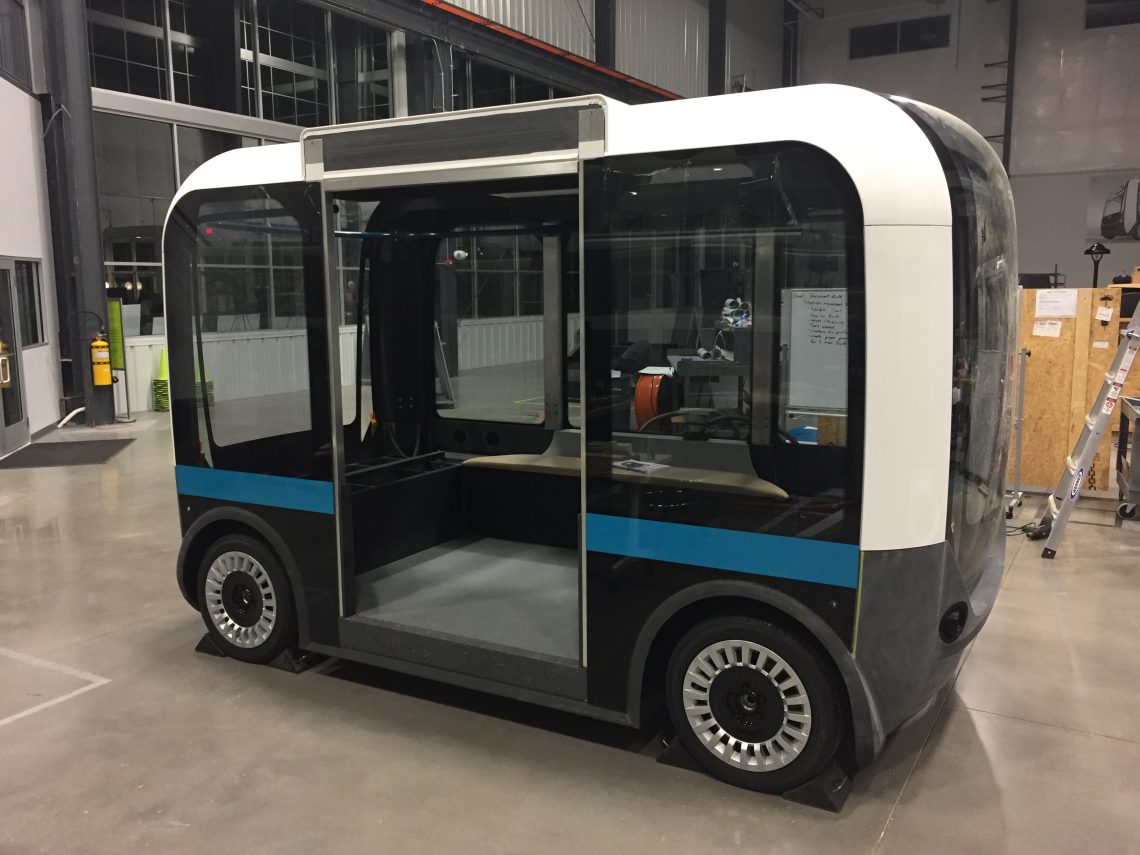
Local Motors’ first shuttle solving mobility problems
flexibility of professional digital manufacturing and the expertise of one of the world’s leading aerospace and defense companies in a venture that will attempt to answer the world’s most pressing mobility and manufacturing concerns. With access to the technological innovations of both partners – such as LMI’s open, AV shuttle platform and Airbus’ positioning system for drones enabling easier and safer take-off and landing – Neorizon employees and customers can imagine and create solutions unforeseen to anyone else.
“We’ve been working with LM Industries’ team at Local Motors since early 2016 when we realized the unique value proposition surrounding direct digital manufacturing and open-source design. Both parties recognized the commercial opportunities for pooling resources and expertise, specifically combining LM Industries’ digital manufacturing with Airbus’ materials expertise, metal 3D printing and additive manufacturing, and prototyping and serial production capabilities,” suggested Peter Weckesser, Digital Transformation Officer of Airbus Defence and Space.
“Together with our employees, shareholders, and leading mobility and innovation companies in Germany and abroad, we will address local mobility issues by rapidly producing concepts, prototypes, products, and solutions, in collaboration with the local technological ecosystem,” said Benjamin Queisser, CEO of Neorizon CEO.
Subscribe to Our Email Newsletter
Stay up-to-date on all the latest news from the 3D printing industry and receive information and offers from third party vendors.
Print Services
Upload your 3D Models and get them printed quickly and efficiently.













You May Also Like
3DPOD 316: Beehive’s Gordie Follin on 3D Printed Engines and More
Gordie Folin had deep experience in engineering at Pratt & Whitney, GE, and GE Aviation before becoming the Chief Product Officer at Beehive Industries. Among his achievements, he served as the...
3DPOD 315: Dirk Simon, from BASF to Farsoon to FKM, and now Square New Business
Dirk Simon had already spent years in the chemicals industry before joining and pioneering BASF‘s 3D printing effort. We get to hear how that firm looked at 3D printing and...
Printing Money Episode 42: Q2 2026 Public Markets 3D Printing Earnings Analysis with Troy Jensen, Cantor
Welcome to Printing Money Episode 42. Troy Jensen (Managing Director, Cantor) returns, joining Danny Piper (Managing Partner, NewCap) to review Q2 2026 publicly traded 3DP/AM company earnings reports. Troy’s quarterly...
3DPOD 314: Debinding, Sintering, and Metal Binder Jetting with Stefan Joens, Elnik Systems and DSH Technologies
Stefan Joens of Elnik Systems sells ovens. Their debind and sintering equipment powers a lot of high-volume binder jet and MIM production. We learn about Elnik and its origins. But...