Wells Fargo Backs ICON in Landmark Milestone for 3D Printed Housing


Qualification is an indispensable step on the path to legitimization for any new technology, but it’s still just one step: markets tend to remain unswayed without a co-sign from an established corporate giant. TSMC spent years qualifying its semiconductor manufacturing process in order to land its deal with Apple, which would, ultimately, permanently change the industry. But the industry only really changed once the partnership between the iPhone maker and the chip foundry was publicly confirmed.
In the additive manufacturing (AM) industry, Apple has played a similar role, if only on a much smaller scale thus far, in its confirmations over the last few years that the company is increasingly incorporating AM into its workflows. The additive construction (AC) market segment may have just had its own “Apple moment”: banking giant Wells Fargo has forged a deal with the world’s most innovative AC company, ICON, to write mortgages for homes built by the construction automator.
What’s more, Wells Fargo will provide a 50-basis-point credit to ICON homebuyers who use Wells Fargo for their mortgages. With mortgage rates at their highest level in nine months — a number that could realistically increase if persistent inflation leads to fewer Fed rate cuts, or even a rate spike, in the near future — a credit of .5 percent, significant in its own right, could be a deciding factor for new buyers.
According to CNBC, ICON’s success in its partnership to build 100 homes with Lennar Group, first announced in 2021 and completed last year, may have provided Wells Fargo with enough proof-of-concept, not only that ICON’s technology works, but, just as importantly, that the demand in the market for 3D printed housing is sufficient to sustain long-term interest (and appreciation value). It’s also perhaps worth noting here that, last month, ICON announced the establishment of a dedicated government contracting division, ICON Prime, headed by former CIA officer and Republican congressman from Texas, Will Hurd.
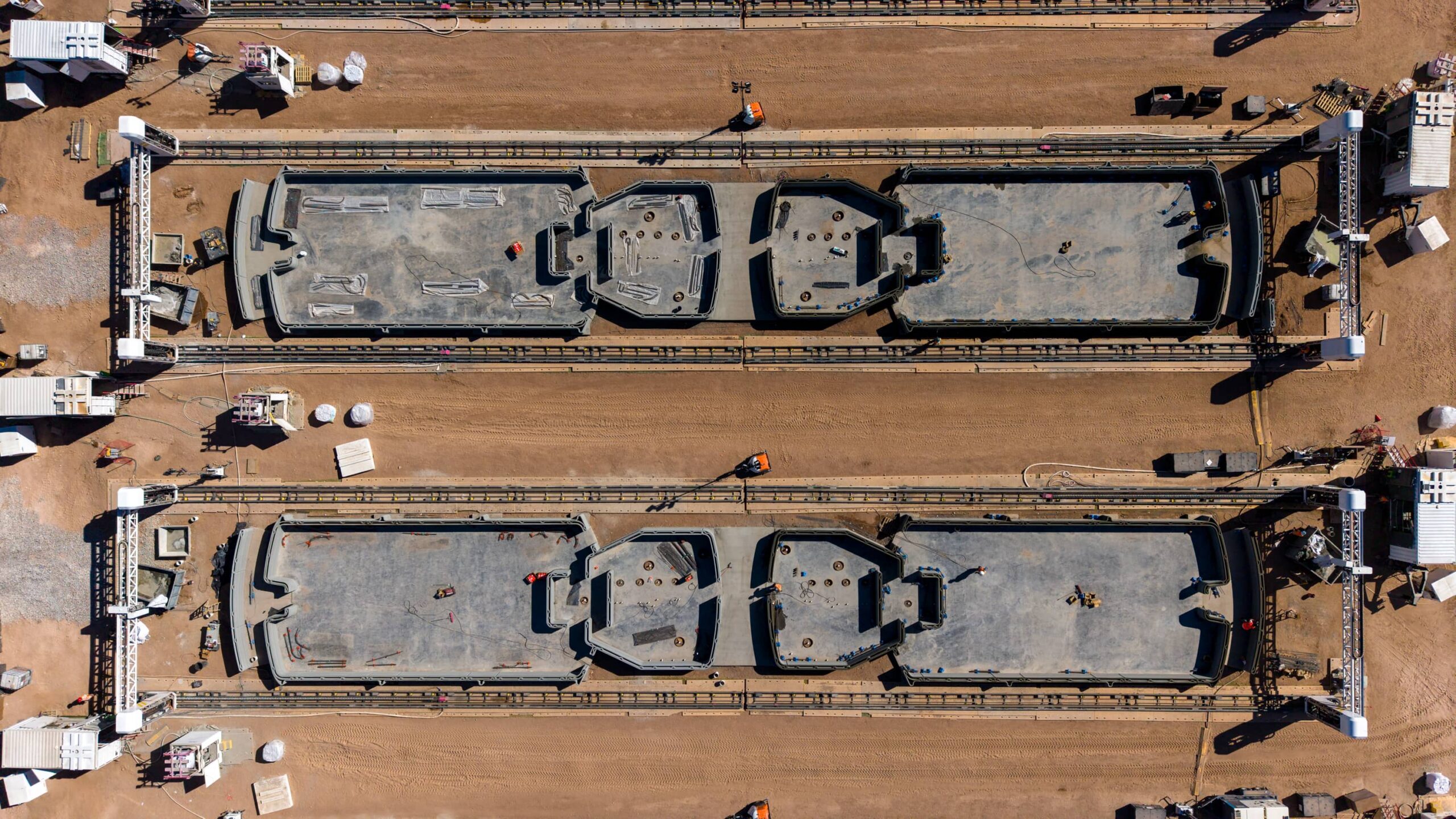
Aerial view of several 3D printed building foundations, showing the scale and layout of ICON’s construction system. Image courtesy of ICON.
The CEO of home lending at Wells Fargo, Serhat Oztop, told CNBC, “We think the technology that Icon has built has the potential to lower construction costs and to speed up homebuilding at a time when we are seeing broader challenges in housing affordability and access to homeownership. Through this partnership Wells Fargo is bridging the gap between this new technology and access to homeownership.”
Jason Ballard, the founder and CEO of ICON, added, “Even though our testing and our results are all in the books, having one of the big banking players make such a strong and pointed announcement that, ‘We like these houses, we’re excited about these houses, in fact, we’re going to give preferential treatment to these houses,’ helps people believe and understand that this technology, and the houses it produces are ready for primetime.”
Wells Fargo will also provide financing for users of ICON’s printers, which could help the AC market reach economies of scale — in turn making 3D printed homes even more affordable and further stimulating demand.
In a vacuum, that possibility may sound logical, but it’s still purely theoretical. Precisely what’s so important about a co-sign from an institution like Wells Fargo is that the scale it operates on carries with it genuinely transformative power to move the needle.
The move echoes what Alquist has done, in the context of commercial real estate, via its partnership with Walmart. This could be far more consequential, however: while Walmart is a leading customer for construction projects, Wells Fargo is a leading supplier of mortgages. It has a direct incentive to grow the 3D printed housing market as quickly as it makes financial sense.
Beyond the actual terms of the deal, the most legitimizing thing Wells Fargo may have done for ICON specifically, and AC generally, is the statement that the financial giant is making about the state of the technology: “We don’t have any reason to believe that the long-term value for these homes will be any different from homes that are built based on traditional construction technologies,” Oztop told CNBC. In other words, the market consensus appears to be settling on the sentiment that, 3D printed or otherwise, a house is a house.
Images courtesy of ICON
Subscribe to Our Email Newsletter
Stay up-to-date on all the latest news from the 3D printing industry and receive information and offers from third party vendors.
Print Services
Upload your 3D Models and get them printed quickly and efficiently.













You May Also Like
Creality K3 Opens for Pre-Order at $849, Advancing Multi-Color 3D Printing
Creality has officially opened pre-orders for the Creality K3, its latest flagship K Series 3D printer, starting at $849 in the United States. Recognized as an IFA Innovation Awards 2026...
Prusa Core One L+: A Worthy Upgrade?
Disclosure: The Core One L+ was provided to me by Prusa3d free of charge for the purpose of this review. I have not received any other compensation. All opinions expressed...
Prusa Upgrades Its Lineup with CORE One+ (Gen 2), CORE One L+, and XL+
Prusa Research has updated its high-end desktop 3D printer lineup. The company is offering new and improved versions of the machines it targets at industrial and power users, with the...
Zaha Hadid Architects Print 6M Model with WASP’s Robotic Arm Solutions
Zaha Hadid Architects (ZHA) have successfully used WASP 3D printers to make a 6-meter-tall model of an aircraft control tower. Zaha Hadid Architects’ Tech Lab made the tower in-house for the ZHAviation...