Neotech Announces Release of 3D Printed Electronics Platform


German company Neotech AMT announced yesterday it planned to release commercially a production platform for sintering 3D printed electronics. This new machine, called LBS 45XE, uses light beam sintering to place  Ag inks onto polymer substrates. Managing director of Neotech, Dr. Martin Hedges, explained the new machine’s benefit for their clients:
“This platform will assist customers to develop novel 3D printed electronics structures on low temperature substrates. The initial target markets are printed antenna for mobile phones and heater patterns for the automotive industry. The LBS 45XE has been designed for mass production with low operating costs. The system will be a very useful complement to our current range of five axis printing platforms to advanced 3-D print electronics.”
A case study performed by Neotech AMT’s research and development team, using the newly released machine, demonstrated improvements in design flexibility, reductions in product thicknesses, and environmental benefits when printing cell phone antennas as compared to the traditional processes for their creation. The digital nature of the process made possible with this machine eliminates the need for hard tooling, special plastic resins, and plating processes.
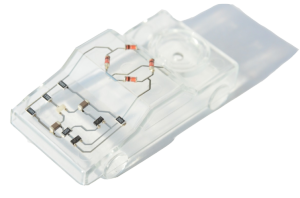
A 3D printed car model with 3D printed circuitry
This machine can carry out sintering processes on up to five axes of motion simultaneously. Each has its own individual light source that is tuned to the particular absorption wavelength of the printed media. That light beam allows for local heating and sintering to be focused on a very specific area, leaving the surrounding material unaffected. That centered area leaves a trace that is both conductive and has strong adhesive and cohesive strength.
Neotech has been involved in the development of systems for 3-D printed electronics since 2006. The company is located in Nuremberg, Germany and rose to stardom when they installed the world’s first five axis 3D printed electronics system in 2010. The advent of that system allowed for the combination of hardware and software elements capable of producing complex circuitry on nearly all 3D services.
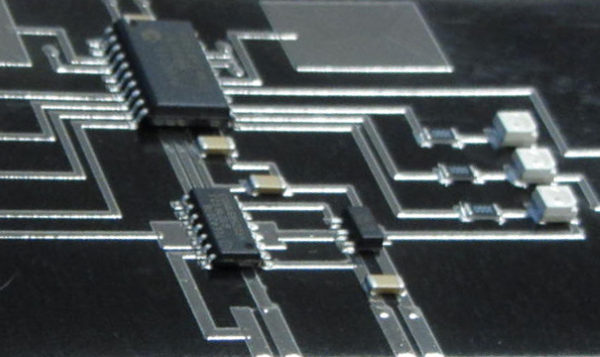 With the announcement of their latest technological contribution, they are advancing capabilities for 3D printing of electronics. There are other companies pioneering developments in electronics printing technologies, such as Optomec, developer of an aerosol jet printing process. Neotech is, in a sense, standing on the shoulders of giants by combining motion 3D toolpath generation software, Optomec’s aerosol jet print engine, and a five-axis CNC motion platform.
This new technology is most likely one step on the pathway rather than endpoint itself. Just as Neotech has built upon their ability to understand potential connections among existing technological capabilities, it is only a matter of time before Neotech or someone else develops an integrated electronics printer capable of producing both the object and its electronics at the same time. It will certainly be interesting to watch as this technology furthers its uses within manufacturing. Let us know what you think about this new electronics 3D printing platform in the Neotech electronic 3D printer forum thread on 3DPB.com. Check out the video below provided by Neotech AMT for further information regarding their printers.
[Sources: TCTMagazine, Neotech]
Subscribe to Our Email Newsletter
Stay up-to-date on all the latest news from the 3D printing industry and receive information and offers from third party vendors.
Print Services
Upload your 3D Models and get them printed quickly and efficiently.












You May Also Like
3D Printing News Briefs, July 9, 2026: RIMPAC 2026, Software, Housing, & More
In today’s 3D Printing News Briefs, Massivit continues its focus on aerospace and defense manufacturing, and Meltio is collaborating with Phillips Corporation for RIMPAC 2026. Moving on to software, AMIS...
3DPOD 304: Precast Concrete AM with Greg Kerkstra, Mangrove
Greg Kerkstra is part of a family business that leads in the precast concrete industry. They’ve now turned to Progress Group’s large-format binder-jet concrete technology, which we covered here in...
3D Printing News Briefs, June 10, 2026: Grand Opening, Photoresins, Footwear, & More
We’re starting with some exciting news in today’s 3D Printing News Briefs: Stratasys just celebrated the opening of its new North American headquarters in Minnesota. Moving on, Nanoscribe is scaling...
Wells Fargo Backs ICON in Landmark Milestone for 3D Printed Housing
Qualification is an indispensable step on the path to legitimization for any new technology, but it’s still just one step: markets tend to remain unswayed without a co-sign from an...