3D Printed Geiger Counter is Integral to its Creator’s Work


 Maker Conrad Farnsworth’s recent contribution to MakerBot’s Thingiverse is pretty unusual as projects go. In fact, it’s doubtful that there is widespread demand for Farnsworth’s 3D-printed Geiger counter, but the project speaks directly to the young inventor’s already impressive resume.
A Geiger counter, also known as a Geiger-Müller counter, is a device that detects radioactivity or ionizing radiation. Most Geiger counters detect Gamma and X-rays while some models also detect the other two types of radioactivity, Alpha and Beta radiation. The counter detects radiation and then displays a reading. The device consists of what’s called a Geiger-Müller tube, which is filled with an inert gas such as argon, neon, or helium at low pressure. High voltage is applied to the tube, which briefly conducts an electrical charge when a particle or photon of incident radiation, which is what happens when radiation hits a specific surface. It is the radiation that makes the gas in the tube conductive. The ionization is amplified within the tube and an easily measured detection pulse is produced.
When a Geiger counter takes a reading, the readout is provided either in radiation dose or counts but the counts display is the simpler reading of the two to produce. The readout can then be either digital or analog. With Geiger counters, there is typically an option to produce audible clicks, the characteristic sounds that represent the number of ionization events the device detects.
“Why,” you may wonder, “would Farnsworth be interested in building a Geiger counter?” In fact, in addition to being a student of electrical engineering at the South Dakota School of Mines and Technology in Rapid City, SD, Farnsworth, who is originally from Newcastle, Wyoming, has long been interested in, as he puts it, “anything nuclear.” “At the age of 17,” he explained, “I became the first person in the state of Wyoming to build and operate a nuclear fusion reactor.” While he continues his education at the School of Mines and Technology, Farnsworth is working at Farnsworth Downs Technology, a company that is endeavoring to revive interest in the alternative energy possibilities provided by nuclear energy via the construction of small, modular, molten salt reactors.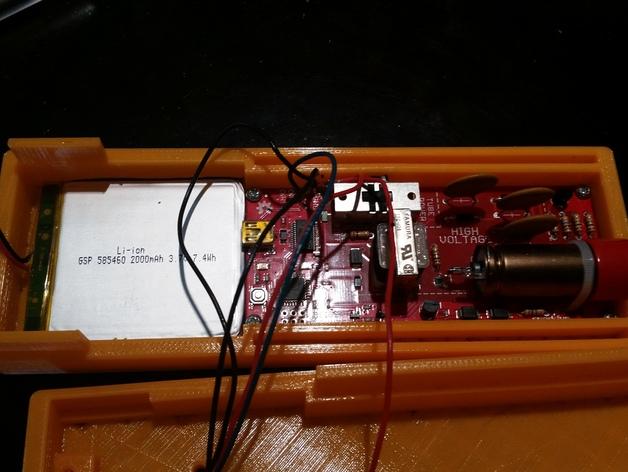
Farnsworth is definitely not new to 3D printing, having gotten his first 3D printer, a MakerBot that he named “Hal9000,” the 37th MakerBot off the line, in 2008. Eventually he moved on from his original MakerBot, which he replaced with a Replicator 2X.
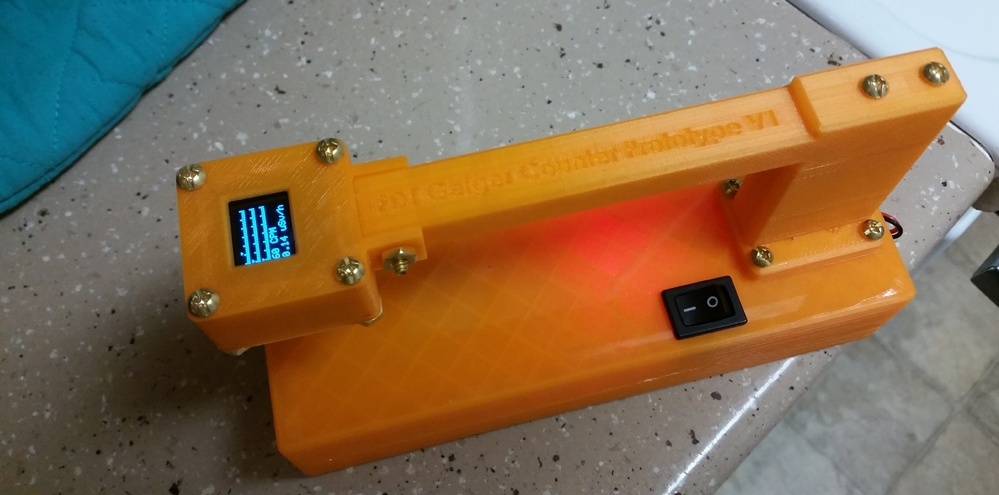
He has combined a number of his passions to create a handheld Geiger counter using 3D-printed parts and electronic components from SparkFun, the online retailer of supplies for electronic projects that currently boasts of an online catalog comprised of “over 3,500 components and widgets designed to help you unleash your inner inventor.”
Farnsworth created an electronic version of an analog Geiger counter. He used a Geiger counter board, a 3.7v lithium ion battery, a 3.7v boost converter switch, and a microview, all from SparkFun. His handheld, 3D printed device has, says Farnsworth, “its advantages and disadvantages.” As advantages go, his Geiger counter cost around $200 to construct whereas a handheld Monitor 4 Radiation Detector costs at least $350. As for the disadvantages of his device, Farnsworth’s 3D printed Geiger counter lacks the distinctive clicking sound as there is no audio feedback and there is no indicator LED. Those shortcomings are, however, mediated to some extent by the endurance of the 3D-printed electronic version of the more expensive analog one. Farnsworth’s Geiger counter is rechargeable and can run for more 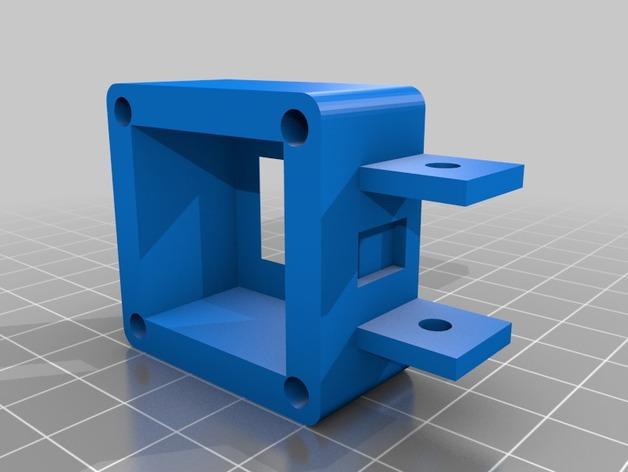 than six hours before requiring a charge.
He designed his device in less than a day using SolidWorks and then printed the six required parts for it on an Ultimaker 2 in about 12 hours. The Ultimaker had a build plate sufficient to accommodate the size of the parts, whose .stl files are available on his Thingiverse page and licensed under the Creative Commons (Attribution-Unlicensed).
Not your everyday maker project, Farnsworth’s 3D-printed Geiger counter, for which he eventually plans to launch a crowdfunding campaign to support expanded production, was intended to be a learning experience for this seemingly tireless and infinitely curious “dreamer and do-er.” His website, another project undertaken for auto-didactic purposes, provides more information about his work in the field of nuclear energy. As projects go, we’d be remiss to wish him anything but success with this one. As electronic devices go, we hope this one is under worked.
Are you considering taking on a project like this yourself? Let us know in the 3D Printed Geiger Counter forum thread on 3DPB.com. Check out the video of the device in action below:
Subscribe to Our Email Newsletter
Stay up-to-date on all the latest news from the 3D printing industry and receive information and offers from third party vendors.
Print Services
Upload your 3D Models and get them printed quickly and efficiently.













You May Also Like
Divergent Declares that German 3D Printers are Superior, And Plans Massive LPBF Expansion
Divergent has announced a new version of its Laser Powder Bed Fusion (LPBF) printer and a new site. The company aims to do nothing short of “further accelerating its mission...
Incodema3D Buys 14 Metal EOS Systems, Now One of the World’s Largest Metal 3D Printer Operators
Recently, a majority stake of 3D printing service bureau Incodema3D was purchased by AFM Capital. Under new ownership, the Freeville, New York company is now using its cash-rich parent for...
CEO Yoav Zeif on Why Stratasys’ Markforged Acquisition Is Really a Bet on Industrialization
When Stratasys announced plans to acquire Markforged, the immediate focus was on the deal. Markforged is one of the most recognizable names in additive manufacturing (AM), known for its continuous...
3D Printing & the Autonomous Era: Defense Tech’s Latest Mutation
When we last checked in on the broad defense tech landscape and the role of the additive manufacturing (AM) industry in that environment, it became clear that the connecting thread...