
Fabri Raises $13.5 Million to Create Digital Foundry

Fabri is a startup that wants to create a “digital foundry,” and just raised some funds to help it reach this goal. There are far too few foundries in America. These legacy businesses are closing or find it difficult to recapitalize after founders retire. Money is elsewhere, chasing bytes not bits, and foundries are an ancient business. Even if firms invest in manufacturing, then CNC, precision manufacturing, or 3D printing will be at the forefront of their plans. Foundries are old world, a part of an America that made things. Now, with most products being made outside of the US, this is a decided problem for the defense industry in particular. Fabri is therefore part of a new cohort of firms that want to reinvent foundries.
As far as I know, Skuld was the pioneer, reinventing foundry technology years ago. With a renewed focus on defense, independence, and a US military gap, many more firms are following it now. The US needs to build more submarines to shore up its nuclear triad, it needs to replenish its depleted (by half to two-thirds) precision missile arsenal, and will need to build many more autonomous vehicles in the future. This is a significant opportunity for additive, but also Fabri and firms like it. What Fabri wants to do is use the latest computational tools to advance foundries through automation. By reducing labor as a component of investment casting and speeding up lead times, the firm hopes to grow by shipping parts faster.
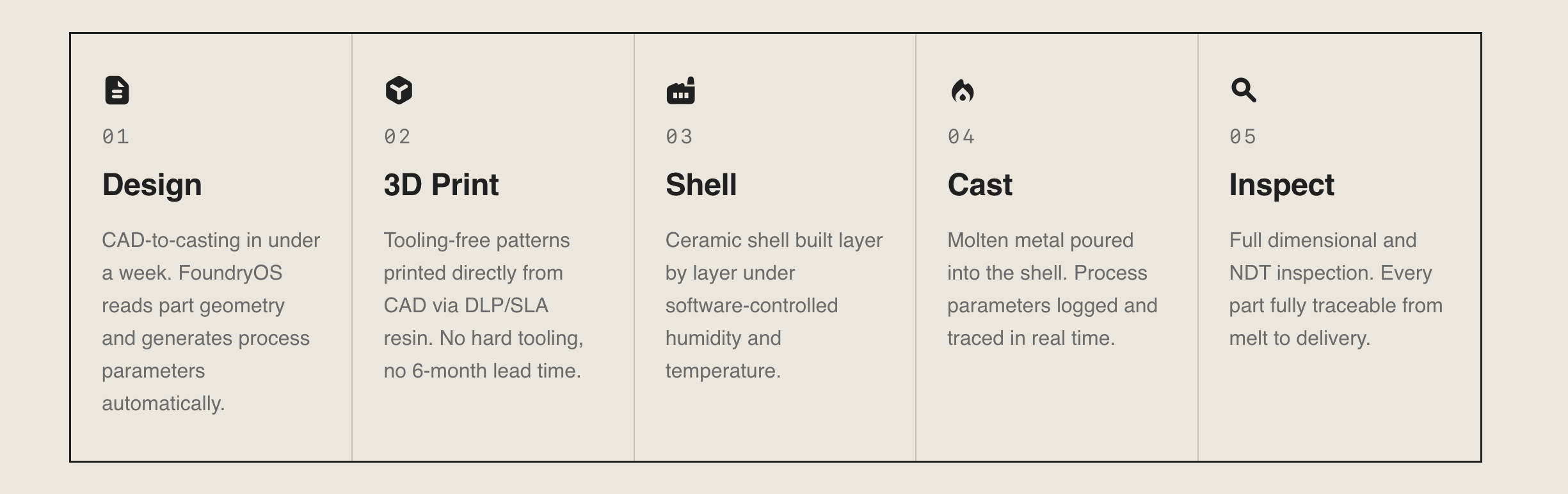
Fabri is 3D printing wax molds to skip a few steps in the investment casting process. Furthermore, they hope to automate many steps and use data and software to optimize production. For now, the company is working in Aluminum, copper, bronze, C71500, and steels, and wants to expand into nickel (IN713C, Mar-M247). Casting sizes are limited to 7 x 13 x 15.75 inches. The company is ITAR registered and has the CMMC Level 2 cybersecurity validation, as well as JCP Enhanced Validation, which also looks into compliance and security.
In some cases, foundry lead times can exceed two years, so this is a real opportunity with real money behind it. Fabri will now have real money as well. The firm has raised $13.5 million from the likes of Lavrock Ventures, Balerion Space Ventures, RTX Ventures, Lockheed Martin Ventures, Marlinspike, Tenon Ventures, and SBXi. The latter is a club comprised of Accel, Polaris Partners, GETTYLAB, General Catalyst, Pillar, Danaher, Underscore VC, and Glasswing Ventures, all working together to back MIT founders. Balerion is a space VC that has stakes in Anduril, Vast, and Relativity. So their money means a lot, given their exposure to firms that need to build stuff. Marlinspike, which has the coolest name of any VC, invests in AI, robotics, aerospace, and cybersecurity, and is also in Anduril. So having Anduril as a prospective client should not be too much of a problem. And having both Lockheed and RTX on this is just awesome for Fabri. Fabri also received $5 million in 2024, and RTX and Lockheed were a part of that as well.
Fabri says on its site that people should “Join us and rebuild American manufacturing. The DoD named castings a top-four defense priority. The foundry is the front line of reindustrialization.” Boom, no ambiguity there, no talk about golf clubs or spinal cages. This is a company with focus. And to go out and be able to just focus so fully on the DoD opportunity is a real benefit for the firm.
The firm, which is led by ex-Relativity staffer Steven Davis, ex-Velo3D software engineering manager Pieter Coulier, and ex-Inkbit VP of Operations Tom Cole, benefits from real experience in wanting to do something old completely new again. Hopefully, they’ll develop a tool to fit a purpose, become reliable, and stray away from complexity. Fabri also hopes to leverage “our exclusive high-throughput additive manufacturing process and AI-driven design software, we can deliver casting in days, saving our customers critical time and money.” It is working on FoundryOS, which “interprets part geometries, generates tooling-free patterns, and automates process control from shell building through pour and inspection, with full traceability from melt to delivery.” And the firm is very ambitious, saying that, “the plan is one new foundry a year until American casting capacity is back where it should be.”
The really cool thing is that they’re not going to (as far as we know) sell the software. The intention is also not to sell the equipment. Instead, they’re going to, like Seurat and Vulcanforms, use their technology to build a service. So they’re actually in the business of buying, building, and retooling foundries. We would expect more firms like Fabri to emerge over the coming years. Given the critical needs of US defense and the vast amounts of money at play, this is a very lucrative space to invest in. What I also like is that in Precision Castparts, they have a natural predator in that $10 billion behemoth. Smaller defense-oriented foundries such as Waukesha Foundry, Barron, and Signicast will also be more than a little curious. So they have exit opportunities aplenty in large and huge firms. Fabri may very well quietly and in the background build a very competitive significant business that is defensible to boot.
Subscribe to Our Email Newsletter
Stay up-to-date on all the latest news from the 3D printing industry and receive information and offers from third party vendors.
Print Services
Upload your 3D Models and get them printed quickly and efficiently.













You May Also Like
3D Printing News Briefs, August 22, 2026: Polymers for CubeSats, Animal Mobility Devices, & More
We’re starting with defense news in this weekend’s 3D Printing News Briefs, before moving on to polymers for CubeSats and 3D printed prosthetics. We’ll end with a story about engineering...
Pusan National University & ORNL Develop Elastomeric Liquid Crystal Actuators
Researchers from Korea’s Pusan National University and Oak Ridge National Laboratory (ORNL) have developed 3D printed elastomeric actuators. In a paper published in Nature, the team used elastomeric liquid crystal...
Scientists Use BMF to 3D Print Seal Whiskers That Track Prey Long After It’s Gone
Seals use their whiskers to hunt. Not Navy Seals, although they may in some way also, but this article is about lowercase seals. Not Seal the musician either; as far...
Harvard’s Jennifer Lewis Lab Is 3D Printing Artificial Muscles That Twist and Bend on Demand
Researchers at Harvard John A. Paulson School of Engineering and Applied Sciences (SEAS) have developed a new way to 3D print materials that can move on their own, bending, twisting,...























































