Continuum Powders Brings in Jon Cozens to Scale Its Circular Metal Model


Continuum Powders has named Jon Cozens as its new chief executive officer, a move that points to a shift in where the company is headed. After spending the past few years building out its technology, the focus now is on scaling it. The Houston-based materials company said Cozens will lead that next phase, with an emphasis on growing production, working more closely with customers, and expanding adoption across industrial markets.
The appointment comes at a moment when Continuum is no longer in the early “prove it works” stage. The company says it already has an active pipeline and is starting to see real commercial traction. At this point, it’s less about developing the technology and more about executing, taking what’s already working and doing it at a larger scale.

Continuum’s stand at RAPID. Image courtesy of Sarah Saunders/3DPrint.com.
Continuum is a key part of the additive manufacturing (AM) value chain: metal powders. These materials are used in processes such as laser powder bed fusion and binder jetting, and they play a big role in how well a part performs.
What sets Continuum apart is how it makes them. Instead of relying on traditional mining and multi-step refining, the company uses a patented system called Greyhound Melt-to-Powder (M2P). The process converts alloyed metal waste, basically scrap, into high-performance, spherical powders in a single step.
At its core, Continuum takes material that would otherwise be thrown away and turns it into high-quality, usable powder. That approach reduces the need for newly mined materials, cuts emissions, and reduces waste, while still meeting the performance requirements these powders need to meet. Because of that, the company is starting to position itself not just as a materials supplier, but as part of a more circular manufacturing player. Its goal is to make metal powder production more local and less dependent on long, complex supply chains, something that is becoming super important in sectors like aerospace, energy, and defense.

Continuum’s patented Greyhound M2P process. Image courtesy of Continuum Powders.
Continuum is backed by Ara Partners, which led a $36 million funding round to support the company’s growth. The firm focuses on industrial and decarbonization investments, and its backing gives Continuum both capital and strategic support as it works to scale its metal powder production and expand its reach.
A CEO Built for Scaling
Cozens’ background matches what the company needs next. He has spent over a decade working with industrial and cleantech companies, often helping technologies move from early use to full-scale production.
Before joining Continuum, he was CEO of Aries Clean Technologies, where he focused on waste-to-energy systems. Earlier roles at companies like Mura Technology and Fulcrum BioEnergy also centered on turning complex, sustainability-driven technologies into real-world infrastructure. Today, his experience matters because Continuum is no longer trying to invent something entirely new; it’s trying to scale a system that already works.
“I’ve spent much of my career helping industrial technologies move from early promise into commercial scale,” Cozens wrote in a LinkedIn post announcing his new role. “What stood out to me here is that Continuum already has a strong foundation, both technically and commercially, and the team has built something that’s gaining real traction. There’s still a lot to do. Scaling is rarely a straight line. But the opportunity here is clear.”
In the company’s announcement, Cozens also pointed out that “the technology is proven, customers are seeing the value, and the foundation is already in place. The opportunity now is to scale with discipline, expand access to high-quality material, make supply chains more resilient, and do it in a way that makes economic sense for customers. That’s what excited me about joining Continuum.”
Why This Matters for AM
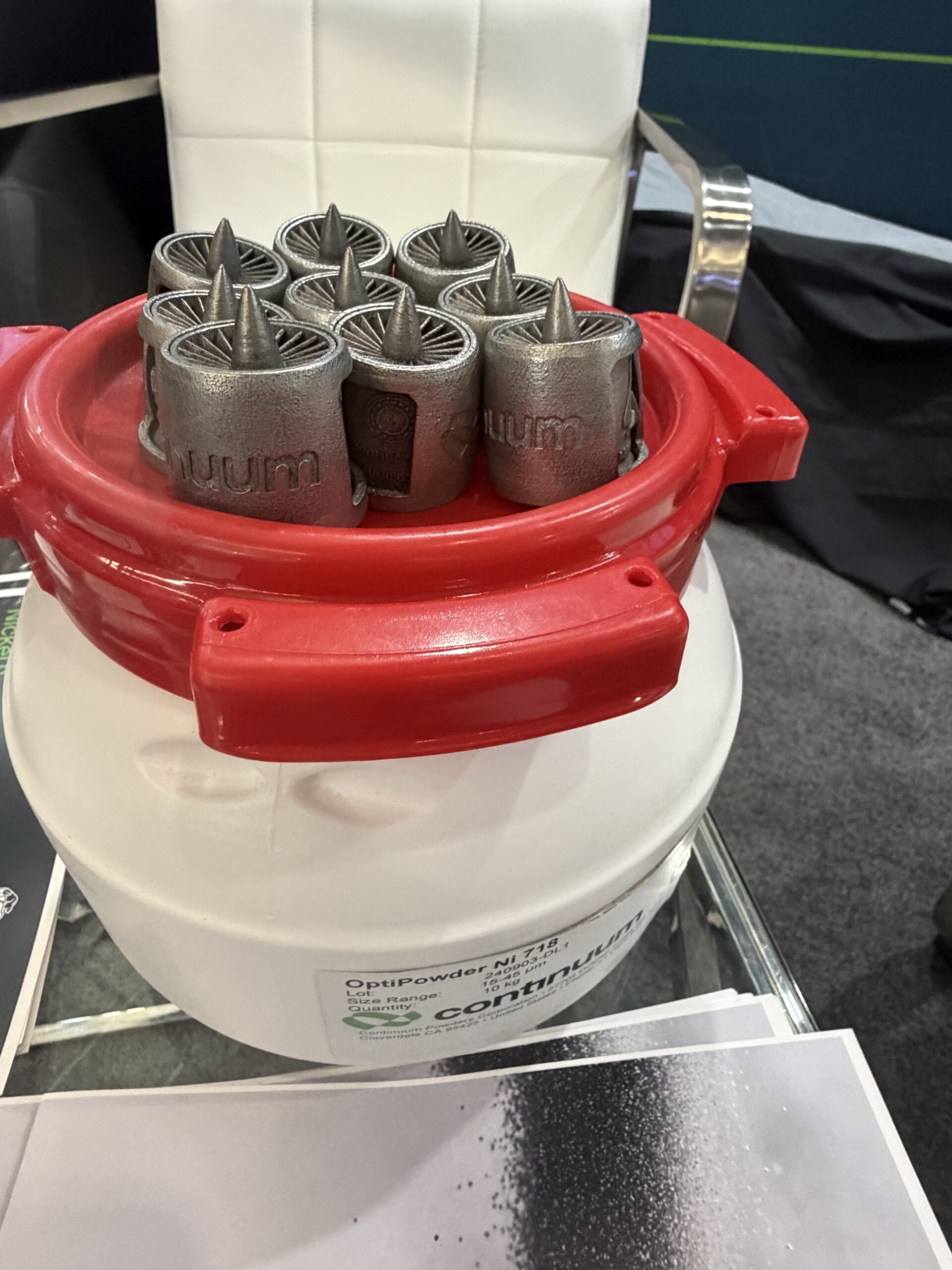
Continuum 3D printing at RAPID. Image courtesy of Sarah Saunders/3DPrint.com.
Metal powder is a bottleneck in AM. As more parts move into production, the need for consistent, high-quality material at scale and at a cost that works becomes more important. Continuum’s approach takes on several of these challenges at once. By recycling alloyed waste, it could reduce the dependence on volatile raw material markets while also lowering emissions compared to traditional production methods. At the same time, the company is focused on maintaining the material performance required for high-end applications. It is already targeting sectors where those factors matter most, including aerospace, energy, and industrial manufacturing.
The company is now focused on scaling its operations and actually growing in the market. Moving from building the technology to running it at scale is a step most 3D printing companies eventually face, and it’s not always a smooth transition.
Subscribe to Our Email Newsletter
Stay up-to-date on all the latest news from the 3D printing industry and receive information and offers from third party vendors.
Print Services
Upload your 3D Models and get them printed quickly and efficiently.













You May Also Like
3D Printing News Briefs, October 10, 2026: Drones, WAAM, Ceramics, & More
We have a packed 3D Printing News Briefs for you this weekend! First, America Makes celebrated the recent National Manufacturing Day with 3D printed drones, and then it’s on to...
3D Printing News Briefs, October 3, 2026: Hypersonics, Hotends, & More
We’re starting off with defense in this weekend’s 3D Printing News Briefs, as Titomic was awarded a $5 million U.S. defense contract, and VulcanForms announced a partnership with Specter Aerospace...
The Part Is Only Half the Story: Why 3D Printing Needs a Digital Thread
A 3D printed part can generate a lot of information. The challenge is keeping track of it. Manufacturers need to know which design was used, what material went into the...
Advanced Manufacturing at IMTS 2026: 3D Printing and AI and Drones, Oh My!
Last week’s International Manufacturing Technology Snow (IMTS) in Chicago welcomed over 90,000 attendees to the jungle that is McCormick Place. With over 1.17 million square feet of exhibit space, and...