ASTM International Works with UK MoD on America Makes Project

The UK Ministry of Defense (MoD) will work with ASTM International on a $1.1 million project to let it work in closer concert with the US Department of War. The project, called the Allied Additive Manufacturing Interoperability (AAMI) project, is funded by America Makes and the National Center for Defense Manufacturing and Machining (NCDMM).
The project is centered around LPBF and aims to streamline qualification and certification. ASTM will work on the project with Additive Manufacturing Solutions Ltd under Lockheed Martin. Working on sustainment, distributed manufacturing, and on-demand manufacturing, the aim is to align both countries more.
Vice President of Global Advanced Manufacturing Programs at ASTM International, Mohsen Seifi, said,
“The future of defense manufacturing depends on interoperability—not just of technologies, but of standards, qualification approaches, and trust. Through this collaboration, ASTM is helping to enable a common technical language between U.S. and UK partners so that qualified AM parts can be produced with confidence across allied supply chains.”
Ben DiMarco, Technology Transition Director at America Makes, stated,
“Additive manufacturing equivalency between allied nations is essential for resilient defense sustainment. By working with our partners and member organizations, we’re advancing qualification frameworks that support real-world adoption and ensure consistent, reliable parts across U.S. and UK operations.”
The ASTM global team will also work with the UK branch of ASTM, and ASTM said this will help ASTM’s work in “enabling defense industries globally through a combination of standards development, technical advisory services, training, pilot programs, qualification frameworks, and international collaboration.” Doing such work is valuable in the context of additive manufacturing. In this manner, the UK MoD will not have to duplicate work already done by the US government.
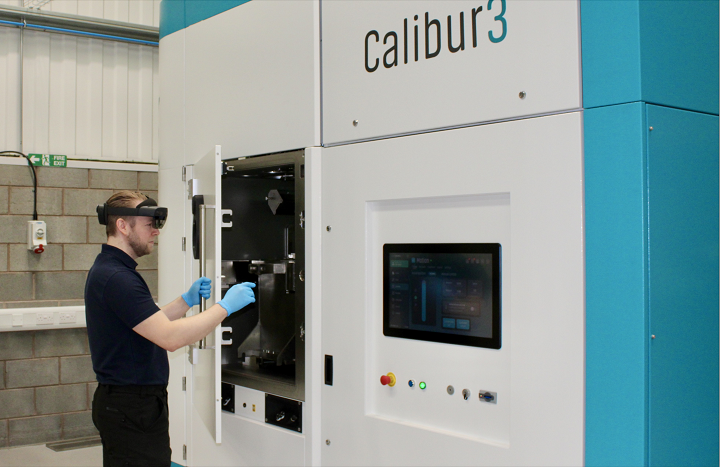
Wayland Additive’s Calibur3. Image courtesy of Wayland Additive.
This effort may very well also accelerate the UK’s MoD’s adoption of additive manufacturing generally. The upfront cost of qualification and certification is a major deterrent to 3D printing adoption and significantly slows it. At the same time, it is notable that this is not being done in a NATO context or with other US Allies. Is this a sign that the UK is looking to maintain an Atlanticist position closer to the US and further away from other NATO allies? Is this some kind of ¨business as usual¨ project in a politically uncertain time? In light of rising geopolitical tension in Greenland, which belongs to Denmark, it is impossible to see this in isolation. Denmark, until recently, was a staunch US ally, and 43 Danish citizens were killed in Afghanistan defending US interests. But now it finds itself under threat of invasion.
On the one hand, this project could let the MoD 3D print better. But it could also make the country even more dependent on the US. It would be in the UK’s interest to promote local companies such as its indigenous LPBF firm Renishaw. Will these certifications and testing procedures be for Renishaw machines? Or will this involve more work on US-made machines, or on the LPBF machines that Lockheed already uses? Will the powders used for this project be made in the US? Or will they be made by UK firms at UK atomization sites? What use would powder from overseas manufacturers have in a UK MoD defense context? Should the UK not use locally made machines and local powder to build resilience? What is the point of distributed manufacturing and manufacturing resilience if you´d make yourselves more dependent on a foreign partner? Surely true distributed manufacturing and resilience mean that you can make your own powder, qualify your own parts, and print them yourself? Depending on what this project is actually doing, it could make the UK more able or less able.
Since around 2022, the UK MoD has worked hard to stimulate the local UK 3D printing industry and capacity. Its Project Tampa seemed to be going at a fair clip, with the country putting parts into service in 2023, and it set up a recycling project recently. The UK Navy, however, bought two US Markforged 3D printers in 2023. The UK strategy, therefore, could still be a very Anglo-American one. This has traditionally been a logical one to pursue. But, in a new geopolitical reality, does this still make sense? With local companies such as Wayland, Renishaw, WAAM3D, Hybrid, Rapid Fusion, Metalysis, and Alloyed, the UK is one of the only countries in the world that could go it alone and develop a complete solution for additive MRO and sustainment. It could, at the very least, develop a local solution for its MRO needs that is always accessible, using both UK-made powder and UK-made machines. It would be sad, but true to form, if the UK let its own industry atrophy in allegiance to an idea that may have already been consigned to the history books.
Subscribe to Our Email Newsletter
Stay up-to-date on all the latest news from the 3D printing industry and receive information and offers from third party vendors.
Print Services
Upload your 3D Models and get them printed quickly and efficiently.











You May Also Like
Applied Acoustics Uses Additive for Subsea Gear
Subsea equipment has to be rugged, temperature-resistant, and able to cope with the long-term effects of saltwater. Extreme pressure and pressure changes are also problems endemic to this industry. Subsea...
3D Printing News Briefs, November 15, 2025: Subsidiary, Reshoring, FDA Clearance, & More
We’re kicking off this weekend’s 3D Printing News Briefs with some business news. Replique has opened an Italian subsidiary, and 3D People is championing local additive manufacturing. Meteor Inkjet and...
UK Digital Inventory Platform 3D People Prints Agri-Robotics Parts On-Demand
The robotics industry is in the midst of a long boom cycle, as industrial robot installations more than doubled over the last decade. Simultaneously, the AI frenzy has driven interest...
Korean Doctors Use 3D Printing to Replace Entire Ankle Bone in Groundbreaking Surgery
A team of orthopedic surgeons in South Korea has successfully replaced an entire ankle bone — the talus — with a custom 3D printed titanium implant. The study, published in...