
3D People Helps Armada Technologies Reduce LNG Tanker Emissions with 3D Printed Air Lubrication System

By now, more or less everyone seems to be aware, in one way or another, that the AI boom is straining global power grids and yielding insatiable demand for new energy sources. On the other hand, far less agreement exists concerning what precise mix of solutions humanity should turn to in order to support its energy needs.
One point to keep in mind that may help to cut through the confusion is that the relationship between “old” energy and “new” energy appears destined to be complementary, not zero-sum. For example, think about how China is using record amounts of coal at the same time as it’s achieving record installations of new renewable capacity. This is an environment in which additive manufacturing (AM) has much to offer, as suppliers of hardware for all sources of energy need to maintain maximal flexibility in their output and product-mix capabilities.
3D People, the UK-based AM service, has touched on this assortment of themes with its latest case study, involving a component the company printed for customer Armada Technologies. Also based in the UK, Armada Technologies produces a unique hardware assembly called the Passive Air Lubrication System (PALS), which reduces the drag underneath a ship’s hull in order to reduce fuel consumption and thereby lower emissions.
Armada Technologies turned to 3D People to print a Venturi ejector for PALS. Armada’s proprietary Venturi design leverages a ship’s “own forward motion,” rather than stored energy, to achieve drag reduction. The combination of complexity in both part geometry and material parameters gave 3D printing the edge over traditional production methods, leading Armada to turn to 3D People, which has produced four PA 12 Nylon production batches for the maritime startup.
The direct connection to the state of global energy demand is that the PALS hardware that Armada and 3D People collaborated on is sitting underneath the hull of a liquefied natural gas (LNG) tanker. LNG is perhaps the ultimate “bridge” fuel right now, serving as a mechanism that can help heavy coal consumers as they make long-term moves towards increased reliance on renewables. 3D People reports that, eight months in, the LNG tanker’s PALS upgrade continues to function perfectly.
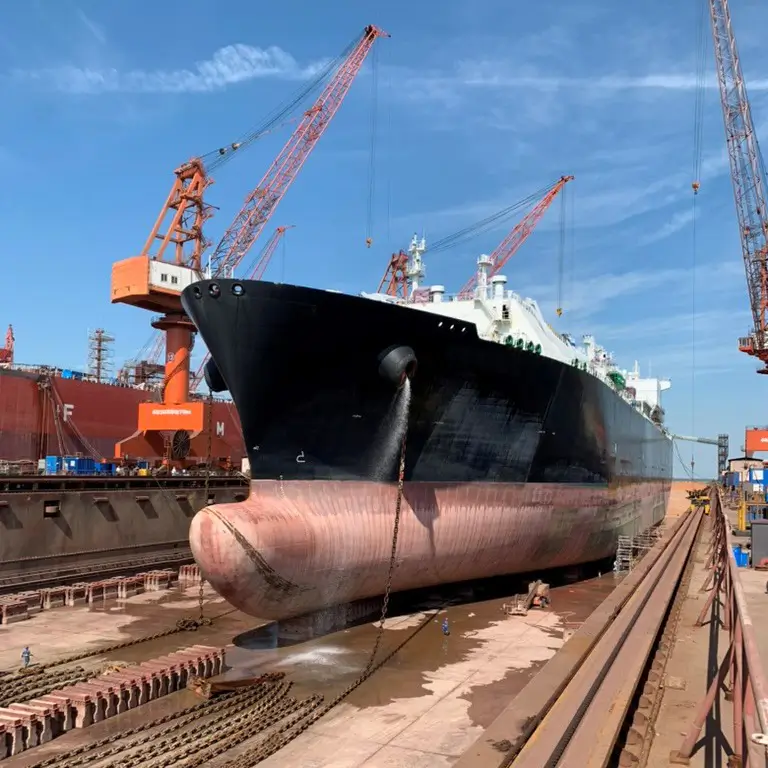
In a press release about 3D People’s production of a 3D printed Venturi ejector for Armada Technologies, the COO of Armada, Roger Armson, said, “3D People stood out immediately. They understood the complexity of the part, grasped our technical needs quickly, and delivered prototypes that met our stringent functional and compliance requirements.”
Sasha Bruml, co-founder of 3D People, said, “As sustainable technologies scale and engineering challenges become more complex, partnerships like this show why [AM] is now integral to modern industrial problem-solving. 3D People has spent years building the expertise, precision, and reliability that projects like Armada’s demand, and we will continue to be the partner innovators turn to when performance truly matters.”
The idea of decarbonizing the fossil fuel industry is as essential as it is paradoxical, and reducing the emissions of fossil fuel extraction and distribution will primarily happen through adoption of a broad assortment of micro-level solutions like what Armada Technologies can offer to the shipping industry. This sort of approach is especially important for LNG suppliers, which transport their product exclusively via ship.
Major LNG suppliers are already exploring making their value chains more sustainable by eating their own dog food: powering their vessels with LNG itself. But they’re also exploring options like powering their operations with renewables, and Armada’s PALS solution fits nicely with that model.
The need to verify emissions reductions in LNG supply chains is a geopolitical consideration, in addition to an ecological one. Because the EU will be banning Russian LNG imports by the end of 2026, imports from new sources — especially the U.S. — are being prioritized, and the EU has stricter emissions standards than any other market in the world.
Thus, if Armada can prove that its solution leads to measurable emission reduction gains, it could become a de facto requirement for LNG exporters, not just a “nice-to-have.” That would obviously be a huge win for 3D People, and could spur exporters to become even more interested in other ways that AM could deliver products that bolster their sustainability bona fides.
Images courtesy of 3D People
Subscribe to Our Email Newsletter
Stay up-to-date on all the latest news from the 3D printing industry and receive information and offers from third party vendors.
Print Services
Upload your 3D Models and get them printed quickly and efficiently.













You May Also Like
The Manufacturing Race Behind the Drone Revolution
We are in the middle of a major manufacturing shift focused on the production speed and payload capacity of uncrewed aerial systems (UAS), or drones. A recent Manufacturing Dive article...
ADDMAN to Buy Up to $10.8M in Nickel 718 Powder from 6K Additive Over 30 Months
After years of buildup, we’re finally starting to see what the US metal additive manufacturing (AM) market could look like at scale. To be sure, it’s still not quite there,...
Metal AM in a Multipolar World, Part 2: How PBF and DED Could Change by 2035
The first decades of PBF development were heavily shaped by machine capability: more power, more lasers, larger build volumes, better recoating, and improved process monitoring. These developments will continue, but...
Advanced Manufacturing at IMTS 2026: 3D Printing and AI and Drones, Oh My!
Last week’s International Manufacturing Technology Snow (IMTS) in Chicago welcomed over 90,000 attendees to the jungle that is McCormick Place. With over 1.17 million square feet of exhibit space, and...

























































