Campbell’s Exec Fired After “3D Printed Chicken” Claim — But What’s Really Going On?

Campbell’s is dealing with an unusual crisis this week, and somehow 3D printing ended up in the middle of it.
It all began when a former employee, Robert Garza, released an audio recording as part of a lawsuit he filed against the company. In the tape, broadcast by a Michigan TV station, a Campbell’s VP in the IT department, Martin Bally, goes on a one-hour, profanity-filled rant about the company’s food and the people who buy it. At one point, he claims that Campbell’s uses “bioengineered meat” and even says he doesn’t want to eat “a piece of chicken that came from a 3D printer.”
More specifically Bally said: “Who buys our s**t? I don’t buy Campbell’s products barely any more. It’s not healthy now that I know what the f**k’s in it … bioengineered meat. I don’t wanna eat a piece of chicken that came from a 3D printer.”
The comments became public pretty quickly, and articles from many outlets picked up the “3D printed chicken” line because it was such a strange and oddly specific thing to say. Campbell’s responded the next day with a formal statement confirming the voice on the recording was in fact Bally’s, calling his claims “patently absurd,” and clarifying that the chicken in their soups comes from long-trusted, USDA-approved suppliers. They also confirmed that Bally is no longer employed by the company.
To ease consumers, Campbell’s even added a new section to its official FAQ page. One of the first questions reads, “Is Campbell’s chicken 3D printed?” The company answers saying that “No. We do not use 3D printed chicken, lab-grown chicken, or any form of artificial or bioengineered meat in our soups.” The FAQ also explains that the “3D printed chicken” idea came from a recent video spreading false claims about their ingredients, and calls those comments “inaccurate” and “absurd.”

Campbell’s canned food. Image courtesy of Campbell’s.
So what exactly happened here? And does Campbell’s have anything at all to do with 3D printed meat? Well, the answer is no — at least there’s no indication they are.
There’s no public information suggesting that Campbell’s is working on 3D printed chicken or any type of bioengineered meat. But it has been involved in the broader world of alternative proteins, only in the traditional sense. The company owns Pacific Foods, which makes plant-based products, and it’s a member of the Plant Based Foods Association. Campbell’s venture arm, Acre Venture Partners, has also invested in several food-tech startups over the years. But none of this work has anything to do with 3D printed meat or bioprinted poultry (that we know of, of course).
In fact, the company’s response made that very clear, and their ingredients are regulated under normal U.S. food-safety rules. So it seems that Bally’s comments weren’t an industry leak; they were just a part of an angry private conversation that later came up in a lawsuit.
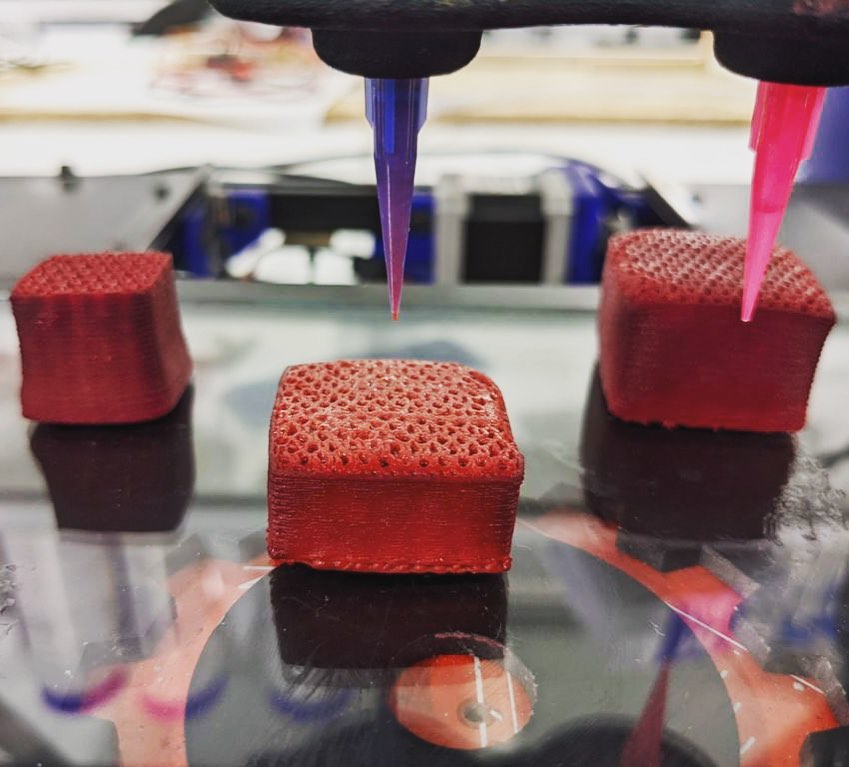
Still, the moment tells us something interesting about the public perception of 3D printed food. 3D printed meat, or bioprinted or structured alternative, cultivated meat, does exist, but mainly in experimental or early commercial forms. For example, in Singapore, the first lab-grown chicken (from a company called Eat Just) was approved for sale in 2020, making that country a pioneer. Since then, a handful of other firms have advanced regulated cell-based meat products under local novel-food frameworks, and some have shown promising prototypes. Companies like Steakholder Foods, Novameat, and others have proven that chicken-like or steak-like structures can be printed from plant proteins or cultured cells.
Meanwhile, in the U.S. (and most of the world), these products are rare, tightly regulated, and far from mass-market scale. Many of the “cultivated meat” products on the market remain small-batch, high-cost, or available only at restaurants, through tastings, or in pilot sales.
To date, there is no public indication that a major global packaged-food company such as Campbell’s is using 3D printing, bioprinting, or cell-based meat in its soups or products. So while the tech for cultured meat is advancing, and regulatory clearance has happened in a few places, 3D printed meat in supermarket cans is still a hypothetical idea; what exists for now is limited, early-stage, and not part of mainstream supply chains.
Novameat released the “world’s biggest piece of cell-based whole cut analogue meat. Image courtesy of Novameat
So we might wonder why Campbell’s VP rant got so much attention. Probably because the technology is becoming visible enough that people have heard of “printed steaks” or “printed chicken,” but not clearly enough to understand what those things actually are. That makes it easy for rumors and confusion to spread, leading to this kind of corporate mess that had nothing to do with real 3D printing at all.
Subscribe to Our Email Newsletter
Stay up-to-date on all the latest news from the 3D printing industry and receive information and offers from third party vendors.
Print Services
Upload your 3D Models and get them printed quickly and efficiently.













You May Also Like
3D Printing News Briefs, August 22, 2026: Polymers for CubeSats, Animal Mobility Devices, & More
We’re starting with defense news in this weekend’s 3D Printing News Briefs, before moving on to polymers for CubeSats and 3D printed prosthetics. We’ll end with a story about engineering...
Pusan National University & ORNL Develop Elastomeric Liquid Crystal Actuators
Researchers from Korea’s Pusan National University and Oak Ridge National Laboratory (ORNL) have developed 3D printed elastomeric actuators. In a paper published in Nature, the team used elastomeric liquid crystal...
Scientists Use BMF to 3D Print Seal Whiskers That Track Prey Long After It’s Gone
Seals use their whiskers to hunt. Not Navy Seals, although they may in some way also, but this article is about lowercase seals. Not Seal the musician either; as far...
Harvard’s Jennifer Lewis Lab Is 3D Printing Artificial Muscles That Twist and Bend on Demand
Researchers at Harvard John A. Paulson School of Engineering and Applied Sciences (SEAS) have developed a new way to 3D print materials that can move on their own, bending, twisting,...