
3D Printed Heat Exchanger Specialist Conflux Joins Honeywell-Led Aircraft Consortium

The additive manufacturing (AM) industry has increased its technical maturity at an accelerated pace in recent years. One way that the industry can continue this positive momentum is by centering its collective activities around the application classes that put AM’s biggest differentiators to the greatest use.
Two such application classes include thermal management optimization and production of components for next-generation aircraft. Conflux Technology, the Australia-based company that leverages metal AM to make modular heat exchangers, has excelled at providing applications for both categories, including a partnership with General Atomics Aeronautics Systems Inc. (GA-ASI) to produce heat exchangers for GA-ASI drones. Now, Conflux has announced that it is joining a consortium focused on “developing advanced thermal management systems and architectures for next-generation hybrid-electric regional aircraft”, led by global defense and industrial giant Honeywell.
Honeywell launched the consortium, called TheMa4HERA (Thermal Management for Hybrid Electric Regional Aircraft), in 2023, and the group currently contains almost 30 members from ten different countries. According to Conflux, through its participation in TheMa4HERA, the company will work on heat exchangers used in both air and liquid cooling systems for hybrid short-to-medium range aircraft, work that will involve multiple projects for each kind of system.
TheMa4HERA aims to get its heat exchanger processes up to Technology Readiness Level (TRL) 5 by 2026, with the consortium targeting initial flight tests and component integration by 2027. Ultimately, TheMA4HERA is working towards “climate-neutral aviation” by 2035.

Compact cylindrical heat exchangers by Conflux.
In a press release about Conflux’s entry into the Honeywell-led TheMA4HERA consortium, Jan Ludvik, Senior Director of Advanced Technology, Europe for Honeywell Aerospace, said, “Conflux brings valuable technological capabilities to TheMa4HERA’s collaborative effort to develop the next generation of thermal management solutions. Each partner’s expertise strengthens our mission to deliver sustainable solutions that transform aviation.”
Michael Fuller, Conflux’s CEO, said, “Joining TheMa4HERA aligns with Conflux Technology’s commitment to delivering high-performance thermal solutions that enable energy-efficient, low-emission aviation. Our [AM] capabilities will help the consortium push the boundaries of thermal management design to meet the demands of hybrid-electric propulsion systems.”
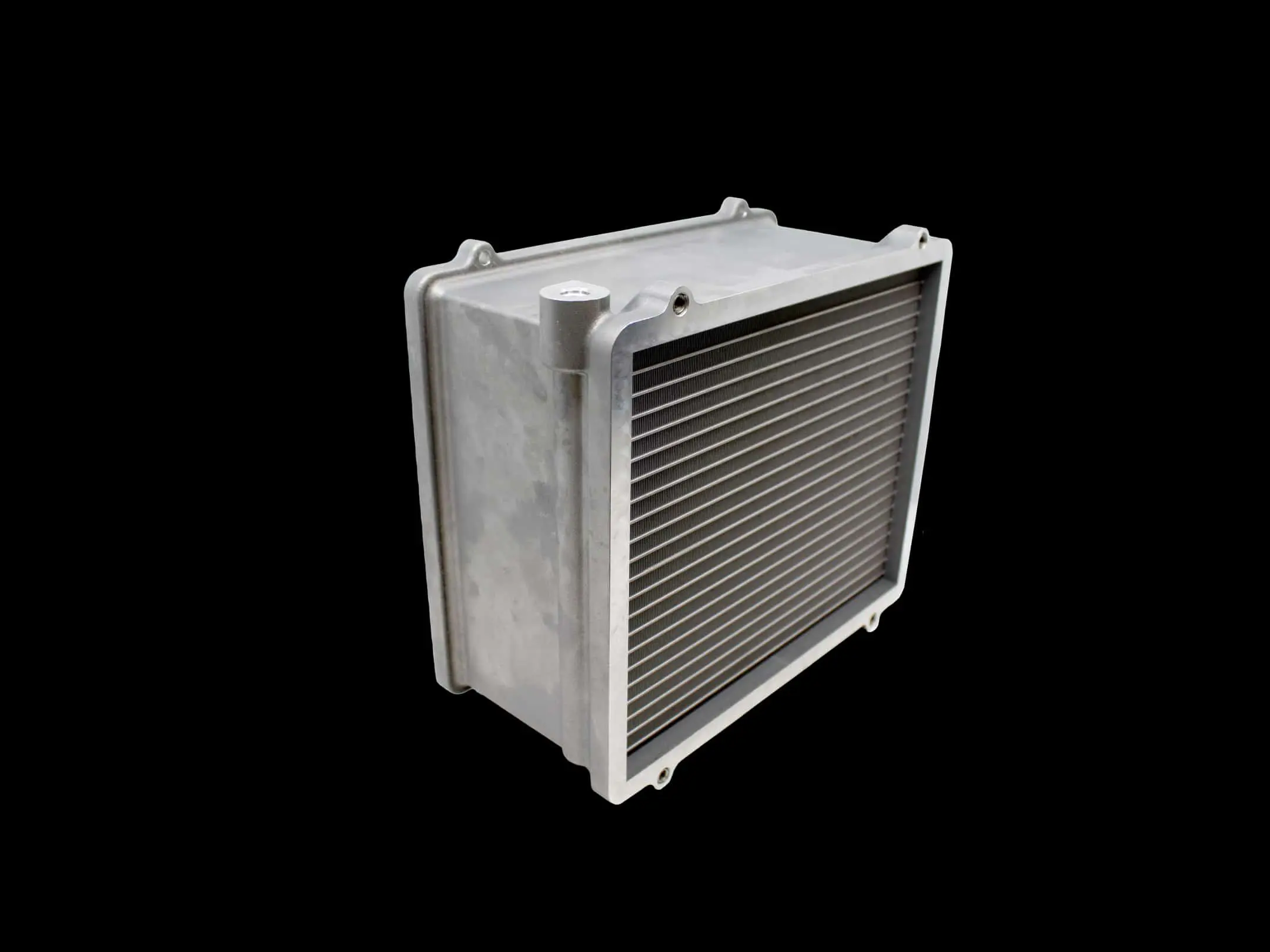
Rectangular heat exchanger developed by Conflux.
Conflux has the profile of a company that’s set up for long-term success. In addition to what I’ve already mentioned regarding its focus on the right applications, Conflux is also backed by the right investors, including AM Ventures, consistently lands significant funding rounds, and has started to expand into new markets that align nicely with the company’s growth strategy.
Joining an organization like TheMa4HERA is the perfect next step for Conflux, and it should also help drive demand growth for Conflux’s partners in the AM industry, especially EOS. Along these lines, in addition to providing thermal management solutions for companies like Honeywell, Conflux is also serving as a technology demonstrator for what EOS can contribute to the future of aviation technologies.
This is precisely why it’s so important for AM companies to pinpoint the right applications and organize around them as a cohesive unit: with the right strategic partnerships, a given company’s success reverberates far beyond its own boundaries, across the whole AM industry. Conflux’s ability to scale not only benefits EOS but ultimately all of EOS’s partners as well.
And this is also why combining multiple different application categories, like thermal management and next-gen aircraft, is such a promising approach. By joining TheMa4HERA, Conflux, and the whole ecosystem it represents now has the potential to expand its reach into two different markets simultaneously, markets which have an impact on an exceptionally broad range of verticals.
Images courtesy of Conflux
Subscribe to Our Email Newsletter
Stay up-to-date on all the latest news from the 3D printing industry and receive information and offers from third party vendors.
Print Services
Upload your 3D Models and get them printed quickly and efficiently.













You May Also Like
Why the AM Industry Should Pay Attention to Schneider Electric’s $22.6B PTC Acquisition
By late 2024, there was already enough signaling of the additive manufacturing (AM) industry opportunity in the data center infrastructure market for AM Research to write a report on the...
How Does Nike’s 3D Printing Approach Fit Into Its Restructuring Plan?
Shares of Nike stock hit all-time highs in late 2021 but have cratered in the years following, with the company losing nearly 80 percent of its market cap since peaking....
3D Printing News Briefs, October 1, 2026: Defense, Enclosures, & More
In today’s 3D Printing News Briefs, we’re starting with defense news, first from Massivit and then from AML3D. Then we’ll move on to U.S. manufacturing of a new large-format LPBF...
South Korea’s Lincsolution Lands Hanwha Defense Deal as Hanwha Invests Billions in US
I recently wrote about how the South Korean additive manufacturing (AM) firm Lincsolution is building an aerospace and defense hub, part of the company’s construction of “the largest AM facility in...
























































