General Atomics ASI Extends Partnership with 3D Printed Heat Exchanger Firm Conflux


General Atomics Aeronautical Systems Inc (GA-ASI), an affiliate of nuclear energy/defense contractor General Atomics, has signed a new memorandum of understanding (MOU) with longtime partner Conflux, an Australian company that specializes in metal 3D printed heat exchangers. GA-ASI and Conflux signed the MOU at AVALON 2023, the Australian International Airshow and Aerospace & Defense Exhibition.
Most recently, the two companies collaborated on a Fuel Oil Heat Exchanger (FOHE) for the SkyGuardian and SeaGurdian, two variants of the MQ-9B drone produced by GA-ASI. Last month, GA-ASI also announced a partnership with Divergent Technologies — the parent company of Czinger Vehicles and a massively-funded startup working on electric supercars made with additive manufacturing (AM) — whereby Divergent will print drone components for GA-ASI.

In a press release announcing its latest MOU with Conflux, Ken Loving, GA-ASI’s VP for the Indo-Pacific region, commented, “We continue to work closely with Conflux on the design and manufacture of FOHE for our aircraft. Through this new MOU, we will establish a clear path to production for the heat exchanger components used by multiple GA-ASI production lines.”
Abe Masoud, Conflux’s Business Development Manager — North America, added, “Our continued partnership with General Atomics is a milestone for the commercialization of additively manufactured heat exchangers within the aerospace and defense markets, carrying the significant weight and performance benefits offered by these technologies towards production.”
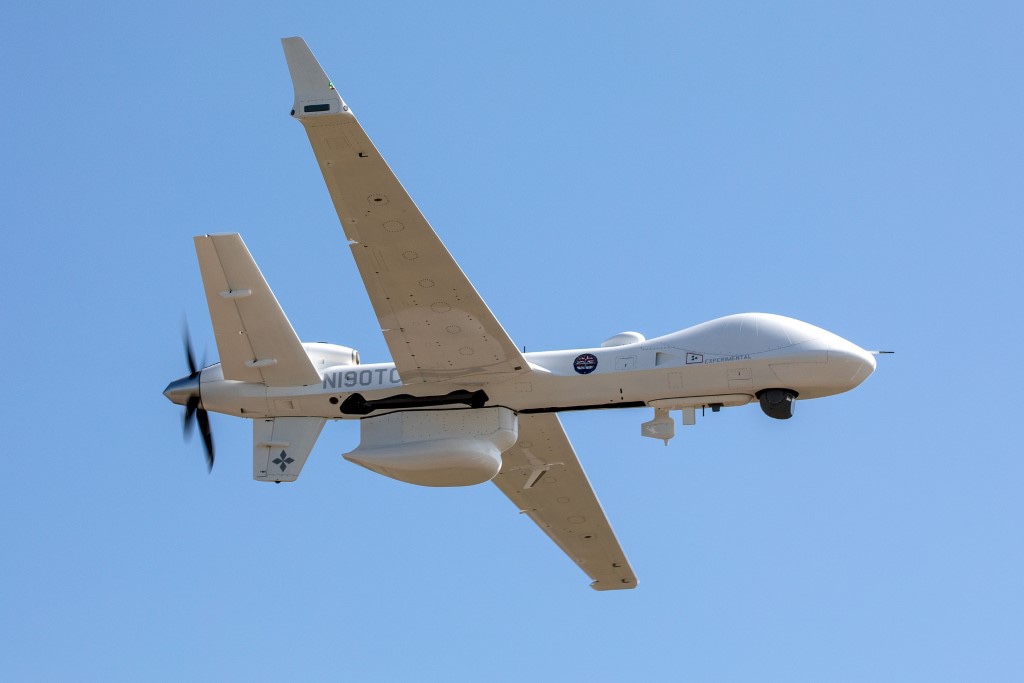 Image courtesy of General Atomics
One of the main advantages to Conflux’s technology, in addition to its geometric optimization, is that the company can tailor its heat exchangers specifically to the size required for a manufacturer’s needs. Thus, a company like General Atomics, for instance, with a presence in a variety of different industries — all of them requiring heat exchangers — could presumably streamline its heat exchanger design process across those different industries, enhancing the potential for synergy between its separate market segments.
On the same subject of synergy, surveillance vehicles are highly relevant to the nuclear energy side of General Atomics’ operations in other ways, as well. As global policymakers seem increasingly serious about making next-generation nuclear power an even more integral part of the energy transition, there is a parallel need for innovation related to automated inspection systems. Drones have been seen as a particularly promising weapon in that arsenal, so components like Conflux’s cartridge heat exchangers are critical to ensuring the stability of supply chains related to every aspect of the electrification of the power grid.
Finally, there is clearly potential here for Divergent and Conflux to work together as well, if they’re not already doing so. In that sense, the same way that investors could be the key coordinators of relationships between AM startups and the federal government procurement supply chain, legacy manufacturers could end up being most valuable over the next decade as hubs for synthesizing the capabilities of emerging advanced manufacturing outfits.
Subscribe to Our Email Newsletter
Stay up-to-date on all the latest news from the 3D printing industry and receive information and offers from third party vendors.
Print Services
Upload your 3D Models and get them printed quickly and efficiently.













You May Also Like
Russia’s 3D Printed Missiles & Can NATO Get Its Act Together?
For most of US history, however much the two major parties differed on domestic policy (in some cases a lot, overall less than you’d think), there was always essentially a...
3D Printing News Briefs, October 21, 2026: Digital Twins, AI CAD Service, AR Smart Glasses, & More
In today’s 3D Printing News Briefs, America Makes announced the winners of its MIAMI Project Call, and AM Europe released a new report. Artec 3D launched its new Artec Twins...
3D Printing News Briefs, October 10, 2026: Drones, WAAM, Ceramics, & More
We have a packed 3D Printing News Briefs for you this weekend! First, America Makes celebrated the recent National Manufacturing Day with 3D printed drones, and then it’s on to...
The Manufacturing Race Behind the Drone Revolution
We are in the middle of a major manufacturing shift focused on the production speed and payload capacity of uncrewed aerial systems (UAS), or drones. A recent Manufacturing Dive article...