Lumafield Secures $75M to Boost CT Inspection for 3D Printing and Beyond

Industrial X-ray CT technology is changing how manufacturers catch product defects before they become expensive failures. This is particularly important for industries that rely on precision manufacturing, like 3D printing. X-ray CT scanning helps detect internal defects (like voids, cracks, or porosity) that are not visible from the outside but can compromise performance.
Lumafield, a company pioneering this technology, just secured a major financial boost to expand its technology. The Cambridge, Massachusetts-based company announced a $75 million Series C funding round, led by VC firm IVP, with participation from G2 Venture Partners and Wellington Management. Existing investors, including Kleiner Perkins, Lux Capital, DCVC, and Spark Capital, also backed the company again.

In the last few years, there have been significant improvements in detecting flaws early in the production process, particularly in 3D printing. New AI-driven monitoring systems and machine learning models are transforming early defect detection in manufacturing, where real-time quality control is becoming the standard. However, finding ways to manufacture higher-quality parts and more efficient production processes still needs more advances and broader industry adoption to unlock its full potential.
Lumafield says its industrial X-ray CT scanners and cloud-based analysis software provide a non-destructive way to inspect products, ensuring quality control without damaging components. This technology could help prevent costly recalls, reduce waste and financial losses, and improve product safety.
In 3D printing, Lumafield’s X-ray CT technology is valuable for ensuring part integrity, an ongoing challenge in additive manufacturing. Defects like porosity, internal cracks, and layer adhesion issues are often invisible to the naked eye but can weaken printed components, says the company.
By offering a non-destructive way to scan and analyze 3D printed parts, Lumafield helps manufacturers detect these flaws early, improving reliability and reducing material waste. As 3D printing scales to mass production, real-time CT inspection could become a key tool to help industries ensure reliable, high-quality parts.
“Industrial CT has been locked away in specialized labs and accessible only to massive corporations for too long,” said Eduardo Torrealba, Lumafield’s Co-Founder and CEO. “By tearing down the barriers of speed, cost, and complexity, we’re putting this powerful technology directly into the hands of manufacturers of every size. That means faster time to market, fewer hidden problems, and the freedom to push boundaries without fear. We’re on a mission to supercharge American manufacturing—and we won’t rest until we’ve made CT inspection an essential tool in every product team’s toolbox.”
Lumafield offers three key products to make industrial X-ray CT scanning more accessible. First, Neptune is a user-friendly CT scanner built for product development and quality labs, making high-resolution imaging easier for engineers. Voyager is a cloud-based analysis software that seamlessly helps companies manage and interpret CT scan data. For large-scale production, Triton is a factory-ready CT scanner built for high-volume quality control, capable of capturing scans in just 0.1 seconds, allowing manufacturers to inspect parts quickly and accurately.
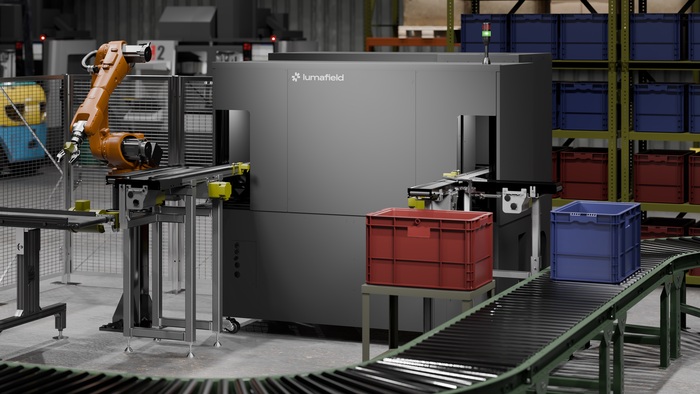
Triton, automated CT inspection. Image courtesy of Lumafield.
Over the last year, Lumafield has brought several product and technology breakthroughs to market that promise to accelerate the adoption of its scanners and software. One of its latest developments, Ultra-Fast CT, makes scans over 100 times faster, drastically cutting inspection times and enabling real-time quality control. This speed boost makes X-ray CT practical for industries that rely on fast, high-volume manufacturing.
In consumer packaging, it enables quick detection of cracks or leaks in plastic and glass containers. In optics, it ensures precision by identifying tiny defects in lenses and glass components without slowing production. For electric vehicle batteries, it helps manufacturers catch internal flaws, like electrode misalignment or voids, that could compromise performance and safety.

Bill Cronin. Image courtesy of Lumafield.
Alongside the funding announcement, Lumafield also welcomed Bill Cronin as its new Head of Revenue. Cronin previously served as Chief Revenue Officer at Xometry for eight years, where he played a key role in growing the company’s revenue from $2 million to over $450 million and leading its successful initial public offering (IPO) in 2021.
“The manufacturing sector is undergoing a seismic shift,” said Cronin. “I’ve seen firsthand how transformative technologies can redefine entire industries—creating new workflows, improving quality, and unlocking previously unimagined digitization opportunities. Lumafield is at the forefront of this transformation, bringing a game-changing approach to industrial inspection. I’m excited to help scale Lumafield’s impact and put this groundbreaking technology into the hands of manufacturers looking to rethink quality control and build the next generation of world-changing products.”
This new funding will help Lumafield grow its factory applications and improve its CT scanning technology. The company has been expanding quickly, tripling its yearly revenue for two years. Since 85% of its customers are using CT scanning for the first time, Lumafield promises to make this technology easier to access than ever.
With the new capital, Lumafield plans to directly integrate its high-speed, AI-powered CT scanning technology into manufacturing workflows, enabling real-time quality control across automotive, medical devices, and aerospace industries. This integration boosts product reliability, reduces waste, and strengthens supply chain resilience.
Torrealba sees this investment as a step toward a stronger, more competitive U.S. manufacturing sector.
“Now more than ever, this country needs to invest in cutting-edge technology that keeps American industry competitive, builds unstoppable supply chains, and drives global innovation,” he concluded.
Subscribe to Our Email Newsletter
Stay up-to-date on all the latest news from the 3D printing industry and receive information and offers from third party vendors.
Print Services
Upload your 3D Models and get them printed quickly and efficiently.













You May Also Like
The Manufacturing Race Behind the Drone Revolution
We are in the middle of a major manufacturing shift focused on the production speed and payload capacity of uncrewed aerial systems (UAS), or drones. A recent Manufacturing Dive article...
ADDMAN to Buy Up to $10.8M in Nickel 718 Powder from 6K Additive Over 30 Months
After years of buildup, we’re finally starting to see what the US metal additive manufacturing (AM) market could look like at scale. To be sure, it’s still not quite there,...
Metal AM in a Multipolar World, Part 2: How PBF and DED Could Change by 2035
The first decades of PBF development were heavily shaped by machine capability: more power, more lasers, larger build volumes, better recoating, and improved process monitoring. These developments will continue, but...
Advanced Manufacturing at IMTS 2026: 3D Printing and AI and Drones, Oh My!
Last week’s International Manufacturing Technology Snow (IMTS) in Chicago welcomed over 90,000 attendees to the jungle that is McCormick Place. With over 1.17 million square feet of exhibit space, and...