Conglomerates Are Auctioning GE Metal 3D Printers and More

As the additive manufacturing (AM) industry continues to slough through its economic downturn, we’ve seen not only smaller firms like Uniformity Labs and Arevo go belly up, but larger entities restructuring in an attempt to navigate the financial environment. Now, some major conglomerates are auctioning off their costly metal 3D printing equipment. In several cases, the machines being sold are Concept Laser systems and/or directly related to General Electric (GE). Though these sales may at first seem to be a part of the larger macroeconomic climate, a closer look at the companies’ financial performance in 2023 would suggest otherwise.
The latest auctions come from both GE, which is in the process of fracturing into several large companies, and Wabtec, which owns what was once the GE Transportation business unit. The U.S. rail leader is selling a 2018 GE Concept Laser M2 Cusing Dual Laser system, alongside a 2020 SLM 280 and a 2019 Debind & Sinter Furnace from Elink.
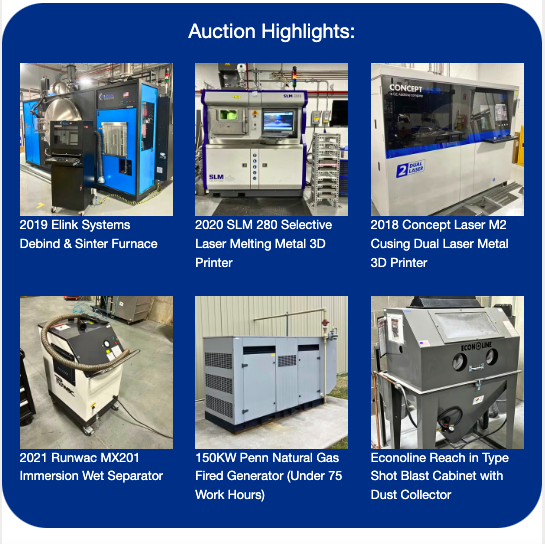
This may be related to the shutting of facilities in Allegheny County and Philadelphia, which resulted in 94 employees laid off. The closures may not reflect poor business operations as much as a reshuffling of resources. In 2023, Wabtec reported significant growth, with a 22.5% increase in sales reaching $2.55 billion in the third quarter, driven by both Freight and Transit segments.

Meanwhile, surplus to multiple GE Aerospace businesses is also being auctioned off. This includes: a 2015 Prodways Promaker L5000 Moving Light machine, a 3D DTM Sinter Station 2500 Plus SLS, a 3D Systems ProJet 5000, 2019 & 2018 Concept Laser quality management systems, 2017 Arcam EBM DI-12 Powder Recovery System, and a 3D Systems Procure 750 UV Curing Chamber. Like Wabtec, GE’s annual report highlighted significant growth within the company, including strong demand in end markets and earnings that more than tripled compared to the previous year, with almost 70 percent more free cash flow.
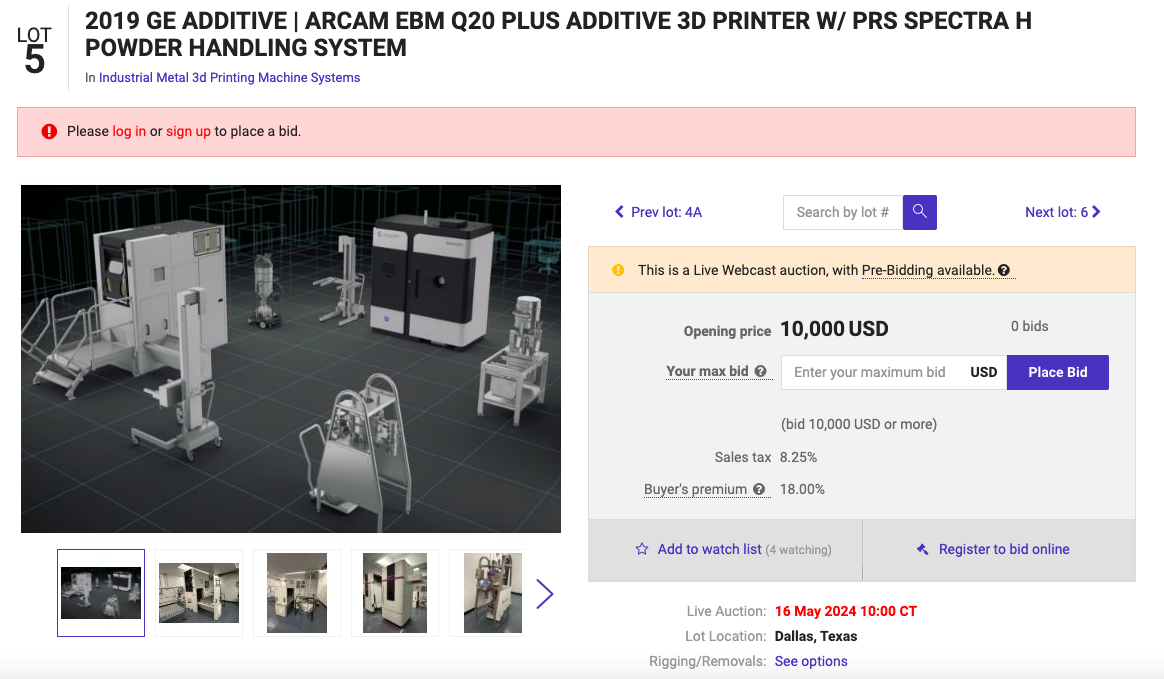
The new auctions come on the heels of a listing from RTX Corporation, which is offloading two 2018 Concept Laser XLINE 2000R systems, alongside a 2020 and 2014 M2, as well as a 2019 GE Arcam Q20 Plus electron beam 3D printer. The XLINE series represented the company’s largest and most expensive machines at the time. These machines are likely being auctioned as a result of RTX’s closure of a Dallas, Texas facility. However, again like GE and Wabtec, the aerospace giant generally did very well financially in the previous year.
The companies’ decisions to close facilities despite strong financial performances likely reflect strategic initiatives aimed at optimizing operations and realigning resources. By shutting down certain plants and selling off expensive 3D printers and other equipment, they can reduce costs, improve efficiency, and reallocate capital towards more profitable or innovative areas. These moves may also be driven by a desire to focus on core competencies, adapt to changing market demands, optimize geographic distribution, enhance environmental sustainability, or respond to external pressures.
Meanwhile, it’s possible that the used equipment can go toward less substantial businesses that may see such discounted machines as prized capital equipment in growing their own operations. Instead of dispensing with what could be framed as substandard machines, these conglomerates may actually be selling them to acquire the next generation of the technology. Wabtec, for instance, recently acquired an SLM 500 machine for its center in France, so it may be upgrading its equipment.
The facilities being shuttered by RTX and Wabtec can be thought of in similar terms, which may now potentially go to startups that can take advantage of funding from the Biden Administration to introduce innovations to the same sectors that those conglomerates serve. For instance, it wouldn’t be entirely unsurprising for a company like Hyliion to move into Wabtec’s site, while a firm like Conflux Technologies could take RTX’s. Alternatively, service bureau consolidators or even foreign manufacturers might take these assets.
These sorts of developments are crucial to understanding the current state of the AM market. With some analysts suggesting that the sector is no longer growing due to the fact that some publicly traded firms and startups are doing poorly, it’s important to see that the corporate giants that are largely responsible for the momentum driving the sector into its industrial phase are actually doing well. How well their AM programs are surviving is another matter and, depending on what the intention is behind these auctions, will determine what that matter is.
To continue the conversation with us, feel to reach out at michael@3dprint.com. Send anonymous tips to 3DPrintingLeads@protonmail.com.
Subscribe to Our Email Newsletter
Stay up-to-date on all the latest news from the 3D printing industry and receive information and offers from third party vendors.
Print Services
Upload your 3D Models and get them printed quickly and efficiently.













You May Also Like
AM & National Competitive Advantage, Part One: the Real Problem with US Manufacturing
The problem with US manufacturing is the productivity growth rate. Depending on the source, US manufacturing productivity has either been flat or slightly declined since 2010. Before going any further...
Advanced Manufacturing at IMTS 2026: 3D Printing and AI and Drones, Oh My!
Last week’s International Manufacturing Technology Snow (IMTS) in Chicago welcomed over 90,000 attendees to the jungle that is McCormick Place. With over 1.17 million square feet of exhibit space, and...
Let the Games Begin! Xi Throws Down the Advanced Manufacturing Gauntlet
Sangmin Lee went to TCT Asia back in March and reported on the event for 3DPrint.com. He wrote two articles arguing that China’s AM industry looks “ready to scale.” This...
What 3D2GO Says About 3D Printing’s Growth in Southeast Asia
The Philippines offers an interesting case study in how 3D printing can develop in Southeast Asia, and Manila-based 3D2GO helps illustrate it. 3D printing in Southeast Asia doesn’t have to...