
3D Printed Glasses to Hit $2.35B by 2031 — AM Data Slice

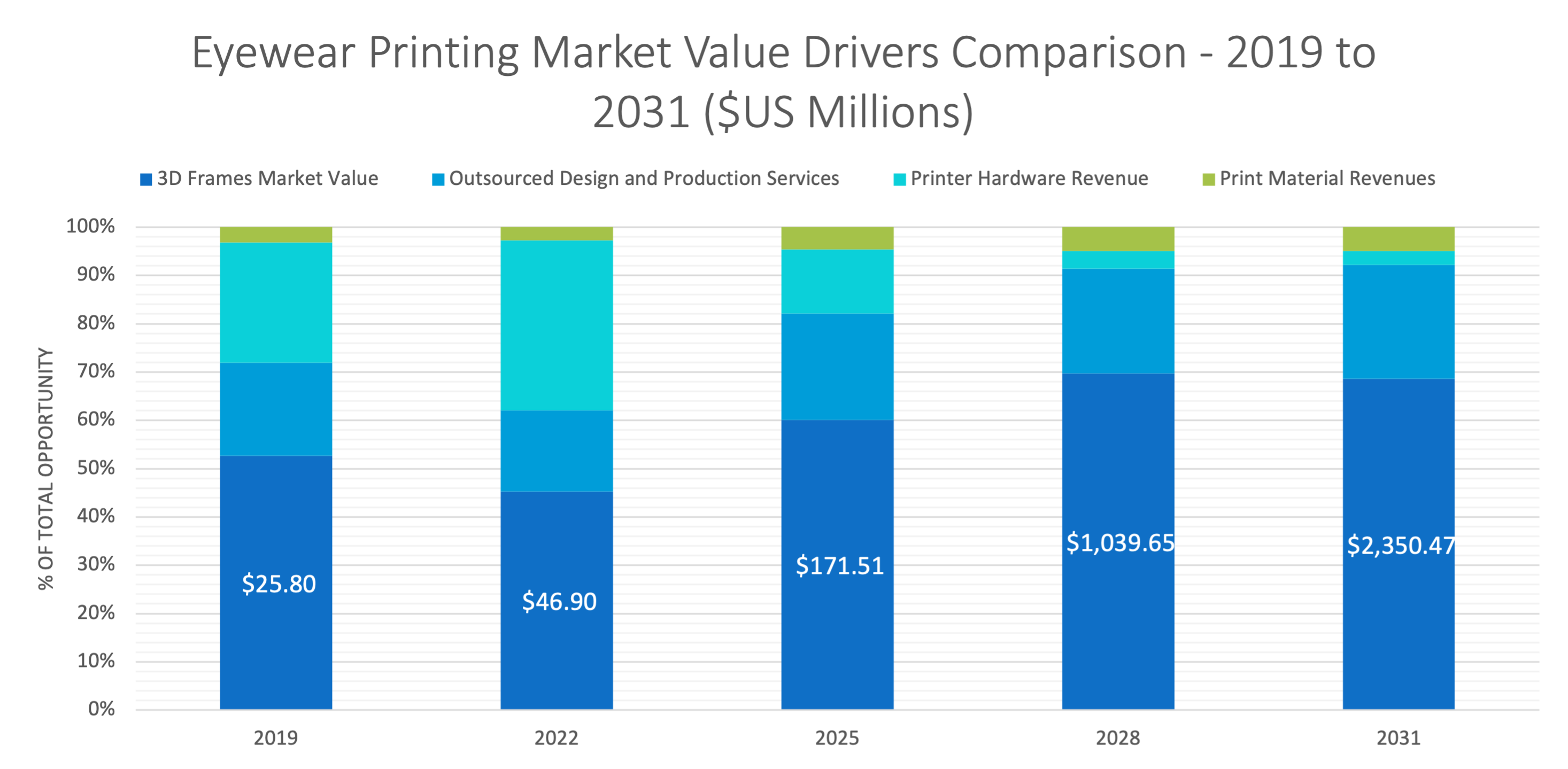
“AM Data Slice” from Additive Manufacturing Research (“AMR”, formerly SmarTech Analysis) is a weekly segment that offers readers an insightful dive into the additive manufacturing (AM) landscape, showcasing pivotal statistics and trends derived from AMR’s exhaustive research. This week, the spotlight is on the burgeoning eyewear 3D printing industry. The market dynamics for 3D printed eyewear frames, outsourced design services, printer hardware revenue, print material revenues, and the total market opportunity are dissected to paint a comprehensive picture of where the sector stands and where it’s poised to go. From the impressive ascent in the 3D printed frames market value to the nuanced growth patterns in printer hardware revenue, the data underscores the burgeoning potential and vast opportunities that lie within the realm of 3D printed eyewear.
3D Printed Frames Market Value: Starting from $25.80 million in 2019, the market value of 3D printed frames witnesses a staggering increase. By 2031, it’s projected to reach a value of $2,350.47 million. This indicates a substantial demand for 3D printed eyewear frames and suggests that the market is experiencing rapid adoption of this technology.
Outsourced Design and Production Services: This sector also showcases a rising trend. From a modest $9.44 million in 2019, it escalates to an impressive $810.82 million by 2031. This could hint that many eyewear manufacturers are leaning towards outsourcing their design and production tasks, capitalizing on specialized expertise.

Adidas’s 3D printed 3D CMPT sunglasses. Image courtesy of Adidas.
3D Printer Hardware Revenues: The revenue from printer hardware sees a varied growth. Beginning at $12.26 million in 2019, there is a notable surge until 2022, reaching $36.43 million. However, the growth slows down in the subsequent years, with the value being $97.08 million in 2031. This could be attributed to factors like saturation of the market, innovations leading to cost reductions, or companies investing more in other areas.
Print Material Revenues: Starting at a value of $1.53 million in 2019, the revenues from print materials grow steadily and reach $169.67 million by 2031. This suggests that as the adoption of 3D printing in eyewear increases, so does the need for specialized print materials.
Total Opportunity: The overall market opportunity for the eyewear 3D printing sector displays a robust upward trajectory. From $49.02 million in 2019, it burgeons to an impressive $3,428.03 million in 2031, emphasizing the expansive potential and growth of the 3D printing industry in the eyewear domain.
Subscribe to Our Email Newsletter
Stay up-to-date on all the latest news from the 3D printing industry and receive information and offers from third party vendors.
Print Services
Upload your 3D Models and get them printed quickly and efficiently.













You May Also Like
AI Design and Point-of-Care Integration Headline ADDITIV Medical 2026
Medical additive manufacturing is expanding rapidly inside major healthcare institutions. In 2026 alone, hospital systems including Indiana University Health and Sheffield Teaching Hospitals launched dedicated point-of-care 3D printing facilities to...
GKN Aerospace’s UAV Demonstrator with 3D Printed Engine Avoids ITAR Regulations
The US CIA director recently made an unannounced visit to Moscow that has naturally raised much speculation, while the EU and NATO have now officially accused Russia of being behind...
The Business Case for 3D Printed Stents
A new 3D printed stent developed at New York University (NYU) does not look like the devices doctors typically use today. Instead of a simple tube, the prototype resembles a...
3D Printing Financials: 3D Systems, Prodways, and Align Build on Positive Momentum
The latest earnings from 3D Systems (NYSE: DDD), Prodways (EPA: ALPWG), and Align Technology (Nasdaq: ALGN) show that the 3D printing market continues to move forward. Some businesses are growing...

























































