China’s BLT Metal 3D Printing Sales up Almost 60% YOY

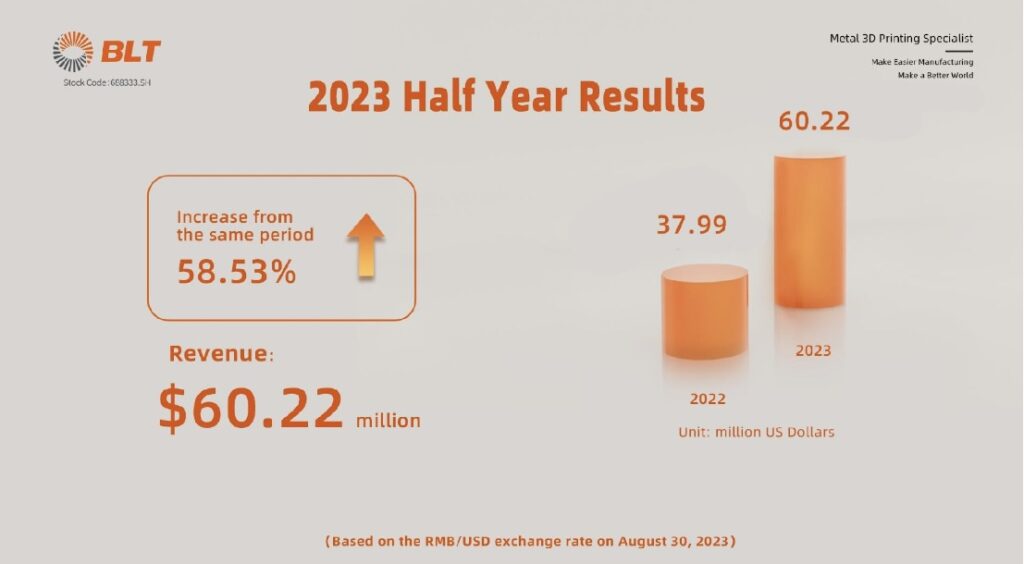
Xi’an Bright Laser Technologies (BLT), one of China’s leading original equipment manufacturers (OEMs) in the metal additive manufacturing (AM) space, has released its financial results for the first half (H1) of 2023. One of the main highlights of the report is that the company’s sales increased 58.53 percent compared to H1 2022.
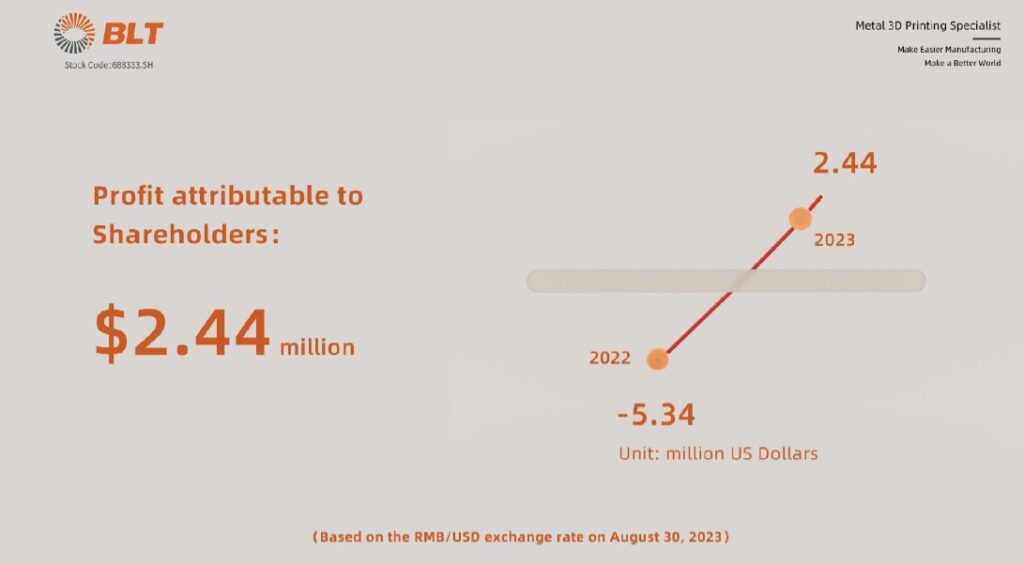
The other main highlight is that BLT, which is publicly traded on the Shanghai Stock Exchange (SHA), has a market cap of $2.51 billion, which means that its market cap is currently almost twice the combined market cap of the two largest publicly-traded US 3D printing firms, Stratasys and 3D Systems. It is also worth pointing out that whereas the company reported a net loss of about $5.34 million in H1 2022, it showed a profit of $2.44 million for H1 2023.
Notably, BLT’s performance on the SHA has been precisely the opposite of the index’s overall performance the last six months, with the SHA dropping about 4 percent, during which timeframe BLT has spiked almost 20 percent. Perhaps unsurprisingly, the company’s share price peaked about three days after Ming-Chi Kuo, who covers Apple for the Hong Kong investment bank TF International, posted a rumor that Apple would be using BLT (among other platforms) on the next Apple Watch Ultra.
Apple would later confirm at the end of August that it is using 3D printing on the Apple Watch Ultra. However, the world’s wealthiest company cited that it would be using binder jetting, whereas BLT and Farsoon (one of the other companies floated by Kuo) both make powder bed fusion (PBF) platforms. This isn’t to say that BLT won’t be (or isn’t already) involved in the Apple Watch Ultra, just that the rumor has still yet to be confirmed.
Working with Apple would constitute a highly significant case of branching out for BLT: the company also noted in its earnings report that 52.29 percent of its business comes from the aerospace sector, and 39.76 percent of its customers are in the industrial machinery sector. At the same time, BLT opened a new R&D facility in Shanghai in June 2023, one which places a particular emphasis on electronics and smart devices, so consumer goods could be precisely the area that BLT has set its sights on next.
If that’s the case, BLT is virtually guaranteed to become an integral part of the Chinese economy’s next phase, which seems like it’s going to be largely predicated on optimizing China’s domestic manufacturing ecosystem to secure Huawei’s supply chains. Along those lines, even if BLT is not 3D printing consumer goods en masse in the near future, the company should be indispensable to supplying parts for the industrial machinery market that the consumer electronics market depends on. Whatever the major source of the company’s growth turns out to be, one thing that seems certain is that BLT will keep growing.
Subscribe to Our Email Newsletter
Stay up-to-date on all the latest news from the 3D printing industry and receive information and offers from third party vendors.
Print Services
Upload your 3D Models and get them printed quickly and efficiently.













You May Also Like
AM Investment Strategies 2026 Sets the Stage for AMS 2027
AM Investment Strategies 2026 Nov. 5 · 12 p.m. ET · Free online event RESERVE YOUR SPOT ↗ A one-hour online discussion featuring some of the biggest names in 3D...
With Its Latest $200M Round, ICON May Be Running Away With the 3D Printed Construction Market
I used to view ICON, the Austin-based additive construction (AC) firm, as one of a handful of companies that could realistically consider itself the leader of the 3D printed construction...
Deals, Dollars and 3D Printing: What’s Moving in AM
There’s been plenty of business activity in additive manufacturing (AM) lately, with new deals, partnerships and investments in production. One of the bigger moves comes from Sweden, where investment firm...
Oerlikon Adds ATLIX’s xBUILD 5000, Plans More for 2027
Oerlikon has installed a new ATLIX xBUILD 5000 metal 3D printer at its facility in Huntersville, North Carolina, marking the first production deployment of the system worldwide. The machine will...